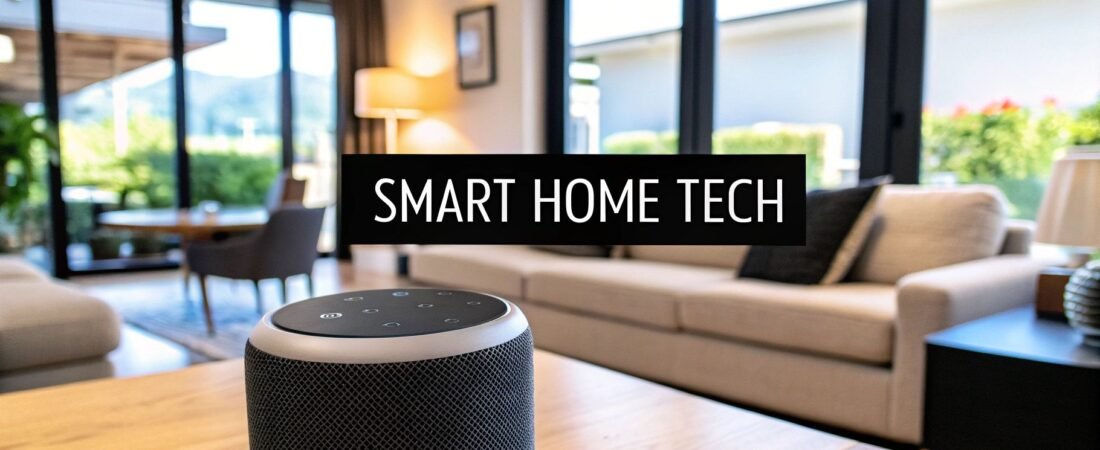
At its core, smart home technology is simply a way to connect and automate the devices in your house, letting you manage everything from your lights and thermostat to your security cameras with a simple voice command or a tap on your phone.
It essentially turns a regular house into a responsive, intelligent environment that works for you.
Unpacking the Concept of a Smart Home
Think of it like giving your home a brain and a nervous system. Instead of every switch, appliance, and system working in isolation, they're all connected and can talk to each other. This creates a single, cohesive ecosystem that learns your habits and responds to your needs—often without you having to do a thing.
This isn't about cluttering your home with futuristic gadgets; it's about making your daily life genuinely simpler and more efficient.
This interconnectedness is what makes powerful automations possible. For instance, you could create a "Good Morning" routine that simultaneously raises the blinds, starts the coffee pot, and warms the house up a few degrees right before your alarm goes off. This is more than just a neat trick—it’s a fundamental change in how we interact with our living spaces, turning them from passive structures into active partners.
The Three Pillars of a Smart Home
So, what’s the real payoff? When you cut through all the jargon, smart home technology really delivers on three key promises that work together to make life better. Grasping these pillars helps explain why millions of people are bringing this tech into their homes.
Here's a quick look at what smart home technology truly offers:
The Three Pillars of a Smart Home
| Pillar | What It Means for You | Everyday Example |
|---|---|---|
| Convenience | Simplifies daily routines and saves you time and effort. | Your smart lock automatically secures the doors every night at 11 PM. |
| Efficiency | Reduces energy waste and lowers your utility bills. | A smart thermostat learns when you're away and adjusts the temperature. |
| Security | Enhances safety and gives you invaluable peace of mind. | Getting an instant alert on your phone if a smart camera spots motion. |
Each pillar supports the others to create a home that feels more intuitive and secure.
The real beauty of a smart home is its ability to learn and adapt. It’s not just about remote control; it's about creating an environment that anticipates your needs, enhancing comfort and security proactively.
This isn't a niche hobby anymore. The global smart home market was valued at a massive USD 121.6 billion in 2024 and is expected to jump to USD 147.5 billion in 2025, thanks in large part to companies like Amazon and Google making it so accessible.
With over 1.1 billion smart devices already in use by 2023, it's clear that this is more than just a passing trend. Our homes are getting smarter, and the technology is only getting better.
Of course, these powerful systems are built from individual components. To really get a feel for how it all works, it helps to understand what are smart home devices and the specific jobs they do.
How All Your Smart Devices Talk to Each Other
Ever wonder how a single voice command can dim your lights, lock the front door, and fire up your favorite playlist all at once? It’s not magic—it's a carefully choreographed dance where every device knows its part. Getting your head around this communication is the key to really understanding smart home technology.
Think of your smart home like a well-oiled team. Each piece has a specific job, and they all work together to pull off complex tasks without a hitch. This "team" has three key players: the devices, the hub, and the network protocols they use to talk.
This diagram shows the payoff of getting that team to work together, highlighting how convenience, safety, and efficiency are all products of a connected system.
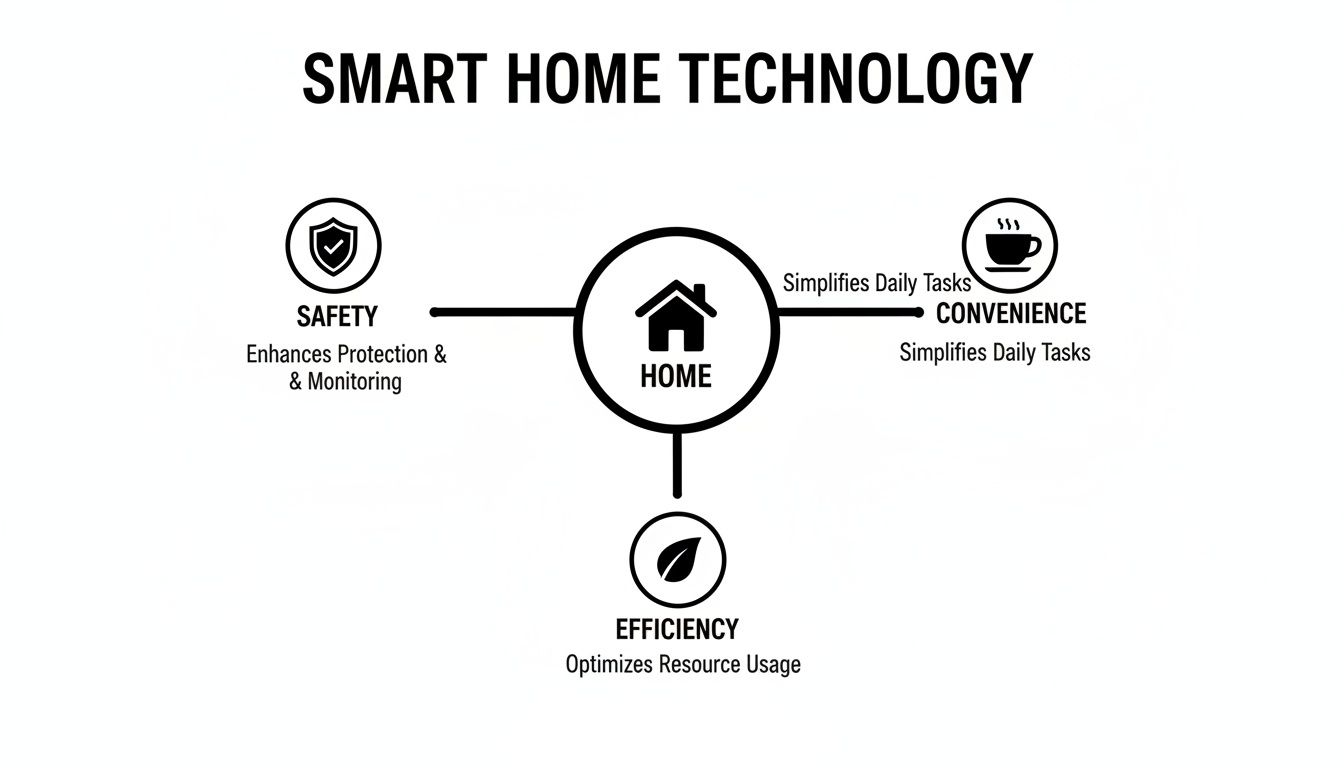
As you can see, these benefits aren't separate things. They overlap and build on each other to create a home that truly responds to you.
The Specialists: The Smart Devices
First up, you have the specialists: your individual smart devices. These are the boots on the ground, each one an expert in its field. Your smart bulb is a lighting pro, your smart lock is a security guard, and your smart thermostat is a master of climate control.
Each specialist is great at its job but needs orders to know what to do and when. They are the eyes and ears of your home, sensing the environment and carrying out commands. For instance, a motion sensor can detect movement, but by itself, that information is useless. It needs to report up the chain of command.
The Project Manager: The Smart Hub
That brings us to the project manager: the smart hub. The hub is the central brain of the entire operation and what really makes a collection of gadgets a "smart" home. You've probably heard of the big ones, like the Amazon Echo, Google Nest Hub, and Apple HomePod.
The hub takes in reports from all the specialists (your devices) and translates your commands into clear instructions. When you say, “Alexa, it’s movie time,” your Echo doesn’t just hear you. It becomes a director, telling the lights to dim, the blinds to close, and the TV to turn on.
Think of the smart hub as the conductor of an orchestra. It ensures every instrument plays its part at the perfect moment, turning a jumble of individual sounds into a beautiful, coordinated symphony.
Without this project manager, your devices would be like a team of experts with no one in charge—talented, but unable to collaborate on anything meaningful.
The Shared Language: The Network Protocols
Finally, for any team to work, everyone has to speak the same language. In the world of smart homes, this shared language is the network protocol. These are the invisible rules and standards that let your devices communicate with each other and with the hub.
You’re already an expert in the most common one: Wi-Fi. It's fantastic for devices that need to send a lot of data, like security cameras streaming video. But for simpler jobs, other protocols are often more efficient.
- Zigbee: This is a low-power protocol perfect for small, simple devices like light bulbs and sensors. It creates a "mesh network" where devices can relay signals to each other, which helps extend the network's reach and makes it more reliable.
- Z-Wave: Much like Zigbee, Z-Wave also uses a mesh network. It operates on a slightly different frequency, which can sometimes mean less interference from all the other electronics in your house.
- Matter: This is the new universal translator on the scene. Backed by huge players like Apple, Google, and Amazon, Matter is designed to make all devices play nicely together, no matter who made them. The goal is to make setup a breeze and guarantee everything just works.
Knowing a bit about how your devices talk to each other can make a real difference in how fast and dependable your smart home is. To dive deeper, you can explore this complete guide to each smart home protocol and figure out what’s best for your setup.
When you bring these three elements together—the specialist devices, the project manager hub, and a shared language—you get a home that can run complex routines that make your life safer, easier, and more efficient.
What Can Smart Home Technology Actually Do for You?
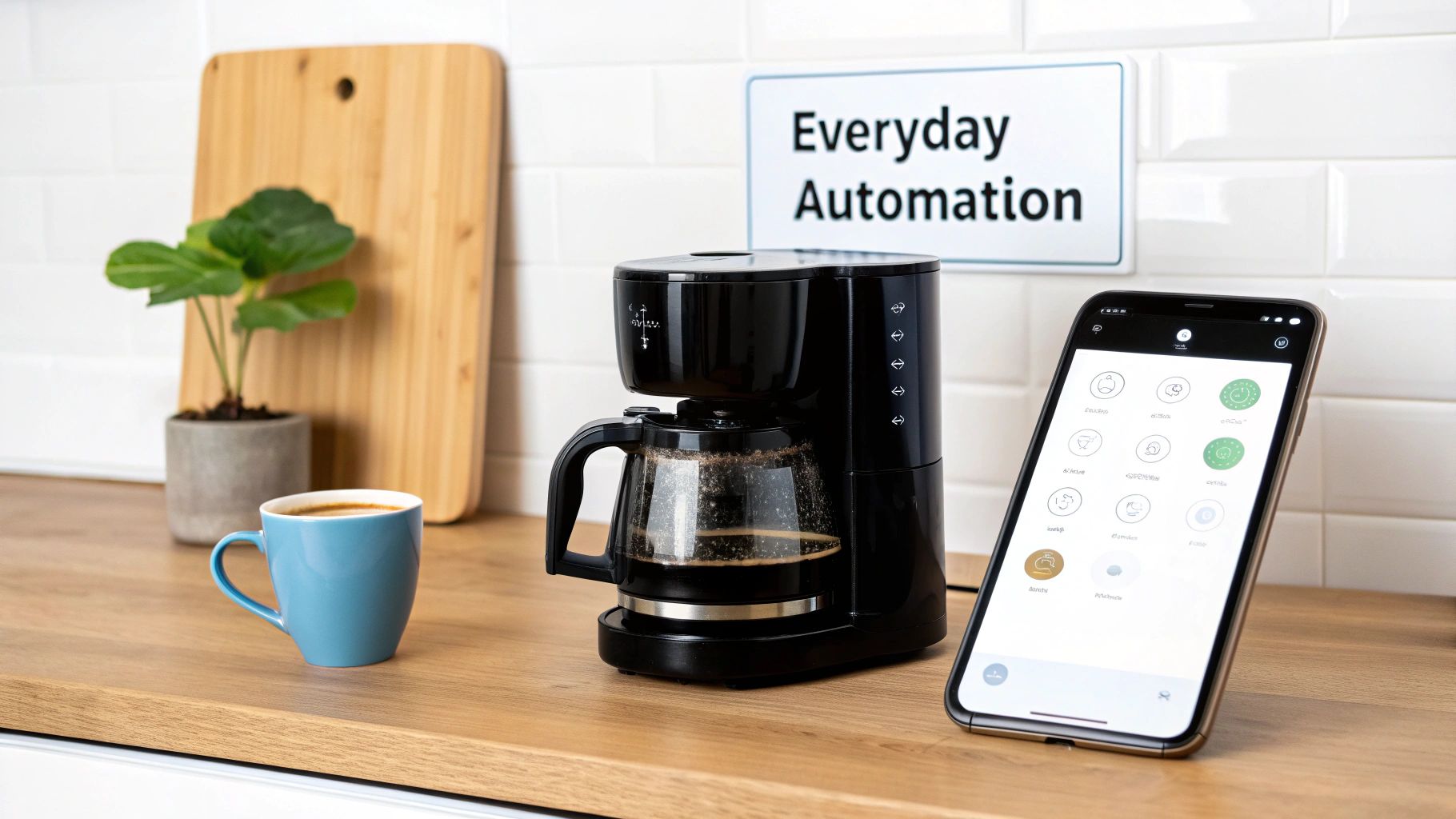
Knowing how smart devices talk to each other is one thing, but seeing what that teamwork actually accomplishes is where the magic happens. A smart home isn't about collecting cool gadgets; it's about solving real-world problems and making your life easier in tangible ways.
The real value pops up when all these devices work together, creating a home that feels safer, runs more efficiently, and is just plain more convenient. Let's get past the theory and dive into the most popular ways people are using this tech right now.
Creating a Protective Shield With Smart Security
For many, home security is the gateway into the world of smart technology, and it's easy to see why. Modern systems offer a level of awareness and control that was pure science fiction just a decade ago, building a digital fortress around your property.
This isn't just a niche market; it's massive. Video surveillance is expected to take up 45.70% of the smart security market's revenue in 2025. As a whole, the industry is projected to jump from USD 43.21 billion in 2026 to USD 87.29 billion by 2031. That's a clear signal that homeowners see real value here.
Here are the key players in a modern smart security setup:
- Smart Cameras: Think of these as your eyes on the ground. They stream HD video right to your phone, letting you check in from anywhere. Many can now tell the difference between a person, a pet, or a package, so you only get alerts that matter.
- Video Doorbells: See and speak with anyone at your front door, whether you're upstairs or on vacation. It’s a simple device that’s also a powerful deterrent.
- Smart Locks: Ditch the keys. You can grant temporary access to a friend or contractor from your app and get peace of mind by checking if you remembered to lock up after leaving.
- Sensors: These small but powerful devices are the unsung heroes. Stick them on doors and windows to get an alert if they’re opened, or place them in the basement to detect leaks long before they become a disaster.
The best part is how they work in concert. A motion sensor in the driveway can trigger an outdoor camera to start recording and simultaneously turn on a floodlight—stopping a potential problem before it starts.
Slashing Utility Bills With Smart Energy Management
One of the most practical benefits of a smart home is its ability to trim waste and lower your monthly bills. Smart energy devices learn your household's rhythm, making automatic tweaks to cut down on power usage without you having to sacrifice comfort.
On average, homes with smart energy gear use an estimated 30-40% less energy. Of course, to make the biggest impact, it helps to understand how to calculate energy consumption in your home.
These are some of the heavy hitters for saving energy:
- Smart Thermostats: This is the cornerstone of a smart energy strategy. It learns your schedule and knows when you’re home or away, adjusting the heat or AC automatically so you aren't paying to cool an empty house.
- Smart Lighting: Forget to turn off the basement light again? Smart bulbs and switches can be put on a timer, controlled from your phone, or even linked to motion sensors.
- Smart Plugs: These handy adapters turn any old lamp or appliance into a smart device. Use them to cut power to "energy vampires" like your entertainment center that quietly draw power 24/7.
- Smart Blinds: Automated blinds can be a game-changer. They can open in the morning to help heat your home with natural sunlight or close during a hot afternoon to keep things cool, taking some of the load off your HVAC system.
Imagine this: your thermostat automatically lowers the temperature right after everyone leaves for the day, then starts warming the house back up just before you pull into the driveway. That simple, hands-off automation can lead to huge savings over a year.
Streamlining Your Day With Convenience and Entertainment
Beyond the serious stuff like security and savings, smart technology is fantastic at just making life a little smoother and more fun. It takes care of all those small, repetitive tasks, freeing up your time and mental space. This is where a smart hub or voice assistant really shines.
You can set up "routines" that kick off a whole sequence of events with a single command. For instance, saying "Good night" could lock the doors, turn off every light, lower the thermostat, and start playing some calming music. Our guide on setting up a smart home can help you think through these kinds of powerful automations.
This kind of integration transforms your house from a collection of rooms into a responsive environment that adapts to what you need, moment by moment.
To give you a clearer picture, smart home tech can be grouped into a few main categories, each with its own purpose.
Table: Smart Home Categories and Their Functions
This table breaks down the major smart home categories, their core purpose, and some of the most common devices you'll find in each.
| Category | Core Purpose | Popular Devices |
|---|---|---|
| Security & Safety | Monitoring, access control, and hazard detection. | Smart cameras, video doorbells, smart locks, smoke/CO detectors. |
| Energy & Climate | Optimizing heating, cooling, and electricity use. | Smart thermostats, smart plugs, smart lighting, smart blinds. |
| Convenience | Automating daily tasks and simplifying routines. | Voice assistants, smart speakers, robot vacuums, smart coffee makers. |
| Entertainment | Creating immersive audio and visual experiences. | Smart TVs, streaming devices, multi-room audio systems, smart lighting. |
As you can see, each category tackles a different aspect of home life, but the real power emerges when you start mixing and matching devices from each.
Weighing the Good Against the Bad in a Connected Home
Smart home tech paints a pretty picture of a life that's easier, safer, and more efficient. And while that's often true, it's smart to walk into home automation with your eyes wide open. Understanding the real-world benefits and the potential headaches is the key to building a system that genuinely improves your life.
The advantages are usually what get people excited. From small daily wins to bigger long-term savings, a well-thought-out smart home adds tangible value you can feel right away.
The Powerful Upsides of Home Automation
The most obvious win is a massive boost in convenience. Picture this: your lights pop on as you pull into the driveway, the heat kicks on before you even feel a chill, and your doors lock themselves when you go to bed. These little automated moments add up, smoothing out the friction of daily life and freeing up your headspace.
Next up is a serious upgrade in security and peace of mind. With smart cameras, video doorbells, and all sorts of sensors, you can literally check in on your home from anywhere on the planet. Getting an alert on your phone the second a door opens or motion is detected gives you a sense of awareness that older security systems just can't touch.
Finally, there’s the potential for some serious energy efficiency. A huge plus is the ability to cut down on waste and save real money. You can find all sorts of smart home solutions for reducing utility bills, but things like smart thermostats and lighting are the heavy hitters. A smart thermostat, for instance, learns your comings and goings and stops heating or cooling an empty house, which can lead to some pretty noticeable savings.
Facing the Potential Downsides
Of course, it's not all seamless magic. Adopting this technology means you'll have to navigate a few challenges. Knowing what they are from the get-go helps you make better decisions and sidestep common pitfalls.
The biggest elephant in the room for most people is privacy and security. Every single device you connect to the internet is another potential door for hackers. A 2018 study shockingly found that 70% of common Internet of Things (IoT) devices had security holes. On top of that, these devices work by collecting data, which raises fair questions about how companies are storing and using your personal information.
"With the rapid expansion of smart home technology, legal frameworks and best practices will have to evolve to address data security and user privacy. In 2025, homeowners will demand devices that not only deliver convenience but also assure them that their personal data is protected." – Jonathan Feniak, General Counsel at LLC Attorney.
This really gets to the heart of it. We're starting to demand more transparency and better security from the companies making these products. It puts the ball in their court to build safer gear, and in ours to use it wisely.
Another hurdle can be the initial cost and complexity. While a single smart plug won't break the bank, decking out your entire home can get pricey. And getting all your gadgets to talk to each other—what the pros call interoperability—can be a real source of frustration if you mix and match brands that don't play well together.
Making a Smart, Balanced Decision
So, how do you get all the amazing benefits without falling into the common traps? It all comes down to being thoughtful and strategic. You don't have to automate everything at once.
Here's a simple game plan for building a smarter, safer connected home:
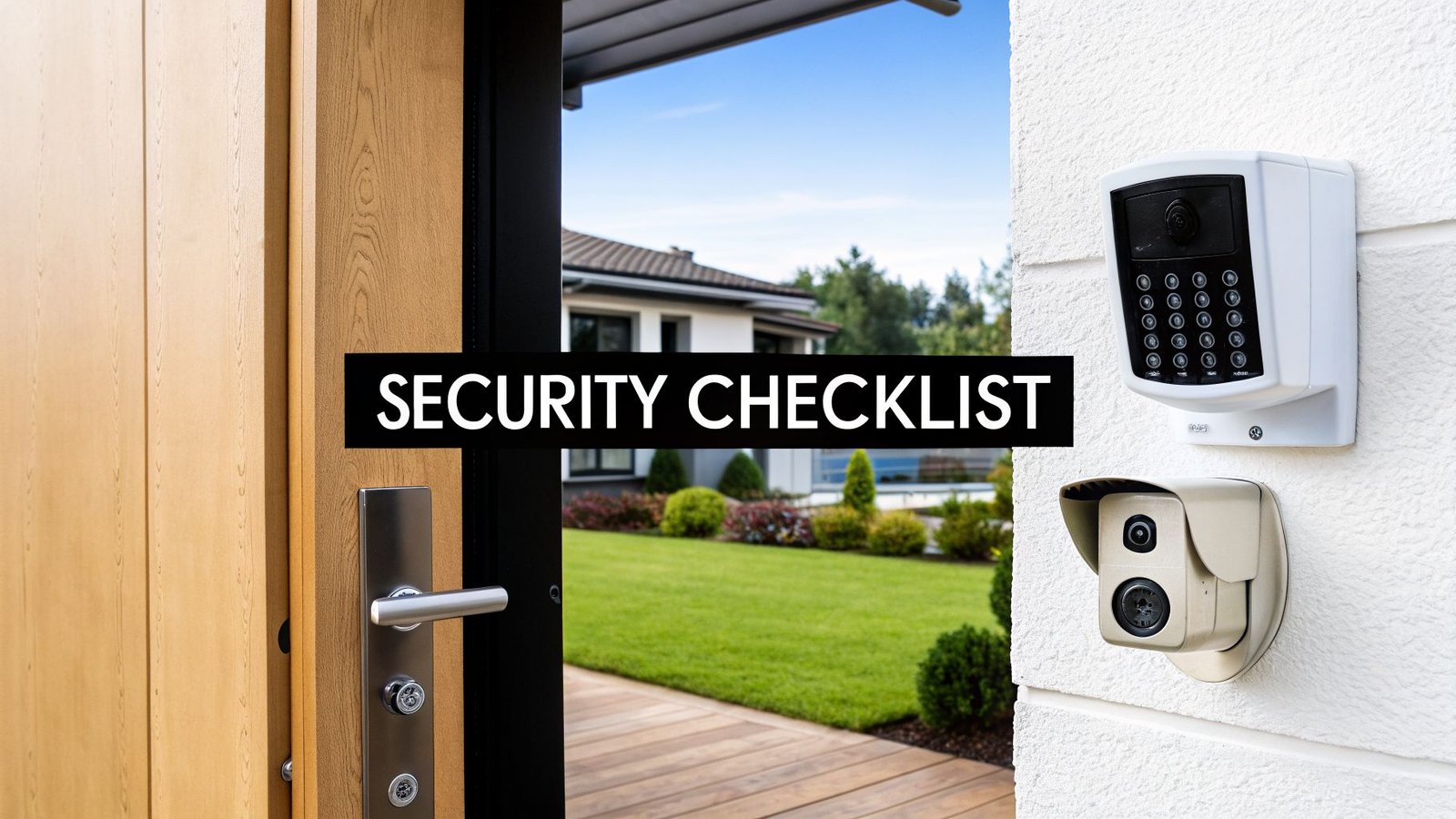
- Focus on Security First: The moment you unbox a new device, change its default password. No excuses. Use a different, strong password for everything and turn on two-factor authentication (2FA) wherever you can.
- Stick to Reputable Brands: Go with manufacturers you've heard of—companies that have a history of pushing out regular security updates. A quick Google search of a brand's privacy policy can also tell you a lot about how much they care about protecting your data.
- Start Small, Then Expand: You don't need to do it all overnight. Begin with one or two things that will make a big difference, like a smart thermostat or a video doorbell. This lets you learn as you go and figure out what you actually like before you invest more.
- Check for Compatibility: To save yourself a world of hurt, look for devices that work with the big ecosystems like Amazon Alexa, Google Home, or Apple HomeKit. Even better, keep an eye out for products that support the Matter standard. It's specifically designed to make sure devices from different brands can communicate without a fuss.
By balancing the cool possibilities with a healthy dose of caution, you can build a smart home that isn't just convenient and efficient—it's also secure and trustworthy.
Your First Steps into Smart Home Automation
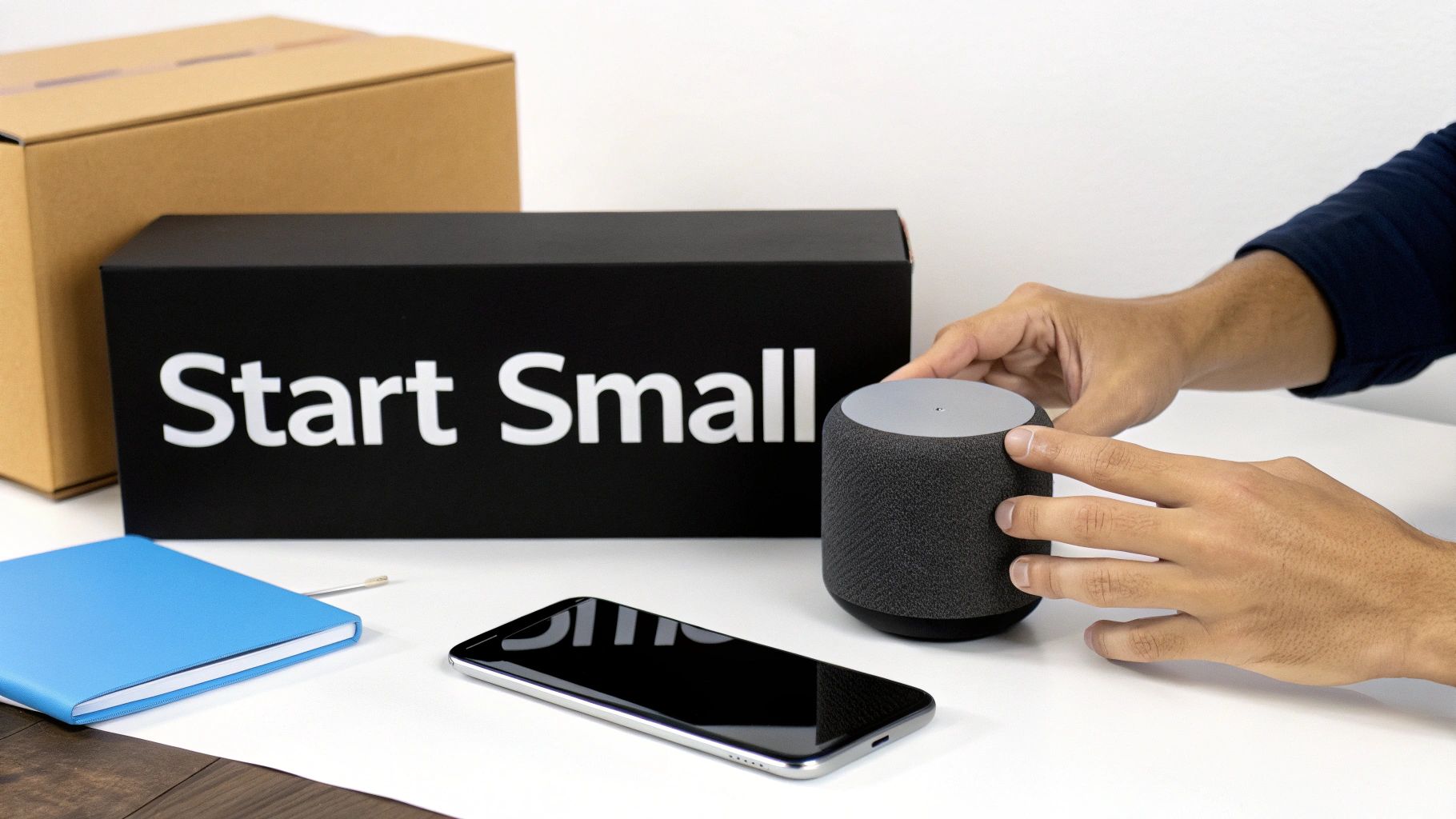
Jumping into home automation can feel like you're about to take on a massive, expensive project. But you don't have to. The real secret from those of us who have been doing this for years is to ignore the urge to do everything at once.
Instead, just start small and build smart. This approach lets you feel the benefits right away and gives you time to figure out what you actually like and use. The journey starts with a single, high-impact device, not a complete home makeover. By picking one problem to solve, you make the whole thing manageable and get that satisfying "wow, this is cool" moment from day one.
Pinpoint Your Starting Point
Before you even think about adding something to your cart, take a minute to walk through your daily routine. What’s one little thing that always bugs you? The best first gadget is one that scratches a real itch.
A great first purchase usually falls into one of these buckets:
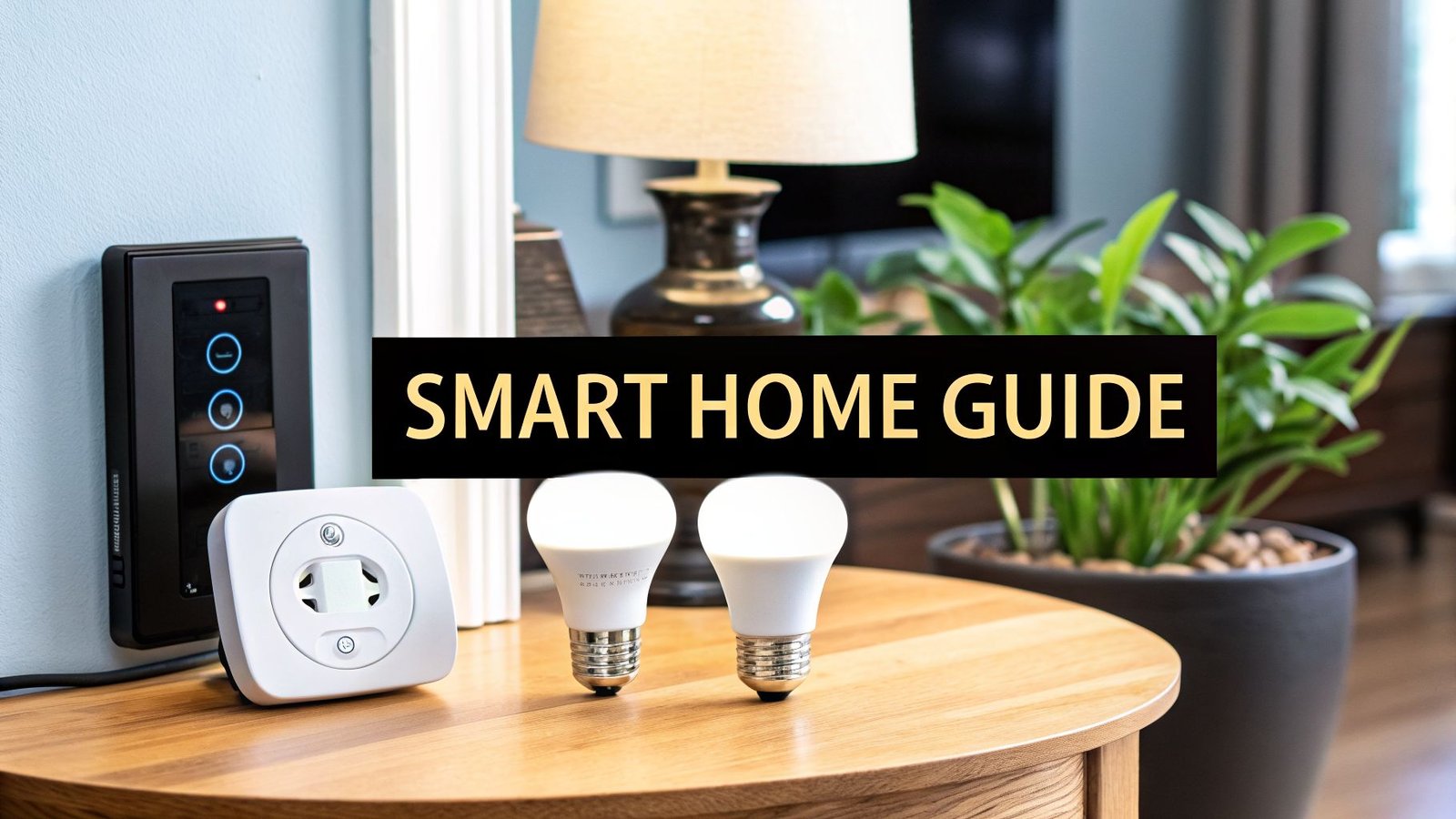
- Smart Plugs: These are the gateway drug of smart homes. Seriously. They can turn any simple appliance "smart," from the lamp you can't quite reach from the couch to the coffee maker you want ready when you wake up. For a low cost, you can solve that nagging "did I leave the fan on?" question for good.
- Smart Speakers: There's a reason devices like the Amazon Echo or Google Nest Hub are so popular. They're a fantastic command center to build from later, but they're incredibly useful right out of the box. You can set kitchen timers with your hands full, play music, or settle a dinner table debate with a quick voice command.
- Smart Lighting: This is where the magic really starts to feel tangible. Swapping just a few regular bulbs for smart ones can totally change the vibe of a room. Imagine scheduling the lights to turn on a few minutes before you get home from work or dimming them for movie night without ever getting up.
Focusing on a specific, real-world need guarantees your first buy will actually get used. That immediate payoff is the best motivation to keep going.
Choose Your Team Captain: The Ecosystem
Okay, you have an idea of where to start. Now for the most important decision you'll make at the beginning: picking an ecosystem. Think of it like choosing a sports team—all your devices need to play for the same one. The big three are Amazon Alexa, Google Assistant, and Apple HomeKit.
Sticking to one ecosystem, at least at first, will save you a world of headaches. It makes sure all your gadgets can communicate without you having to become an IT expert. When you're shopping, just look for the "Works with Alexa" or "Supports HomeKit" badges. Those are your green light.
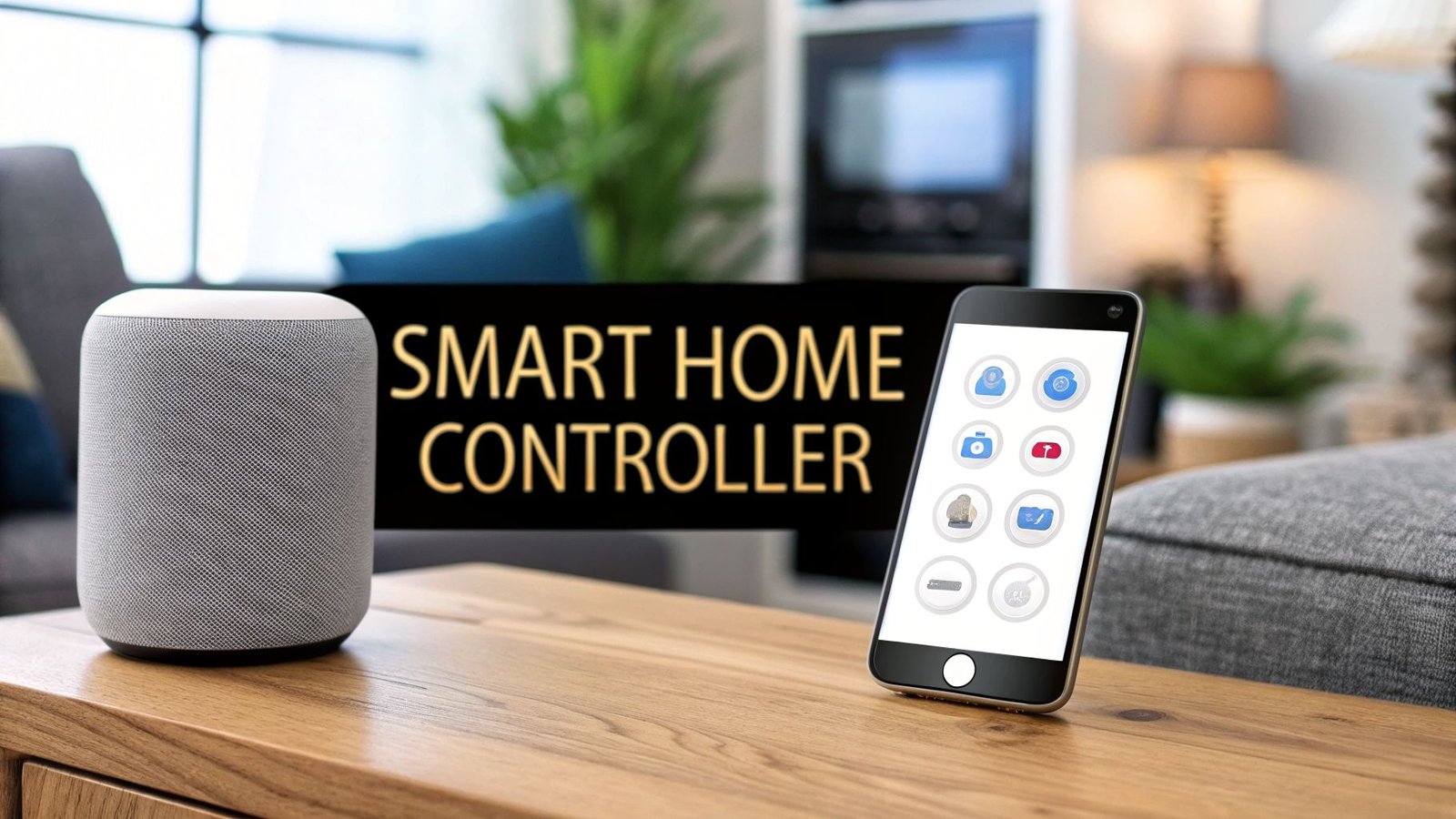
Your chosen ecosystem is the project manager for your whole smart home. A smart speaker is often the physical embodiment of this, giving you a central place for voice commands and control.
Most people just go with what they already know. If you're an iPhone user, Apple HomeKit will feel like a natural extension of your phone. If your life is already run by Google services, Google Assistant is the obvious choice. This decision isn't set in stone, but it gives you a solid foundation to build on.
Assess Your Home Network
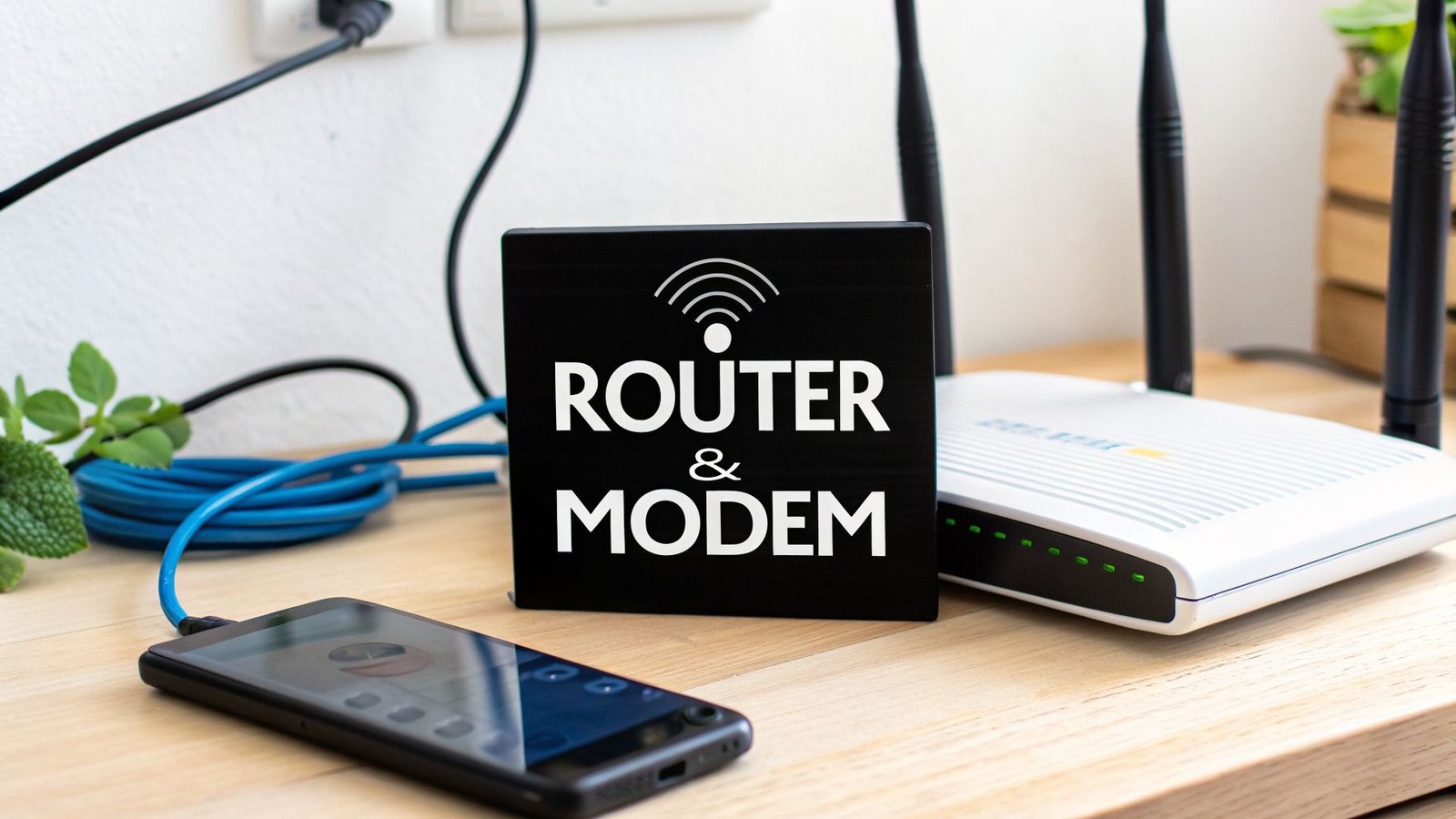
Let's talk about the unsung hero of any smart home: your Wi-Fi network. It's the invisible backbone that holds everything together. Before you start adding a bunch of new devices that rely on it, you need to make sure it’s up to the job.
A weak or unreliable signal is the number one cause of smart home frustration. Grab your phone and walk around the house, especially to the spots where you plan to put your new smart devices. If you find "dead zones" where the signal drops, you'll want to fix that first. A simple Wi-Fi extender or a more complete mesh network system can solve the problem before it even starts.
A strong network means your commands get a response instantly, not after a frustrating delay. Getting started is all about taking these small, deliberate steps. Pick a useful first device, commit to an ecosystem, and make sure your Wi-Fi is solid. You’ll set yourself up for a smooth, fun experience as you expand your system at your own pace.
The Future of the Intelligent Home
Today's smart home is great at following orders. You tell it what to do, and it does it. But the future isn't about giving commands; it's about creating a home that anticipates your needs before you even think of them. This is the leap from a "smart" home to a truly "intelligent" one.
This evolution is all thanks to Artificial Intelligence (AI) and machine learning. Instead of waiting for you to say, "turn on the lights," future systems will learn your family's daily rhythms. It'll figure out that after a long day at work, you prefer softer, warmer lighting and have it ready the moment you step inside.
That’s when a collection of gadgets starts feeling more like a proactive partner in your life.
From Jumbled Wires to Seamless Integration
Let's be honest: one of the biggest headaches with smart homes has always been getting devices from different companies to talk to each other. This is precisely the problem that a new universal standard called Matter is here to solve.
Backed by all the big names in tech, Matter is basically a common language for smart devices. It means a light bulb from one brand and a smart plug from another will just work together, no fuss. This single change is tearing down a huge wall for people, making smart homes far more reliable and easier to build.
The success of smart home systems lies in their ability to communicate seamlessly. Standards like ‘Matter’ are a game-changer, ensuring devices from different brands work harmoniously to create a truly connected home.
This universal standard is the foundation for the next big thing.
The Rise of Ambient Computing
The ultimate dream is for the tech to just fade away, becoming an invisible part of our environment. This idea is called ambient computing. In this future, you’re not constantly fiddling with apps or shouting at a speaker. The intelligence is just there, woven into the fabric of your home.
Think of walls that gently shift their color to match the time of day, or your favorite playlist following you from room to room as you move about. That's where we're headed.
Here's a glimpse of what these trends will bring to our homes:
- Hyper-Personalization: Your home will adjust lighting, temperature, and even background sounds based on who is in the room and what they're likely doing or feeling.
- Predictive Assistance: It will pick up on your habits, like movie night on Fridays, and automatically dim the lights and lower the blinds for you.
- Invisible Interfaces: You'll control things without thinking about it. Your presence, gestures, and learned routines will be the new commands.
The home of the future isn't just connected; it's conscious. It’s always working in the background to make your life safer, more comfortable, and simpler, often without you ever having to ask.
Common Questions About Smart Home Technology
Jumping into the world of smart homes can feel a little daunting, and it's totally normal to have a few questions before you start. Let's tackle some of the most common ones so you can feel confident about making your home a little bit smarter.
Think of this as a quick-start guide to clear up any lingering uncertainties.
Do I Need to Be Tech-Savvy to Set Up a Smart Home?
Not at all. In fact, most smart home gear today is designed with the average person in mind. Companies have put a ton of effort into making setup a breeze, usually with a user-friendly app that guides you step-by-step.
Honestly, if you can connect a new phone to your Wi-Fi, you've got all the skills you need to get a smart plug or speaker up and running. A great way to start is by picking just one or two simple devices; you'll get the hang of it in no time.
How Secure Are Smart Home Devices?
This is a big one, and for good reason. Reputable brands take security seriously and use encryption to keep your data safe from prying eyes. But the truth is, you're the most important line of defense.
A few simple habits can make a huge difference in keeping your smart home secure:
- Use strong, unique passwords for every single device and app. Don't reuse them!
- Turn on two-factor authentication (2FA) whenever it's available. It adds a powerful extra layer of security.
- Keep your firmware updated. These updates often contain critical security patches from the manufacturer.
Before you buy, it’s always smart to glance over the company's privacy policy to see exactly how they manage your personal information.
"With the rapid expansion of smart home technology, legal frameworks and best practices will have to evolve to address data security and user privacy. In 2025, homeowners will demand devices that not only deliver convenience but also assure them that their personal data is protected."
What Happens if the Internet Goes Down?
A classic question! The answer really depends on the device. Anything that relies on the cloud for its "brains"—like voice assistants or remote access from your phone—will probably stop working until the connection is back.
However, a lot of systems are designed for this exact scenario. Many devices using local protocols like Zigbee or Z-Wave can still communicate directly with each other and a local hub, completely bypassing the internet. So, that smart switch you installed will likely still turn on the lights just fine.
Can I Use Devices from Different Brands Together?
You absolutely can, and it's getting easier all the time. The trick is to look for badges that signal compatibility, like "Works with Alexa," "Google Home enabled," or "Supports Apple HomeKit."
The real game-changer here is a new universal standard called Matter. It was created for the sole purpose of making devices from different companies play nicely together. While sticking with one brand can sometimes be simpler, mixing and matching is more possible and reliable than ever before.
At Automated Home Guide, our mission is to make home automation easy to understand. For more expert advice and in-depth reviews to help you build a smarter, safer home, visit us at Automated Home Guide.

Leave a Reply