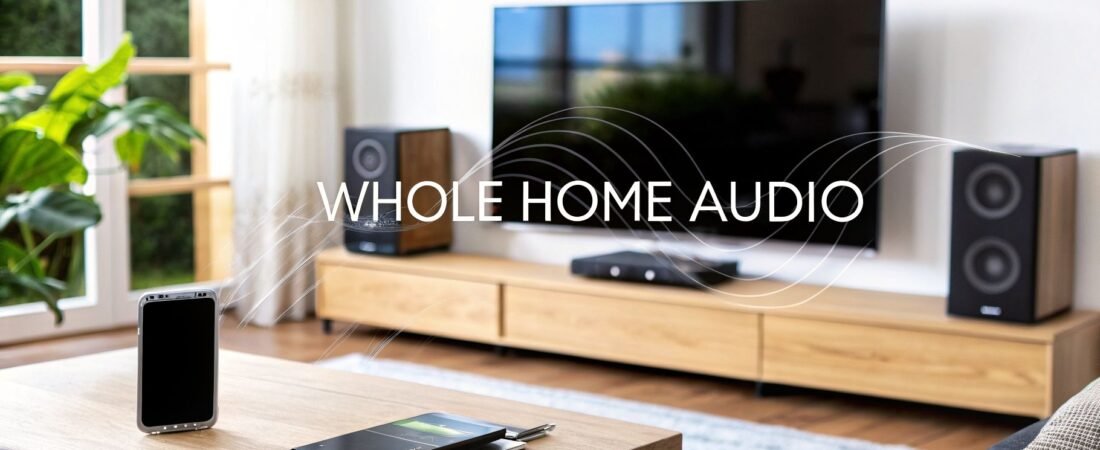
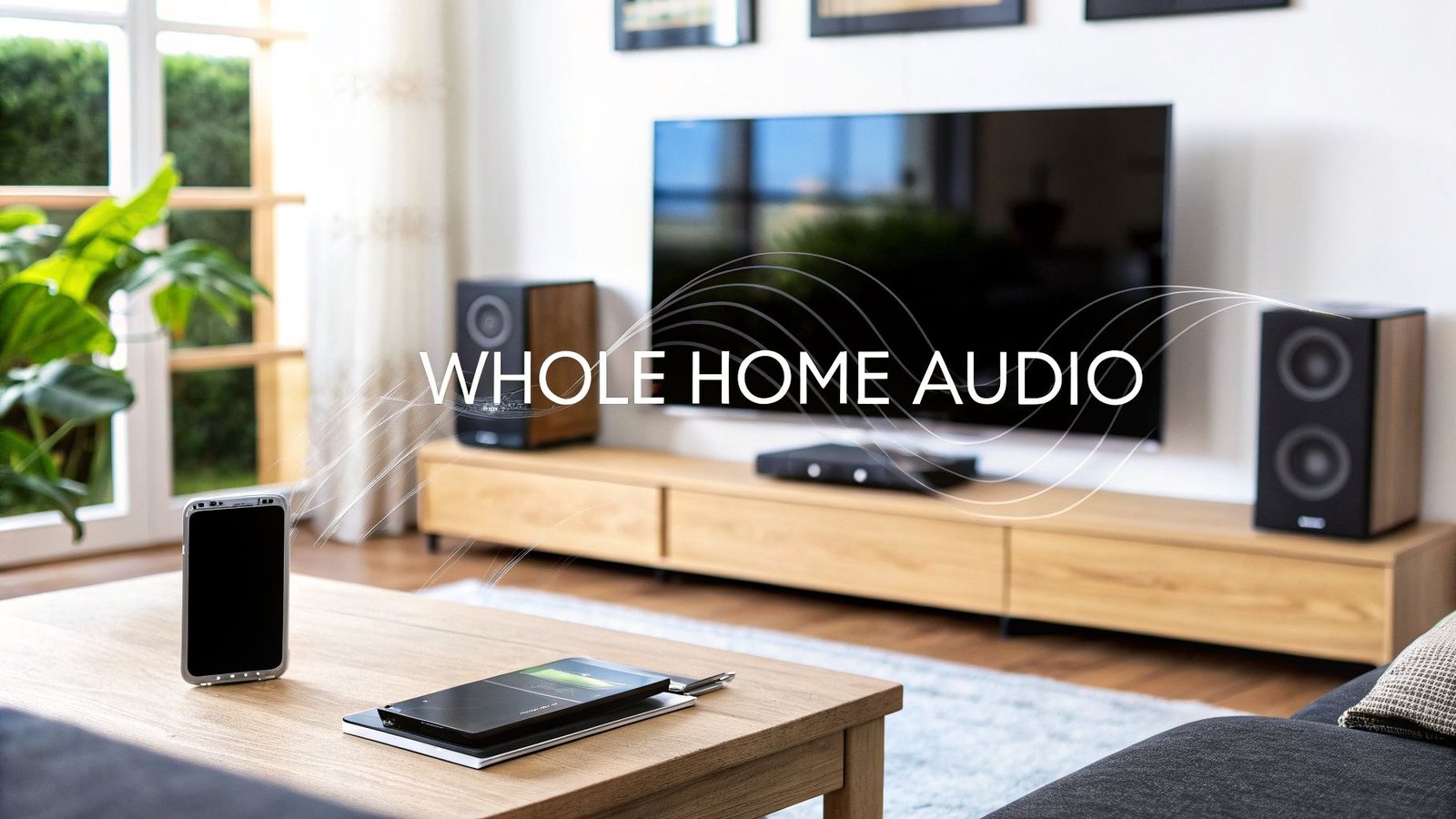
Ever wished your favorite playlist could follow you from the kitchen to the living room without missing a beat? That's the simple promise of a whole-home wireless audio system. It connects a series of speakers over your Wi-Fi, letting you control everything from a single app on your phone.
Think of it less like a single Bluetooth speaker and more like a fully integrated lighting system for your ears. You can play different songs in different rooms, or sync them all up for a seamless, house-wide experience.
The Magic of a Truly Wireless Home Audio System
Remember when having music meant being tethered to a stereo in one room? A wireless audio system completely breaks that mold. It shifts music from a siloed activity—stuck on your headphones or a single speaker—to a fluid experience that fills your entire home.
So, how does it all come together? It really comes down to three key pieces working in harmony:
- Your Speakers: These are the stars of the show, placed in any room where you want to hear music.
- Your Wi-Fi Network: This is the invisible backbone of the system, carrying the audio signal from your phone or music service to each speaker without a single wire.
- The Control App: This is your conductor's baton. It's the command center on your phone or tablet that lets you direct the whole symphony.
This trio gives you some incredible freedom. You can easily create different "zones" for whatever is happening at home. For example, you could have some mellow classical playing in the office, a podcast streaming in the kitchen, and pop music blasting in the kids' playroom—all at the same time.
From Individual Devices to a Unified Experience
The real power move with a wireless system is grouping those zones together on the fly. Having people over? Just a couple of taps in the app can link the living room, kitchen, and patio speakers to play the exact same playlist, perfectly in sync. As your guests wander from room to room, the music flows right along with them. This is what separates a true multi-room system from just having a bunch of separate speakers.
And this isn't just a niche gadget for tech enthusiasts anymore. The demand for this kind of integrated experience is huge. In fact, residential use is expected to make up 77.45% of the entire wireless speaker market by 2026. It’s clear that homeowners now see multi-room audio as a key part of a modern, connected home. If you're curious, you can find more research on wireless audio market trends that shows just how big this movement has become.
Ultimately, it’s all about making great sound effortless. Whether you’re using the app, a dedicated remote, or just asking your smart assistant to play a song, the technology should feel invisible. The goal is to make your home’s soundtrack as easy to manage as flipping a light switch, setting the stage for a life filled with music that moves with you.
2. The Wireless Technologies That Power Your Sound
To get that seamless, house-filling sound, we first need to look under the hood. The specific wireless technology a system uses is the secret sauce—it dictates audio quality, reliability, and how well everything plays together. Choosing the right one is like picking the right kind of road for your audio traffic.
This diagram breaks down the basic relationship: you have the speakers making the noise, your Wi-Fi network acting as the data highway, and your phone or tablet playing traffic controller.

It all hinges on a solid wireless connection. Your commands have to travel reliably over the network to tell each speaker what to do. Let's look at the different "roads" your audio can take.
H3: Wi-Fi: The Multi-Lane Audio Highway
Most true whole-home audio systems run on your standard home Wi-Fi network. It’s the default for a reason. Think of Wi-Fi as a wide, multi-lane highway with enough capacity to handle a ton of data over long distances.
High-resolution music files are big, and Wi-Fi has the bandwidth to carry all that data without squashing it down. This means it can handle lossless audio, preserving every bit of detail from the original recording. Since it leverages your existing home network, it's also a natural fit for covering your entire house and letting speakers in different rooms talk to each other without a hiccup.
H3: Bluetooth: The Private Driveway
We all know Bluetooth. It’s a fantastic technology, but it operates on a much smaller scale. If Wi-Fi is the highway, Bluetooth is more like a short, private driveway that connects your phone directly to a single speaker. It's incredibly convenient for simple, point-to-point connections.
For a single room, Bluetooth is king. It's the easiest way to connect your phone to a portable speaker or soundbar right next to you.
But for a whole-home setup, you quickly run into its limits. Bluetooth has a much shorter range—typically around 30 feet—and lower bandwidth. This often means audio files have to be compressed, which can degrade sound quality. For example, a Bluetooth turntable is a great way to spin records wirelessly, but it’s designed to stream to one nearby speaker, not your entire house.
H3: Proprietary Mesh Networks: The Express Lane
Some of the biggest names in the game, like Sonos, use a clever third option: a proprietary mesh network. This is like having a private, high-speed express lane built just for your audio, running alongside your regular Wi-Fi traffic.
Here's how it works: you plug one speaker into your router, and it instantly creates its own dedicated wireless network. Every other speaker you add joins this private network, acting as a new access point that strengthens and extends the signal.
- Dedicated Bandwidth: Your music stream isn't competing with Netflix, gaming, or video calls. This leads to rock-solid stability and far fewer dropouts.
- Superior Coverage: Each speaker acts as a signal repeater, blanketing your home in a strong audio signal, often more reliably than your Wi-Fi router can manage on its own.
This kind of robust, wireless-first approach is exactly why consumers have overwhelmingly moved away from running cables. In 2023, the wireless segment dominated the home audio market, with the Asia Pacific region alone accounting for a 35.5% market share, driven largely by the adoption of these easy-to-install systems.
To give you a clearer picture, here’s how these technologies stack up side-by-side.
Wireless Audio Technology Comparison
| Technology | Best For | Audio Quality | Range & Stability | Multi-Room Support |
|---|---|---|---|---|
| Wi-Fi | High-quality multi-room audio using your existing network | Excellent (Lossless) | Good to Excellent | Excellent |
| Bluetooth | Single-room, portable, and convenient listening | Good (Often Compressed) | Poor (Short Range) | Very Limited |
| Proprietary Mesh | Dedicated, ultra-reliable multi-room systems | Excellent (Lossless) | Excellent (Self-healing) | Excellent |
Ultimately, while Bluetooth is perfect for personal audio, a true multi-room system relies on the wide coverage of Wi-Fi or the unmatched stability of a proprietary mesh network. These different communication methods aren't unique to audio; it’s a core concept across the smart home. To learn more, check out our guide on understanding smart home protocols and see how all your connected devices communicate.
How to Plan Your Multi-Room Audio Zones
Once you understand the basic technology, it's time to get creative. Planning a whole home audio wireless system is less about poring over tech specs and more about understanding how you actually live in your space. This is where you get to be the designer, mapping your home into distinct listening areas, or audio zones.

Think of yourself as creating a blueprint for sound. The real goal is to tailor the audio to the function of each room so the entire system feels completely intuitive. It’s a fun process that pays dividends every single time you hit play.
Think Room by Room
The best way to start is by simply walking through your home, one room at a time. For each space, consider its main purpose. Don't just ask, "Where can I put a speaker?" Instead, ask, "How will we listen to music or podcasts in here?" This simple audit is the foundation of a system you'll love.
Here are a few ideas to get the wheels turning:
- The Kitchen: Often the social hub of the house, the kitchen is perfect for a single, powerful smart speaker. It’s great for listening to podcasts while cooking or catching the news over breakfast. You might even want to look for a moisture-resistant model that can handle a little steam.
- The Living Room: This is your prime entertainment space, so it probably calls for something more immersive. A soundbar for the TV, paired with two wireless rear speakers, can create a fantastic surround-sound experience for movie nights.
- The Home Office: In a space built for focus, a pair of high-quality bookshelf speakers can create a detailed stereo soundstage. It’s perfect for background music that helps you concentrate without being distracting.
- The Bedroom: Simplicity is often key here. A small, single speaker is usually all you need for some relaxing music at night or waking up to your favorite online radio station.
Taking this room-by-room approach helps you put your money where it matters most, avoiding overkill in some rooms while ensuring your main listening areas get the attention they deserve.
The core idea behind zoning is to make your audio system adapt to your life, not the other way around. You can always start small with just one or two zones and build it out over time.
Grouping Zones for Your Lifestyle
After mapping out individual rooms, you can start thinking bigger. The real magic of modern wireless audio is grouping these zones together on the fly to match what you’re doing.
Think about your daily routines and how you entertain. From there, you can create logical groups:
- Party Zone: Instantly link the kitchen, dining room, and patio speakers. With a single tap, you can have the same playlist flowing seamlessly as guests move through your home.
- Relaxation Zone: Maybe you want to group the master bedroom and en-suite bathroom. This lets you create a continuous, calming atmosphere as you wind down for the evening.
- Private Zones: By keeping bedrooms and the home office as separate zones, everyone in the family can listen to their own music, audiobooks, or podcasts without bothering anyone else.
This desire for flexible, personalized audio is what's driving the entire market forward. Today, wireless and Bluetooth-enabled models account for over 60% of new audio purchases. We're also seeing a remarkable 10-14% annual growth in systems with built-in streaming. In fact, the U.S. alone makes up over 31.4% of global hi-fi shipments, a surge largely fueled by our love for smart, zoned audio. You can discover more about these consumer audio trends and see just how mainstream these setups have become.
When you plan your zones this thoughtfully, you end up with a system that doesn't just sound incredible—it fits perfectly into the rhythm of your life.
Choosing the Right Wireless Audio Ecosystem for You
With your audio zones mapped out, you’ve arrived at the most important crossroad for your **whole home audio wireless** system: choosing the right ecosystem. This choice is a big one. It dictates every speaker you buy, how they all talk to each other, and what your daily experience will feel like.The market is really split into two camps. Getting a handle on the difference between them is the secret to picking a system that you'll be happy with for years, not just for a few months.
The Walled Garden: Closed Ecosystems
First up are the closed ecosystems. Think of iconic brands like Sonos and Bluesound. Committing to a closed system is a bit like choosing to fly exclusively with a single, premium airline. You’re guaranteed a consistent, high-quality experience every time, but you’re sticking with them for the long haul.
These platforms are famous for their polish and rock-solid reliability. Since one company designs both the hardware (the speakers) and the software (the control app), everything just works together, straight out of the box. Setup is usually a breeze, and day-to-day use is incredibly smooth. The trade-off, of course, is flexibility—you’re locked into that brand’s family of products.
- Sonos: Widely seen as the king of user-friendliness, Sonos has mastered the art of making multi-room audio easy for everyone. Their app is a dream to use, they offer a wide range of speakers, and the system’s reliability is legendary.
- Bluesound: This one’s for the audiophiles. Bluesound puts high-resolution, lossless sound quality front and center, delivering a premium listening experience for those who crave every last detail in their music.
The main appeal here is simplicity and performance. You’re essentially paying for a curated, seamless experience where you never have to second-guess if a new piece of gear will be compatible.
The Open Playground: Flexible Platforms
On the other side of the coin, you have open platforms like Apple’s AirPlay 2 and Google’s Chromecast. If a closed system is that premium airline, an open platform is more like a travel booking site that lets you mix and match flights from different carriers to build the perfect trip.
This approach gives you an incredible amount of freedom. You can pick and choose speakers from dozens of different manufacturers—like Bose, JBL, or Bang & Olufsen—and get them all to play nicely together using one shared standard. It’s perfect if you fall in love with a bookshelf speaker from one brand but want a soundbar from another.
An open platform empowers you to build a custom whole home audio wireless system with components from various brands, giving you ultimate control over both cost and features.
The potential catch is that the experience can sometimes feel a bit less cohesive. While the core job of playing music everywhere works great, you might find yourself juggling different manufacturer apps for firmware updates or to access specific speaker settings. This can introduce a little complexity that closed systems are specifically designed to eliminate.
Key Players in the Open Arena
The two biggest players in the open-platform world are tied directly to their respective tech giants, which often makes the choice pretty simple for most people.
Apple AirPlay 2 is a no-brainer for anyone living in the Apple world. It lets you stream audio directly from an iPhone, iPad, or Mac to any AirPlay 2-compatible speaker with just a couple of taps. The integration is flawless, and you can even ask Siri to manage your music.
Google Chromecast provides the same kind of magic for the Android and Google Home universe. You can "cast" audio from hundreds of apps to any speaker with Chromecast built-in. It’s an incredibly versatile and widely supported platform.
Ultimately, this decision comes down to what you value most. Are you looking for guaranteed performance and the simplest possible experience? Or do you prefer the freedom to mix and match hardware to build a system that’s uniquely yours? As you think it over, our guide to the best smart speakers for your home can give you a better feel for the specific models out there. By weighing your budget, technical comfort, and what you hope to achieve, you can confidently pick the ecosystem that will fill your home with music.
From Box to Bliss: Setup and Network Essentials
You’ve done the research and picked out your gear. Now for the exciting part: unboxing those speakers and making your whole home audio wireless system a reality. But before you start plugging things in, we need to talk about the single most critical piece of the puzzle—your home’s Wi-Fi network.

Think of your Wi-Fi as the invisible highway carrying music to every speaker. If that highway is weak or full of traffic jams, you’ll get frustrating dropouts and choppy audio. For high-quality, uninterrupted streaming, a rock-solid network isn’t just a nice-to-have; it’s a requirement.
First Things First: Get Your Wi-Fi Right
Before a single speaker is powered on, let's give your network a quick health check. The mission is to deliver a strong, steady signal to every corner where you plan to place a speaker. If you want to dive deep, understanding how to improve WiFi signal strength is the key to preventing problems before they start.
A few simple tweaks can make a massive difference:
- Rethink Router Placement: Is your router stuffed in a closet or banished to the basement? Get it out! Place it in a central, open area, preferably up high, to give the signal the best possible chance to travel.
- Clear the Air: Keep your router away from other electronics that cause interference. The biggest culprits are often microwaves, cordless phone bases, and even large metal filing cabinets.
- Go Mesh for Bigger Homes: If you have a larger house, thick walls, or annoying dead spots, a single router probably won't cut it. A mesh Wi-Fi system is a fantastic investment that blankets your entire home in a stable, consistent signal. For a full breakdown, check out our guide on a wireless mesh network setup and its benefits.
Getting this foundation right ensures your audio data flows smoothly from your phone to every speaker, giving you that flawless experience you’re after.
A Simple, Step-by-Step Setup Guide
Once your network is solid, the actual speaker installation is refreshingly simple. Nearly every modern brand has perfected an app-based setup process that anyone can follow.
Here's my pro tip: Set up one speaker at a time. Trying to connect everything at once is a classic recipe for confusion. Start with one, get it running perfectly, and then move on to the next.
No matter which brand you chose, the process will look something like these four simple steps:
- Unbox and Power Up: Grab the speaker you plan to place closest to your router. Plug it into the wall and give it a minute to boot up. A status light will usually blink to let you know it's ready.
- Download the App: Head to your phone’s app store and download the manufacturer’s control app (like Sonos, Google Home, or Bluesound’s BluOS Controller). This app is your new command center.
- Connect the First Speaker: Open the app and it should immediately start searching for new devices. Just follow the on-screen prompts to connect the speaker to your Wi-Fi network.
- Add and Name the Rest: With your first speaker online, repeat the process for the others. As you add each one, the app will ask you to assign it to a room. Use simple names like "Kitchen" or "Patio"—it makes voice commands and grouping so much easier down the road.
After all your speakers are online, you can use the app to create the zones you mapped out earlier. In just a few minutes, you’ll be ready to group rooms, hit play, and fill your home with perfectly synchronized music.
Of course. Here is the rewritten section, designed to sound like it was written by an experienced human expert.
How to Budget for Your Whole Home Audio System
Alright, let's talk about the investment. Planning a whole home audio wireless system is exciting, but figuring out the cost can feel a bit overwhelming. The good news is that you can break it down into realistic tiers, where your budget directly shapes the speaker quality, brand ecosystem, and the features you'll enjoy every day.
This isn't just about spending money; it's about making a smart investment in your home's atmosphere. Whether you're just dipping your toes in the water or ready to build a system for serious, critical listening, there's a clear path forward. Let's walk through what you can expect at different budget levels.
The Entry-Level Tier: Under $500
You don’t need a massive budget to get started with multi-room audio. For under $500, you can put together a surprisingly effective system with just a couple of smart speakers. This is the perfect starting point for bringing synchronized music into two or three of your most-used rooms, like the kitchen and living room.
Think of speakers from brands like Amazon Echo or Google Nest. While they aren't designed for audiophile-level listening, they are fantastic for creating background ambiance and giving you the convenience of voice control over your music. This tier is perfect for casual listening, catching up on podcasts, and simply getting a feel for how a connected audio system can fit into your daily life.
The Mid-Range Tier: $1,000 to $3,000
This is the sweet spot where true whole home audio wireless systems really begin to shine. Once you move into the $1,000 to $3,000 range, you can invest in a dedicated ecosystem like Sonos, which delivers a significant leap in both sound quality and user experience. A budget like this can comfortably outfit four to five rooms with a mix of high-quality speakers.
So, what does that extra investment get you?
- Superior Sound: Speakers in this category are actually engineered for music, offering much richer bass, clearer highs, and a more dynamic listening experience.
- A Dedicated App: You graduate from basic voice commands to a polished, powerful control app built from the ground up for managing multi-room music.
- More Speaker Options: You can start mixing and matching different speaker types—from compact bookshelf models to room-filling soundbars—all working together seamlessly.
This tier is really for anyone who wants a reliable, great-sounding system that’s dead simple to use and can grow with them over time. It's an incredibly popular choice, and it's easy to see why. The global wireless home audio market is exploding, and it's projected to climb to around $45 billion by 2026 as more people discover how powerful these setups can be. You can dive deeper into the expanding wireless audio market to see the trend for yourself.
The High-End Tier: $5,000 and Up
For those who refuse to compromise on sound quality, the high-end tier begins at $5,000 and can go much, much higher. This is the world of the true music lover, where the entire focus shifts to audiophile-grade components and pristine, high-resolution audio.
In this tier, you're not just buying speakers; you're investing in an uncompromised listening experience that brings studio-quality sound into your home.
Here, you'll find brands like Bluesound, Naim, and the premium lines from companies like Bowers & Wilkins. These systems are built to handle lossless audio formats without breaking a sweat, revealing subtle details in your favorite tracks that most speakers simply can't reproduce. You’re paying for top-of-the-line amplifiers, advanced acoustic engineering, and the ability to build a system that sounds absolutely magnificent in every single room.
Frequently Asked Questions About Wireless Audio
Even with a solid plan in hand, a few practical questions almost always pop up before you start buying gear. Building a whole home audio wireless system is exciting, but it's smart to clear up any last-minute uncertainties. Let's walk through some of the most common questions I hear from people just starting out.
Think of this as the final check-in to make sure you're confident in your choices. From mixing brands to the nitty-gritty of your network, we'll get these questions answered so you can get to the fun part.
Can I Mix and Match Different Speaker Brands?
This is the first question just about everyone asks, and the answer is a classic "it depends"—specifically, on the platform you choose. If you build around an open platform like Apple AirPlay 2 or Google Chromecast, then yes, absolutely! The whole point of those systems is to let you mix and match speakers from dozens of different companies.
On the other hand, if you go with a "walled garden" ecosystem like Sonos or Bluesound, you're committing to that family of products. A Sonos speaker simply won't talk to a Bluesound system. The trade-off for being locked in is often an incredibly smooth setup process and a very polished, reliable user experience.
Do I Need a Special Router for Wireless Audio?
You don't need a "special" router, but you absolutely need a good one. While most routers sold in the last few years can handle music streaming, older or cheap models will quickly become a source of frustration, causing skips and dropouts. For a truly reliable whole home audio wireless setup, especially in a larger house, investing in a mesh Wi-Fi system is one of the smartest moves you can make.
A strong, stable Wi-Fi network is the foundation of any great wireless audio system. Think of it as the most important component you'll buy, even though it doesn't make a sound itself.
How Can I Integrate My Existing Stereo System?
Have a great turntable or a high-end amplifier you love? Good news. You don't have to leave your classic gear behind. Most ecosystems have components specifically designed to act as a bridge between old-school analog audio and your new wireless world.
Products like the Sonos Port or Bluesound NODE are little streamers that plug right into your existing amplifier or receiver. This instantly makes your traditional stereo a new "zone" in your system, controllable from the same app as all your wireless speakers. It's the perfect way to merge the best of both worlds.
Do These Systems Use a Lot of Internet Data?
This is a common concern, but the answer is usually no. Streaming music uses your internet connection, but it's a drop in the bucket compared to streaming 4K video. A typical music stream uses around 1MB per minute. Even a high-resolution lossless track will only use about 5-10MB per minute. The real bottleneck isn't your internet data plan; it's the strength of your local Wi-Fi network. If your Wi-Fi is solid, you'll be golden.
The fact that these systems are so manageable is why they've exploded in popularity. The global home audio market was valued at a massive USD 32.69 billion in 2023 and is on track to more than double by 2030. You can read the full home audio market analysis to see just how mainstream this technology has become.
Ready to design a home audio system that fits your life perfectly? At Automated Home Guide, we provide the expert insights and practical guides you need to make smart decisions about your connected home. Explore our resources today and start building a smarter, more convenient living space.






Leave a Reply