Trying to lower your home's carbon footprint can feel overwhelming. But it really boils down to one thing: finding your biggest energy hogs and making smart, targeted changes. It's less about a massive overhaul and more about a strategic audit to stop hidden waste and focus on actions that give you the most bang for your buck—for the planet and your wallet.
Pinpointing Your Home's Carbon Hotspots
Before you start swapping light bulbs or unplugging appliances, you need a baseline. You wouldn't try to save money without looking at your bank statements, right? The same goes for energy. Making random changes without understanding your home's specific energy profile is like throwing darts in the dark.
The best place to start is with a DIY home energy audit. Don't worry, you don't need any fancy equipment. All you need are your past utility bills and a bit of detective work.
- Dig into your bills: Grab a year's worth of your electricity and gas bills. You'll almost certainly see spikes in the winter and summer months. That's your heating and cooling system screaming for attention, and it’s usually the biggest carbon culprit in any home.
- Do a walk-through: Take a slow walk through your house and make a mental inventory of everything that pulls power. Pay special attention to older appliances, entertainment centers, and home office equipment. The real energy hogs are often hiding in plain sight.
- Hunt for "energy vampires": Many devices pull power even when they're "off." This is called a phantom load. An easy way to spot them is to watch your electric meter, then unplug a suspect device like a TV or game console. If the meter's disk slows down, you've found a vampire. These sneaky loads can account for up to 10% of your home's total electricity use.
This whole process—auditing your use, figuring out where the emissions are coming from, and then prioritizing your attack plan—is the foundation of any effective reduction strategy.

Think of it like this: you gather the clues (your energy data) and then create a plan to solve the case (high emissions). This simple workflow ensures you're putting your effort where it will actually make a difference.
From Data to Action
Once you have this data, you're no longer guessing. A few key areas will likely stand out as obvious first targets. If you want a more guided approach to this process, our comprehensive home energy audit checklist walks you through every room and system.
For a wider look at sustainable living beyond just your home's energy use, there are some great resources that outline more actionable strategies for reducing your carbon footprint.
Key Insight: Understanding your own energy data is incredibly empowering. It turns the vague goal of "being more eco-friendly" into a concrete to-do list with real, measurable results.
To help you get started, the table below summarizes the most common problem areas I see in homes. Use it to cross-reference your own findings and figure out where you can make the biggest impact first.
High-Impact Areas for Reducing Your Home's Carbon Footprint
This table gives you a quick-start guide to the usual suspects behind high household emissions and the most effective ways to tackle them.
| Emission Source | Primary Cause | High-Impact Solution |
|---|---|---|
| Heating & Cooling | Inefficient HVAC systems, poor insulation, air leaks | Install a smart thermostat and improve home insulation |
| Water Heating | Old, inefficient water heater; excessive hot water use | Upgrade to a heat pump water heater; install low-flow fixtures |
| Appliances | Outdated models (refrigerator, washer, dryer) | Replace with ENERGY STAR certified appliances |
| Lighting | Incandescent or CFL bulbs | Switch to 100% LED lighting |
| Phantom Loads | Devices on standby mode (TVs, chargers, game consoles) | Use smart plugs to automate power shut-off |
By focusing on these areas, you're not just making a dent in your carbon footprint—you're also setting yourself up for significant savings on your utility bills down the road.
Everyday Habits That Lower Your Emissions

While major home upgrades get all the attention, the real power often lies in the small, consistent habits you practice every day. You don't need a huge budget to make a meaningful dent in your carbon footprint; some of the most effective changes are completely free.
This is about getting beyond the old "turn off the lights" advice. Let's dig into the practical, real-world tweaks that can collectively slash your household emissions and lower your utility bills at the same time.
Rethink Your Kitchen and Laundry Routines
The kitchen and laundry room are two of the best places to start. It’s not just about having energy-efficient appliances—it’s about how you use them.
Take the dishwasher, for example. Always wait until it's completely full to run it. And you can almost certainly stop pre-rinsing your dishes; just scrape them clean. This simple change can save hundreds of gallons of hot water a year. Modern detergents and dishwashers are more than up to the task, I promise.
The same logic applies in the laundry room, where a staggering 90% of a washing machine's energy use is just for heating the water.
- Wash loads in cold water. This is probably the single biggest energy-saver in your laundry routine. Today's detergents are specifically designed to work great in cold water, so you're not sacrificing cleanliness.
- Embrace the air-dry. Clothes dryers are absolute energy hogs. A simple drying rack or an old-fashioned clothesline is your best friend for cutting emissions.
- Run full loads only. Just like with the dishwasher, running a full machine is far more efficient than doing several small loads.
These aren't big, dramatic changes. They're just small adjustments to your weekly chores that add up to a significant drop in your home's energy demand.
Tweak Your Thermostat and Digital Habits
Heating and cooling are the heavyweights of home energy use, but you can make a real difference with minor adjustments. At the same time, our digital lives come with a surprising carbon cost that’s surprisingly easy to manage.
Simply dialing your thermostat back by one degree can reduce your heating and cooling energy use by up to 5%. Try setting it a degree cooler in the winter and a degree warmer in the summer, especially when you’re asleep or out of the house. A programmable or smart thermostat makes this effortless.
A small change in temperature might seem insignificant, but over a full season, it translates into a noticeable reduction in both your energy bills and your carbon footprint.
Even your Netflix binge has an environmental impact. Streaming video, especially in 4K, demands a massive amount of electricity from data centers around the world. To put it in perspective, a single large data center can consume as much electricity as 50,000 homes.
Here are a few ways to lighten that digital load:
- Stream in Standard Definition (SD). When you're watching on a phone or tablet, switching from HD or 4K to SD makes a huge energy difference, and you likely won't even notice the change in quality.
- Download instead of re-streaming. If you know you'll watch something more than once, download it. This uses far less energy than streaming it multiple times.
- Unplug "vampire" chargers. Chargers for your phone, laptop, and other gadgets still draw power even when they aren't actively charging a device. Get in the habit of unplugging them, or use a smart plug to cut the power automatically.
Each of these habits helps build a mindset of conscious energy use, turning simple daily actions into powerful tools for change.
Master Your Climate with a Smart Thermostat
If you're hunting for the single biggest energy hog in your house, look no further than your heating and cooling system. I've seen it time and time again in home energy audits: this one system is often responsible for nearly half your utility bill and a massive chunk of your home’s carbon footprint.
Getting your HVAC under control is probably the most powerful move you can make. This is where a smart thermostat isn't just a gadget—it's your most important tool. It goes way beyond a simple timer, using smart technology to learn your family's rhythm and cut out waste with surgical precision.
It's More Than Just a Schedule
Old programmable thermostats were a step up, but they were dumb. They just followed a rigid schedule, whether you were home or not. Modern smart thermostats are different. They adapt.
They learn your household's patterns and know exactly when to ease off the heating or air conditioning. For instance, the thermostat can sense when the house is empty after everyone has left for work and school, automatically dialing back to an energy-saving temperature.
Better yet, using geofencing on your smartphone, it knows when you're heading home. It then kicks on the heat or AC to get your house perfectly comfortable right as you walk through the door. No more heating an empty house, and no more coming home to a freezing one.
Key Takeaway: A smart thermostat eliminates wasted energy during unoccupied hours without ever sacrificing comfort. It automates savings so you don't have to constantly fiddle with the dial.
These devices make tiny, constant adjustments all day to keep the temperature stable, avoiding the inefficient, full-blast cycles of older systems. This intelligent management is a cornerstone of how to reduce carbon footprint at home in a way you can actually measure.
The Power of Learning Your Life
The real magic is in their ability to build schedules that reflect your actual life, not just a generic 9-to-5. Let's be honest, your heating needs on a Tuesday morning are completely different from a lazy Saturday afternoon.
A smart thermostat lets you build schedules that make sense for you:
- Workdays: Lower the temperature after you leave and have it warm back up just before you get home.
- Weekends: Keep it comfortable during the day but let it get cooler at night while everyone's asleep under the covers.
- Vacations: Put it in "away" mode. This keeps the system at a minimal, safe temperature to prevent pipes from freezing, saving a fortune in energy while you're gone.
The app interface usually gives you an incredible amount of control right from your phone, making adjustments a breeze.
This level of detailed control puts you in the driver's seat of your home's biggest energy user. You can dig deeper into how these features translate directly into lower bills in our guide to smart thermostat energy savings.
The numbers don't lie. Since heating and cooling account for about 50% of a typical home's energy use, optimizing them has a huge impact. Even a basic programmable thermostat can save up to 10% a year on climate control costs. That translates to avoiding roughly one ton of CO2 emissions for every household, every year.
When you consider that weather patterns caused US emissions to grow by 1.9% in 2025, individual actions really add up. Just lowering the thermostat by 1°C when you're not home can prevent 180 kg of CO2 annually. It’s a small change with a surprisingly big effect.
Upgrade Your Appliances and Lighting for Big Impact

Some of the biggest energy hogs in your house are the ones you barely think about. Your refrigerator, washing machine, and even the light bulbs you flick on every day are constantly pulling power from the grid. Making smart, targeted upgrades here is one of the most powerful ways to cut your carbon footprint, and the return on your investment often comes faster than you'd think.
When an old appliance finally gives out, don't just rush to buy the cheapest replacement. See it for what it is: a golden opportunity. Because these machines are long-term commitments, choosing an efficient model will pay you back in energy savings for the next decade or more.
Look for the ENERGY STAR Label
You’ve seen that little blue ENERGY STAR logo everywhere, but it's more than just a sticker. Backed by the U.S. Environmental Protection Agency, it’s a trustworthy sign that a product meets strict energy-saving standards.
How much of a difference does it make?
- An ENERGY STAR certified refrigerator is, on average, 9% more energy-efficient than a standard one.
- A certified washing machine uses 25% less energy and an incredible 40% less water.
Think of it as a cheat sheet for efficiency. When you're shopping, making that label a non-negotiable requirement is the easiest way to guarantee you're getting a product designed to lower your bills and your carbon output.
Choosing an efficient appliance is like pre-paying for energy savings for years to come. If you're ready to dig deeper, this guide to the best energy efficient appliances is a fantastic resource for making long-term choices.
The Quick Win: Switching to LED Lighting
If you're looking for an upgrade with an immediate and noticeable impact, there's no better place to start than your lighting. It's one of the easiest and most effective changes you can make. Those old, traditional incandescent bulbs are shockingly wasteful, losing about 90% of their energy as heat instead of light.
Compact Fluorescent Lamps (CFLs) were an improvement, but modern LEDs have completely changed the game. They use up to 90% less energy than incandescents and can last up to 25 times longer.
Just replacing the five most-used light bulbs in your house with ENERGY STAR certified LEDs can save you around $75 every year. It's a small swap that makes a real, measurable difference from day one.
Lighting Technology Comparison Annual Cost and Carbon Impact
The difference between lighting technologies becomes crystal clear when you look at the numbers. An old-school incandescent bulb might seem cheap at the store, but its tiny lifespan and massive energy draw make it far more expensive and carbon-intensive over time.
This table breaks down the annual impact of running just a single bulb for a few hours a day.
| Bulb Type | Average Lifespan (Hours) | Energy Use (Watts) | Annual CO2 Emissions (per bulb) |
|---|---|---|---|
| Incandescent | 1,200 | 60W | ~70 lbs |
| CFL | 8,000 | 14W | ~16 lbs |
| LED | 25,000+ | 10W | ~12 lbs |
The data speaks for itself. LEDs not only slash your carbon footprint but also save you the money and hassle of constantly buying and changing bulbs. Making the switch is a foundational move toward a truly efficient home.
Using Smart Tech to Eliminate Hidden Energy Waste
It’s not just your air conditioner or washing machine driving up your energy bill. A constant, silent drain is happening in your home 24/7, caused by what we call "energy vampires" or phantom loads.
These are the devices that keep sipping power even when you’ve turned them off. Think about your TV, game console, coffee maker, and all those phone chargers plugged into the wall. Individually, it’s a tiny amount of electricity, but together, they make a real dent in your monthly bill and your home's carbon footprint.
Thankfully, you don't have to run around unplugging everything. Smart tech gives us a much easier and more effective way to hunt down and stop this hidden energy waste for good.
Making Invisible Energy Use Visible
You can’t fix a problem you can’t see. To get a handle on phantom loads, you first need to understand exactly where your electricity is going. This is where a whole-home energy monitor is an absolute game-changer.
These monitors clamp right onto your home’s main electrical panel and stream real-time data straight to your phone. Suddenly, you can see the exact spike when the AC kicks on or watch your baseline usage drop in the middle of the night.
Having this data is incredibly empowering. For the first time, you can see the precise cost of leaving your entertainment center on standby. I installed one and was shocked to discover my old garage freezer was secretly adding $20 a month to my bill—an energy hog I never would have caught otherwise. It turns a vague idea about "wasting energy" into a clear, actionable target.
Key Insight: A whole-home energy monitor brings the hidden cost of standby power into the light. By seeing your energy use in real time, you can pinpoint the worst offenders and figure out which devices need to be managed more closely.
The Ultimate Vampire Slayers: Smart Plugs
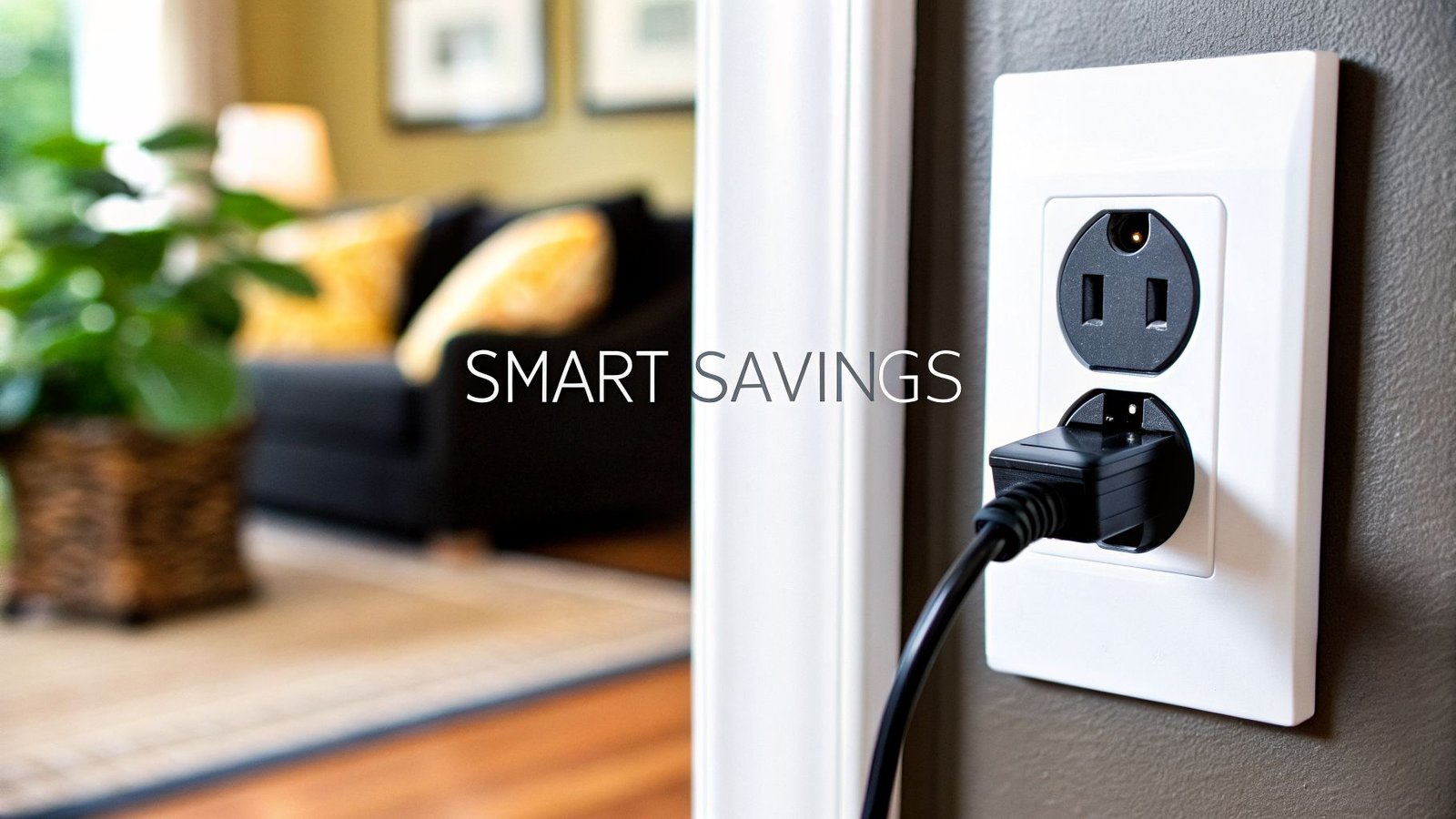
Once you've identified your home's energy vampires, it's time to cut off their power. Constantly unplugging devices is a pain, but this is where smart plugs truly shine. These simple, affordable gadgets go between your device’s cord and the outlet, letting you control the power flow right from an app.
The real magic, though, is automation. Instead of having to remember to turn things off, you can set schedules and rules that do the work for you. This simple step is fundamental if you're serious about figuring out how to reduce your carbon footprint at home.
Here are a few ways this plays out in the real world:
- The "Goodnight" Routine: Set up a routine in your smart home app that powers down your entire entertainment center at 11 PM. With one tap—or on a set schedule—the TV, soundbar, and gaming console stop drawing phantom power while you sleep.
- The Smart Charging Station: Plug all your family's chargers into a smart power strip. You can schedule it to turn off from midnight to 6 AM, which prevents overcharging and eliminates that needless trickle of energy all night long.
- The Office Shutdown: Automatically kill the power to your entire home office setup—monitors, printers, speakers—every weekday at 6 PM and all weekend long. No more wasted power when you're not working.
These small, automated tweaks ensure you’re only using electricity when you actually need it.
The cumulative effect of standby power is massive. According to the International Energy Agency, it accounts for a staggering 10% of all residential electricity use worldwide. Smart home devices, like those often reviewed by the Automated Home Guide, let you tackle this waste directly. Simply using smart plugs can slash this vampire load by 20-30%, potentially preventing half a ton of CO2 emissions per household every year.
With EU homes already seeing a 15% drop in energy use after adopting smart meters, and as you can see from data on global emissions and reduction efforts, these individual actions really do add up.
By pairing the diagnostic power of an energy monitor with the automated control of smart plugs, you create a powerful system to methodically wipe out hidden waste. It’s a targeted, tech-driven strategy that makes your home more efficient without you having to think about it.
Thinking Beyond Your Electricity Bill

Getting a handle on your electricity consumption is a massive win, but a truly sustainable home requires looking at the whole picture. If you really want to know how to reduce your carbon footprint at home, you have to think beyond your monthly power bill. The hidden energy in your water, the waste you generate, and even your daily routines all contribute to your home's impact.
The Hidden Carbon Footprint of Water
Most people don't think about the journey water takes to reach their tap. It requires a tremendous amount of energy to pump, treat, and deliver it. Then, you use even more energy—usually from gas or electricity—to heat it for showers, laundry, and dishes.
This relationship, often called the "water-energy nexus," is a huge and frequently missed source of emissions. The good news is that addressing it is pretty straightforward.
- Switch to low-flow fixtures. A modern low-flow showerhead can slash your hot water consumption by 40% or more, and you won't even notice a difference in pressure. The same goes for adding aerators to your kitchen and bathroom faucets.
- Hunt down and fix leaks. That tiny drip might not seem like a big deal, but it can easily waste thousands of gallons of treated, pumped water every single year.
- Insulate your water heater and pipes. An insulating blanket for your water heater tank and some foam sleeves for your hot water pipes are cheap, easy wins. They reduce heat loss, forcing your heater to work less to keep water hot.
Rethinking Waste from the Ground Up
Recycling is important, but it’s really the last line of defense. The real magic happens when you focus on reducing and reusing first. Think about it: every item we throw away, from food scraps to packaging, has a carbon story attached to its production, shipping, and disposal.
Key Insight: Your trash can is a direct reflection of your home's consumption footprint. By producing less waste, you directly reduce the upstream emissions associated with manufacturing and the downstream emissions from landfills.
Composting is probably one of the most impactful things you can do here. When food scraps rot in a landfill, they release methane, a powerful greenhouse gas. In a compost pile, they become a fantastic, nutrient-rich amendment for your garden soil.
On top of that, start actively refusing single-use plastics. Simple swaps to reusable shopping bags, water bottles, and coffee cups make a real dent in the fossil fuels needed to create and ship disposable goods.
Connecting Your Home to Broader Habits
Your home is your base of operations, but your choices ripple far beyond its four walls. How you get around and what you eat are deeply tied to your household's total carbon impact.
Even a quick trip to the grocery store in a gas-powered car adds up. To really move the needle, you can explore the many alternatives to car ownership that can dramatically cut your personal emissions.
What you bring home from the store matters, too. The production of meat and dairy is incredibly resource-intensive. You don't have to go fully vegetarian overnight, but just adding more plant-based meals to your weekly rotation can have a surprisingly large impact—sometimes as much as taking a car off the road for months.
Clearing Up Common Questions About Your Home's Carbon Footprint
When people start looking for ways to shrink their home's carbon footprint, the same few questions always seem to pop up. It’s completely normal to wonder where to start and what will actually make a difference. Let's tackle them head-on so you can move forward with confidence.
What's the Single Fastest Way to Cut My Carbon Footprint?
If you're looking for the single biggest win right out of the gate, your focus should be on your home's heating and cooling. It’s a massive energy hog in most households, often responsible for about half of a home's total energy consumption.
The quickest fix here? A smart thermostat. Just by installing one and programming it correctly, you can realistically cut your energy use by 10% or even more each year. That one simple change delivers a huge return, saving both CO2 and cash.
Does Smart Home Tech Genuinely Make a Big Difference?
It absolutely does. It’s easy to feel like one smart plug or a few smart bulbs won't move the needle, but the real power of this tech is in its automation. It works tirelessly in the background to enforce efficiency.
Think about it:
- A smart thermostat learns your routine to avoid heating or cooling an empty house.
- Smart plugs kill the "vampire power" drawn by electronics on standby.
- Smart lighting makes sure you never accidentally leave the basement light on all day.
Individually, they're small adjustments. Together, they create a system of constant, automated savings.
Over time, these small, automated efficiencies really add up. Depending on your home and habits, they can slash a household's electricity-related carbon footprint by 15-25% or more.
Is Making My Home Energy-Efficient an Expensive Project?
That’s a common misconception. While some big-ticket upgrades have a high initial cost, you don't have to start there. Honestly, some of the most effective strategies cost nothing at all.
Start with simple behavioral shifts, like adjusting your thermostat by a couple of degrees or getting better about unplugging chargers. From there, you can move on to low-cost wins like LED bulbs and smart plugs, which often pay for themselves in under a year.
Bigger investments like a heat pump or new Energy Star appliances are definitely more expensive upfront. But remember to look for local and federal rebates—they can take a serious bite out of the cost. Plus, the significant long-term energy savings often make them one of the best financial investments you can make in your home.
Here at Automated Home Guide, our whole mission is to help you understand how technology can create a home that’s not just more convenient, but also more secure and sustainable. For more deep dives, product reviews, and practical advice from our experts, feel free to explore more of our guides at https://automatedhomeguide.com.






Leave a Reply