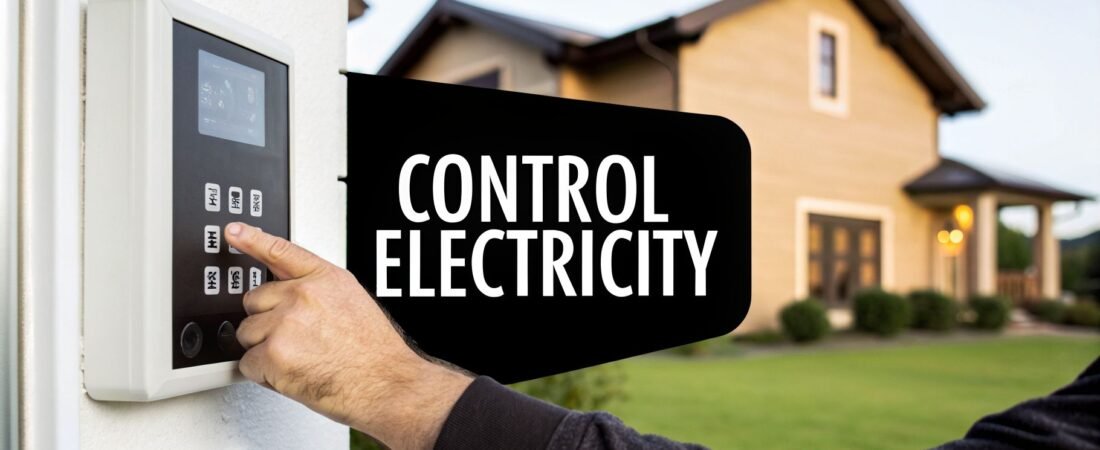
Gaining real control over your home’s electricity boils down to two things: knowing what to do for immediate safety and how to manage your energy for long-term efficiency. It all starts with the most important electrical device in your house: the circuit breaker panel.
Your First Steps to Controlling Home Electricity
Before we even talk about smart plugs or energy monitors, you need to get comfortable with the fundamentals of manual control. This isn't just a "nice-to-know" skill; it’s essential for your safety, whether you're dealing with an unexpected outage or just replacing a light fixture. Your command center for all of this is the main electrical panel, or as most people call it, the breaker box.
Seriously, the very first thing you should do is find it. Most of the time, it's tucked away in a garage, basement, or utility closet. Go find it, open the little metal door, and get familiar with what’s inside. This panel is the heart of your home's electrical system.
To help you get started, here's a quick summary of the most critical actions you can take right now to get a handle on your home's power.
Immediate Electrical Control Actions
| Action | Purpose | Key Tip |
|---|---|---|
| Locate Your Breaker Panel | To know where to go to shut off power in an emergency or for maintenance. | Check the garage, basement, or a utility closet. Make sure it's accessible. |
| Identify Breaker Functions | To understand which switch controls which area or appliance in your home. | Look for a handwritten or typed legend on the panel door. If it's missing, create your own! |
| Practice Resetting a Breaker | To safely restore power to a circuit that has tripped due to an overload. | Always push the breaker firmly to the full "OFF" position before flipping it back "ON". |
With these basics covered, you can confidently manage any immediate electrical issue that comes your way.
Understanding Breakers and Fuses
When you look inside that panel, you'll see neat rows of switches. Those are your circuit breakers. Each one acts as an automated safety guard for a specific electrical circuit in your home. If you try to run too many power-hungry appliances at once—say, a coffee maker and a toaster on the same kitchen circuit—the breaker is designed to "trip," cutting off the electricity to prevent the wires from overheating and creating a fire hazard.
A tripped breaker isn't a sign that something is broken. It's proof that your electrical system is doing its job and protecting you.
If you live in an older home, you might have a fuse box instead. These use single-use fuses that contain a small wire that melts and breaks the circuit when overloaded. Unlike a breaker that you can simply reset, a blown fuse has to be unscrewed and replaced with a new one.
The Safe Way to Reset a Tripped Breaker
So, a breaker tripped and the lights went out in the living room. The switch will likely be in a middle position between ON and OFF, or sometimes all the way OFF. Your first instinct might be to just flip it back on, but hold on. First, unplug a few things in that room to lessen the electrical load.
Then, to reset it properly:
- Push the switch all the way to the full "OFF" position. This is the step everyone forgets, but it’s crucial for properly resetting the internal mechanism.
- Now, flip it decisively back to the "ON" position. You should feel and hear a solid click.
If the breaker trips again immediately, don't keep resetting it. This often points to a short circuit or a more serious problem that warrants a call to an electrician.
Mastering these simple actions at your panel is the true first step in controlling your home's electricity. It gives you the confidence to handle minor issues and is the perfect foundation for performing a more detailed home energy audit.
Mastering Your Home's Breaker Panel
Most homeowners only open that gray metal box on the wall when a circuit trips and plunges a room into darkness. But if that’s your only interaction with the breaker panel, you’re missing out on a fundamental level of control over your home. Getting to know your panel is the first real step toward managing your home’s electricity with confidence.
The key is turning that jumble of switches and scribbled-on labels into a clear, usable map of your home’s electrical system. This isn’t a high-skill electrical job; it’s more like a bit of household detective work.
All you need is a partner, a notepad (or your phone’s notes app), and a label maker. One of you will stand guard at the panel, while the other walks through the house with a small lamp or phone charger. Plug it into every outlet. Flick every light switch on.
Now, start flipping breakers one by one. The person at the panel shuts one off, and the "field agent" reports back on what just lost power. The goal here is to be specific. Instead of a vague label like "Kitchen," write something useful like "Kitchen Outlets – East Wall" or "Upstairs Bathroom & Hall Light." Trust me, you'll thank yourself later when you're trying to isolate a single faulty outlet.
Decoding Your Breakers
While you’re mapping everything out, you'll probably notice that not all breakers are identical. These different types are crucial for protecting your home and family from various electrical hazards. Most will be standard breakers, but you should learn to spot the specialized ones.
Standard Breakers: These are the workhorses of your panel. They trip and cut power during an overload (like running a microwave and a toaster on the same circuit) or a short circuit. They’re rated by amperage—you'll typically see 15-amp breakers for general lighting and outlets, and beefier 20-amp ones for kitchens, laundry rooms, and bathrooms where appliances draw more power.
GFCI (Ground Fault Circuit Interrupter): See that little "Test" and "Reset" button? That’s a GFCI. These are literal life-savers, mandatory in areas where electricity and water might mix, like kitchens, bathrooms, and outdoor spaces. They monitor for tiny imbalances in electrical current and can shut the power off in a fraction of a second—fast enough to prevent a serious electric shock.
AFCI (Arc Fault Circuit Interrupter): These also have a test button but serve a different purpose: fire prevention. An arc fault is a dangerous spark that can happen inside your walls from damaged, degraded, or loose wiring. AFCIs are designed to detect this specific type of electrical signature and cut the power before that spark can ignite a fire. Modern electrical codes often require them for circuits in bedrooms and living areas.

Protecting Your Entire Home
GFCI and AFCI breakers are fantastic for protecting specific circuits from internal faults, but they do nothing to stop threats from outside your home. A power surge from a nearby lightning strike or a problem on the utility grid can send a massive jolt of voltage through your wiring, frying expensive and sensitive electronics in an instant.
The best defense against external power surges is a whole-home surge protector. Installed directly at your electrical panel, it acts as a gatekeeper, stopping damaging voltage spikes before they ever reach your devices.
Think of it as a comprehensive insurance policy for everything you plug in. Our guide on whole-home surge protector installation walks you through how they work and what to look for.
By taking an afternoon to map and understand your panel, you're not just making it easier to reset a breaker. You're taking active control of your home’s safety and electrical system.
Smart Thermostats and Lighting Systems

Knowing your way around a breaker panel is essential for manual control, but to truly get a handle on your home’s electricity, you need to think smarter. This is where you graduate from simply reacting to power issues to proactively managing how and when you use energy. The two best places to start are your HVAC system and your lights—they're almost always the biggest culprits behind a high energy bill.
Smart thermostats and lighting take these traditionally "dumb" systems and make them work for you. You get to set schedules, make changes from anywhere with your phone, and even let the devices learn your routines to cut down on waste. It’s all about making your home more efficient without you having to think about it constantly.
Your Thermostat Is Your Biggest Opportunity for Savings
Look at any home's energy breakdown, and you'll find the heating and cooling system right at the top of the list. It's a massive energy hog. A traditional thermostat is a pretty blunt tool; you set a temperature, and it runs until you tell it to stop. That means you’re often paying to heat or cool an empty house for hours every day.
This is where a smart thermostat, like a Google Nest or an Ecobee, really shines. It doesn't just stick to a rigid schedule. These devices use sensors, a Wi-Fi connection, and some clever programming to actually learn your family’s habits.
A smart thermostat doesn’t just let you control the temperature from your phone; it learns when you leave for work, when you typically return, and even how long it takes your home to heat up or cool down. This allows it to build a custom schedule that minimizes energy use without sacrificing your comfort.
For example, it can automatically dial back the heat after everyone’s asleep or turn the AC off when it detects the house is empty. All those little adjustments really start to add up. With global electricity demand projected to climb by 3.7% in 2026, finding ways to curb your own usage is more important than ever. The Department of Energy estimates that heating and cooling account for nearly 50% of a typical home's energy use, and a good smart thermostat can slash that by 10-15%. That's a real-world savings of around $130-$145 a year.
Illuminate Your Home Intelligently with Smart Lighting
Right after your HVAC system, lighting is usually the next biggest power drain. We’ve all done it—walked into a room and found the lights blazing away with nobody there. Smart lighting systems from brands like Philips Hue or Wyze are the perfect fix for this common energy-wasting habit.
These systems work by replacing your regular light bulbs with connected LED bulbs. From there, you can control every light individually or as a group right from an app on your phone, giving you pinpoint control over your electricity.
Here are a few practical ways people use them to save energy:
- Scene Setting: With one tap, you can trigger a "Movie Night" scene that dims the living room lights to 30%, or a "Goodnight" scene that shuts off every single light in the house.
- Geofencing: You can set your lights to automatically turn off when the system detects your phone has left the house. When you pull into the driveway, they can turn back on. You'll never have to wonder if you left the kitchen light on again.
- Motion Activation: Pair your smart lights with motion sensors in high-traffic areas like hallways, closets, or bathrooms. The lights pop on when someone enters and turn themselves off after a few minutes of inactivity.
By combining these automated features, you gain a powerful new level of control over your home's energy profile. Our detailed guide offers more insights into the specific energy savings you can expect from a smart thermostat. Putting these systems in place is one of the easiest ways to start controlling your electricity without having to make big changes to your daily life.
Using Automation to Reduce Hidden Energy Waste

You’ve probably tackled the big energy hogs with smart thermostats and LED lighting, but what about the silent energy drain happening all over your house? I’m talking about "vampire energy," also known as phantom load. It’s the power consumed by all your electronics in standby mode—the TV waiting for the remote, the coffee maker displaying the clock, the chargers left in the wall.
It might not seem like much, but it adds up fast. Vampire energy can account for 5-10% of a typical US household's electricity bill. That’s a surprising 400-600 kWh leaking away every year, according to the EIA's Annual Energy Outlook 2025. Some reports, like those in the UN's 2025 energy statistics library, show that automation can slash that standby waste by up to 65%, saving you well over $100 a year.
The good news? This is one of the easiest energy problems to solve with a few simple automation tools.
Slaying Vampire Power With Smart Plugs
The best place to start is with a smart plug. It’s a straightforward little device: plug it into an outlet, then plug your appliance into it. From a simple smartphone app, you can completely cut the power to whatever is connected, no matter where you are.
But the real magic is in setting schedules.
Think about your entertainment center—the TV, soundbar, and gaming console all drawing power 24/7. Plug them into a power strip, then connect that strip to a single smart plug, like one from TP-Link Kasa.
Real-World Example: I set up a schedule for my own entertainment center that automatically kills the power from midnight to 6 AM. Just like that, hours of wasted energy are eliminated every single day. The difference was noticeable on my very next utility bill.
This same idea works perfectly for home office setups, kitchen appliances, or any cluster of gadgets that don't need to be on standby around the clock. It's a direct, effective way to control electricity waste.
Gaining Deeper Insight With Energy Monitors
If you want to move from targeted fixes to strategic management, a whole-home energy monitor is the way to go. A device like the Sense Energy Monitor installs inside your main electrical panel. It uses sensors to "listen" for the unique electronic signature of every appliance turning on and off in your home.
This gives you an incredible, real-time breakdown of your energy use right on your phone. No more guessing—you know exactly what’s using power and when.
Here’s what you can do with that kind of data:
- Pinpoint Inefficient Appliances: You might discover that the old freezer in the garage is your single biggest energy hog, quietly costing you hundreds each year.
- Catch Abnormal Use: See a weird energy spike at 2 AM? You can track it down and find out a sump pump is stuck on or a pool heater malfunctioned.
- Track Your Savings: After you install smart plugs or upgrade an appliance, the monitor gives you immediate, concrete feedback, showing you exactly how much you're saving.
These tools turn managing your home's energy from a guessing game into a data-driven process. Of course, automation is just one piece of the puzzle. Beyond smart devices, maintaining your home’s systems is crucial. For instance, if you have solar, it pays to learn how to maximize your energy savings from solar panels through regular upkeep. When you combine smart monitoring with smart maintenance, you get total control.
Knowing When to DIY and When to Call a Professional
Having real confidence in how you control electricity at home isn't about being a hero and tackling every project yourself. It’s about knowing your limits and having a healthy respect for what you're working with. Knowing where to draw the line between a simple DIY fix and a job that needs a pro is one of the most important skills a homeowner can have—it's critical for your safety, your home's integrity, and even your insurance policy.
A lot of homeowners are perfectly capable of handling small electrical tasks. Think of these as "like-for-like" replacements, where you're just swapping out an old component without touching the home's core wiring. As long as you follow the golden rules—shut off the breaker and double-check with a voltage tester that the power is truly off—these jobs are generally low-risk.
But the second a project goes beyond a simple swap, the game changes completely.
Safe DIY Electrical Projects
For the hands-on type, a few tasks are both satisfying and safe to complete. If the wiring is already in place and you're just upgrading the device at the end of the line, you're usually in the clear.
Common projects include:
- Replacing a Standard Outlet: Swapping an old, cracked, or discolored outlet for a new one is a great starter project.
- Installing a Light Fixture: If the electrical box is secure and the wiring is sound, taking down an old fixture and hanging a new one is very manageable.
- Upgrading to a Smart Switch: This is a popular and easy upgrade. Replacing a standard toggle switch with a smart dimmer gives you instant remote control over your lights.
- Replacing a GFCI Outlet: Swapping a faulty GFCI (the outlets with the "test" and "reset" buttons) in a kitchen or bathroom is a crucial safety repair you can often do yourself.
Even with these simpler jobs, my best advice is this: if you feel even a flicker of uncertainty, just stop. The risks of getting it wrong, which range from a dead switch to a devastating house fire, are just too high to gamble with.
When to Immediately Call a Professional
Some electrical work is completely non-negotiable. These are the jobs you should only entrust to a licensed and insured professional. Trying to tackle these projects on your own can lead to serious injury, void your homeowner's insurance, and create dangerous, hidden problems inside your walls that violate building codes.
For emergencies or any major installation, knowing how to start the process of finding a qualified electrician is key. The moment your project involves any of the following, it’s time to pick up the phone:
- Anything inside the main electrical panel (besides flipping breakers).
- Running a completely new circuit for an addition or a power-hungry appliance.
- Installing a dedicated 240-volt outlet for something like an EV charger, oven, or dryer.
- Replacing old, unsafe wiring, especially outdated knob-and-tube or aluminum wiring.
- Troubleshooting persistent electrical gremlins, like breakers that trip constantly for no obvious reason.
Never try to save a few bucks by skimping on professional help for major electrical work. The cost of hiring a pro is nothing compared to the potential cost of a fire, a serious injury, or a failed home inspection when you try to sell.
The DIY vs. Pro Decision at a Glance
Deciding whether to grab your tools or call for backup can be tricky. This table breaks down common jobs to help you make a safe, informed choice.
DIY Electrical Tasks vs. Professional Electrician Jobs
| Task | DIY Feasibility | Primary Risk if Done Incorrectly |
|---|---|---|
| Replacing a light switch | High: Good for beginners if it's a simple swap. | Loose connections causing arcing (fire hazard), or a non-working switch. |
| Installing a ceiling fan | Medium: Involves wiring and mechanical mounting. | Improperly secured fan falling, unbalanced blades, wiring shorts. |
| Installing a GFCI outlet | Medium: Requires careful wiring, but very doable. | Incorrect wiring means no ground-fault protection, defeating its purpose. |
| Running new wiring | Professional Only: Requires code knowledge. | Code violations, overloaded circuits, major fire risk. |
| Replacing a circuit breaker | Professional Only: Involves working in a live panel. | High risk of arc flash, electrocution, or severe panel damage. |
| Installing an EV charger | Professional Only: High-voltage work and permitting. | Overheating, fire, damage to vehicle's charging system, code failures. |
Ultimately, if a job feels too complex or makes you nervous, that's your cue. There is absolutely no shame in calling in an expert to ensure the work is done safely and correctly.
Vetting Your Electrician
Knowing when to call a pro is only half the battle; finding the right one is just as important. Don't just pick the first company that pops up in a search.
Look for a licensed and insured electrician with a solid track record and positive customer reviews. Before they start any work, ask to see proof of their license and insurance—this is your protection if anything goes wrong. For bigger jobs, it's always wise to get two or three quotes. This isn't just about finding the lowest price; it's about making sure you're getting a fair market rate for quality work that's done to code.
Common Questions About Home Electrical Control
Once you start getting a handle on your home's electricity, a few common questions always seem to pop up. Moving from simply flipping switches to actively managing your power can feel like a big leap, so let's clear up some of the most frequent sticking points. My goal here is to give you the confidence to take that next step.
Can I Install Smart Switches Myself to Control My Lights?
For a lot of homeowners, absolutely. If you've done any basic electrical work before and have a healthy respect for safety, swapping out a standard light switch for a smart one can be a great weekend project.
The process is pretty straightforward. You'll kill the power at the circuit breaker—and I mean double-check with a voltage tester to be certain it's off. Then, you'll pull out the old switch and wire up the new one. Most smart switches need a hot, load, neutral, and ground wire, so just follow the manufacturer's diagram closely.
But here’s where you need to be honest with yourself. If you open up the switch box and find ancient aluminum wiring or a rat's nest of connections that looks nothing like the instructions, just stop. That’s not the time for guesswork. An electrician will get it done safely and correctly, and it's money well spent.
What Is the Difference Between a Smart Plug and a Smart Switch?
This is a classic question, and the answer comes down to one thing: permanence.
A smart plug is your portable, grab-and-go solution. You plug it into an outlet and then plug your lamp, fan, or coffee maker into it. It's perfect for controlling individual devices you can easily unplug.
A smart switch is a permanent upgrade. It physically replaces the switch on your wall, integrating directly into your home's wiring. This is the way to go for things that are hardwired, like ceiling lights, bathroom exhaust fans, or a whole bank of kitchen pot lights.
Think of it this way: A smart switch controls the fixture itself. A smart plug just controls whatever you happen to plug into it.
So, if you want to put a floor lamp on a schedule, a smart plug is your best bet. But if you want to tell your voice assistant to turn on all the main lights in your living room, a smart switch gives you that seamless, built-in experience.
Will a Whole-Home Energy Monitor Actually Save Me Money?
An energy monitor won't magically lower your bill on its own. It’s an information tool, not an action tool. Its job is to show you exactly what’s happening with your power usage so you can make smarter decisions.
Think of it like a fitness tracker for your house. The tracker doesn't do the workout for you, but by showing you your activity levels and progress, it motivates you and helps you figure out what's effective.
A whole-home monitor clamps onto your main electrical service lines and learns to identify the unique electrical "signature" of every major appliance. Suddenly, you can see exactly how much it costs to run the dryer, how much power your entertainment center draws in standby mode, or if that old fridge in the garage is the energy hog you suspected.
Armed with this data, you can:
- Pinpoint "energy vampires" that secretly draw power 24/7.
- Spot inefficient appliances that are ripe for an upgrade.
- Change your habits, like running the dishwasher during off-peak hours.
People who pay attention to the data from their monitors often report saving 10-20% on their electricity bills. The savings come directly from the changes you make based on what the monitor reveals.
How Do I Know if My Circuit Breaker Is Overloaded?
Your house has a built-in alarm for this: the breaker trips. A circuit breaker is just a safety switch that automatically cuts power when it senses too much current being pulled through its wires, which prevents overheating and potential fires.
The most common sign of an overload is when a breaker trips right after you turn on a second high-power device. For example, if your kitchen goes dark every time you start the microwave while the electric kettle is boiling, that’s a classic overload. You're simply asking that one circuit to do too much work at once.
The quick fix is to move one of those appliances to an outlet on a different circuit. However, if a breaker trips often without any obvious reason, or if the breaker itself feels warm, don't just keep resetting it. That can be a warning sign of a loose connection or a more serious wiring fault. It's time to call an electrician and have it checked out.
At Automated Home Guide, we're here to help you navigate the world of smart home tech to create a home that's safer and more efficient. Check out our in-depth guides and reviews to discover the right solutions for you at https://automatedhomeguide.com.
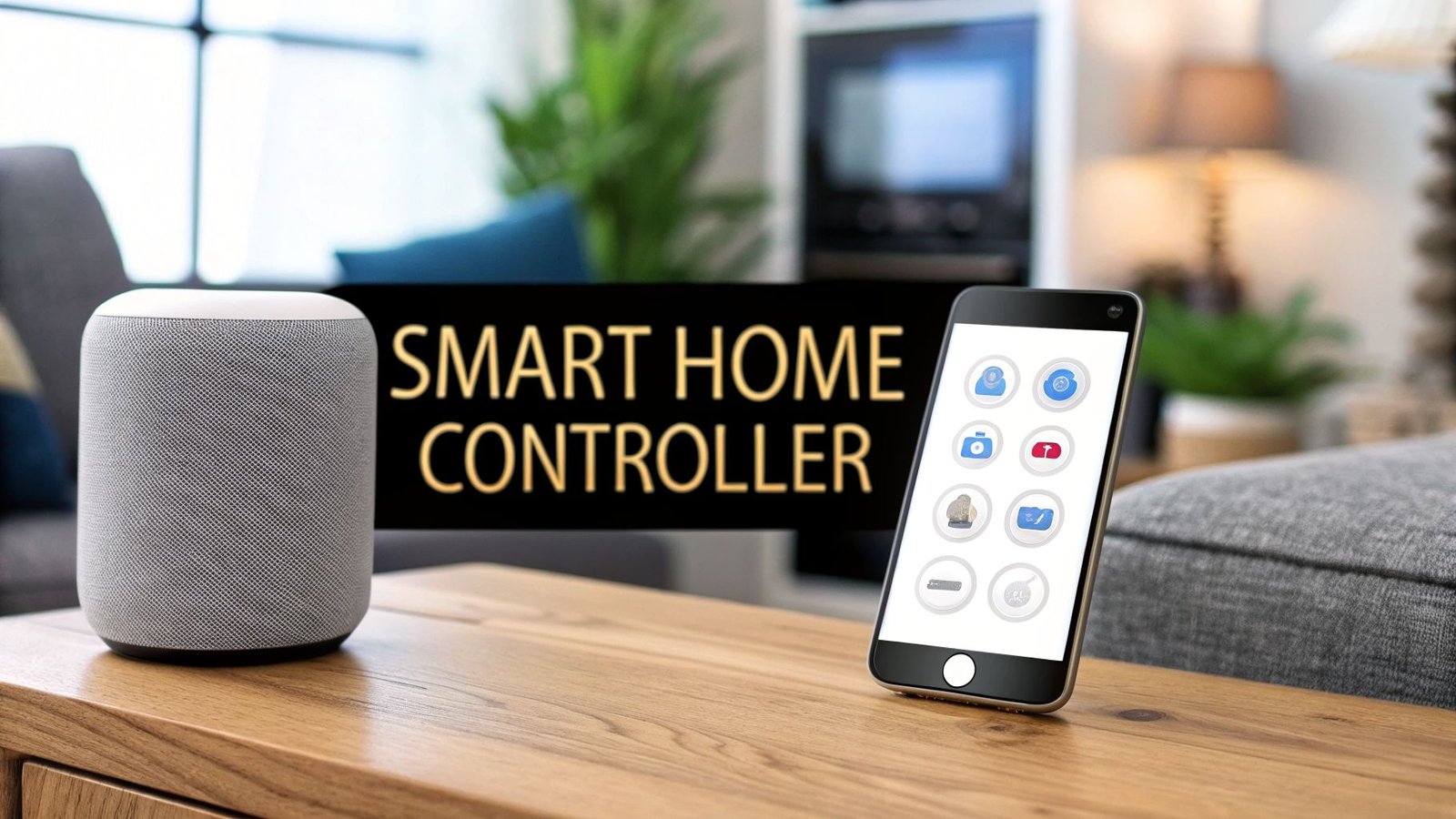
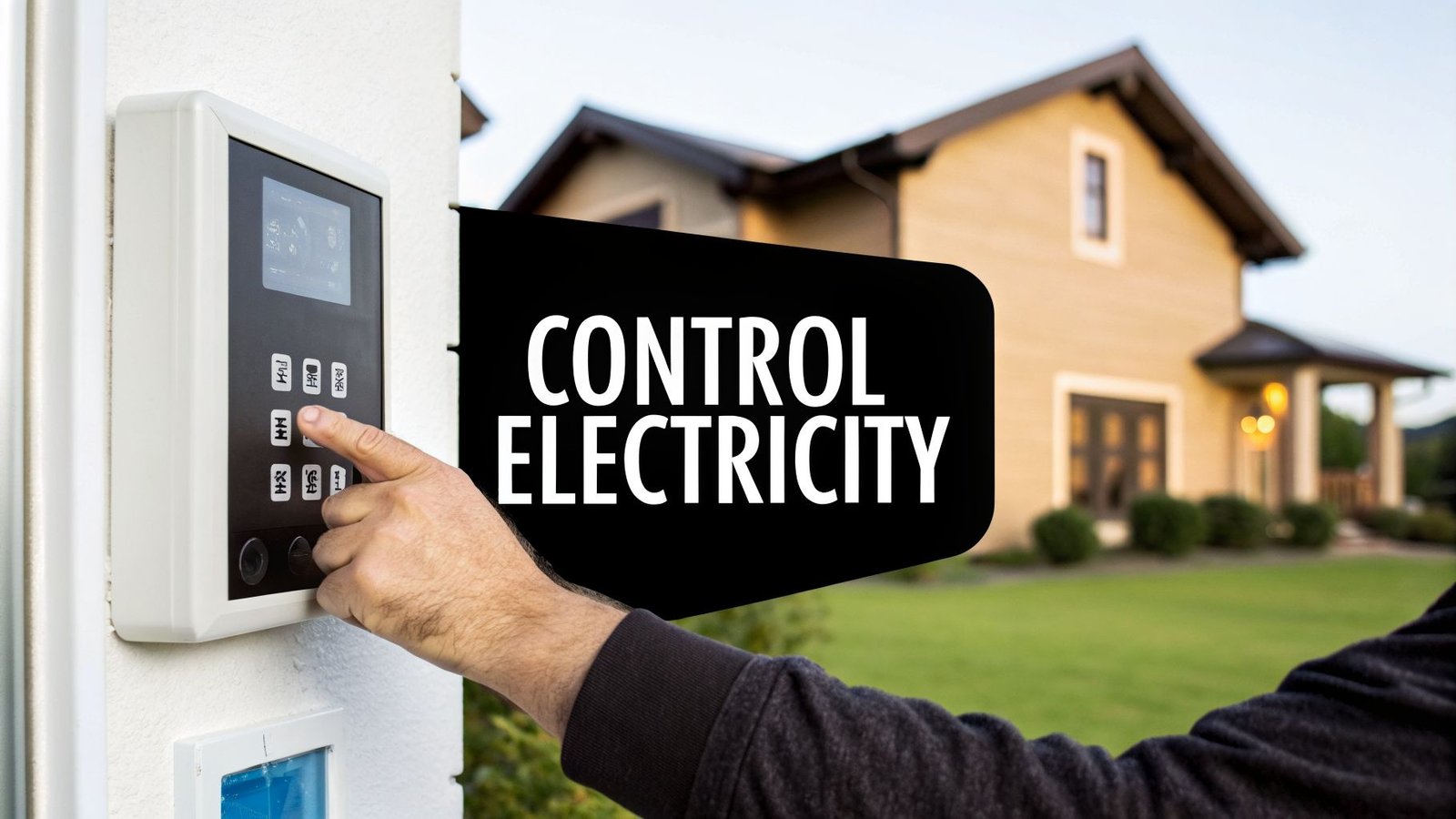


Leave a Reply