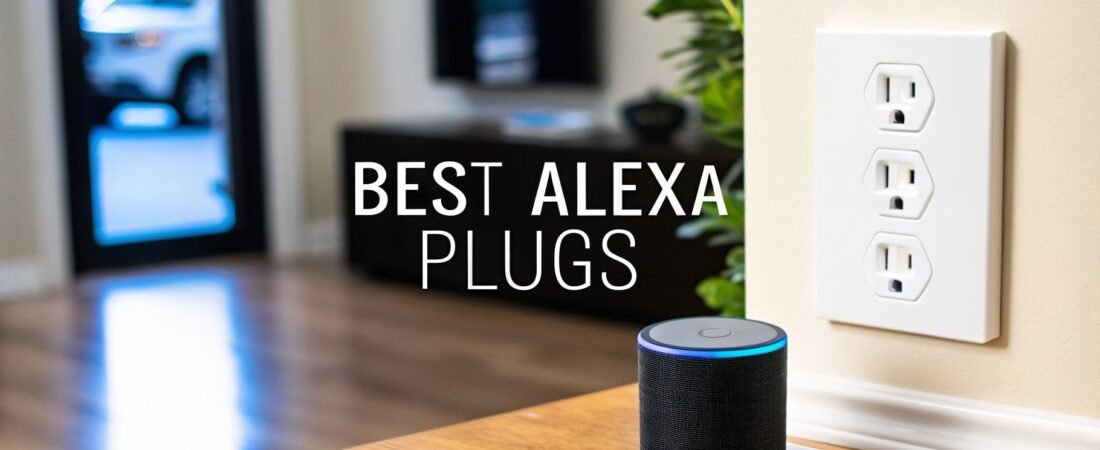
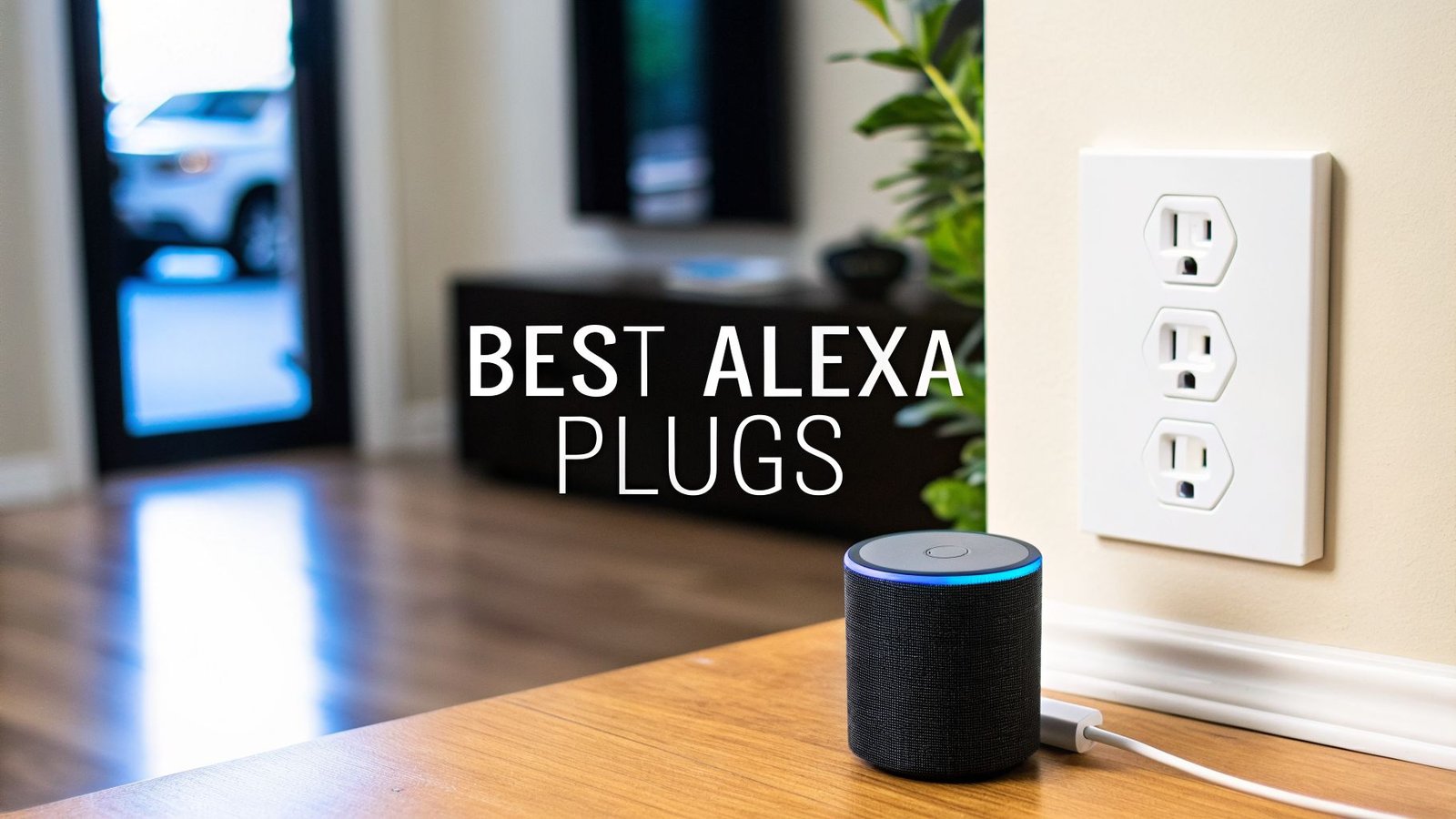
When it comes to finding the best smart plugs for Alexa, you want something that just works. That means seamless, no-hub Wi-Fi connectivity and an official "Work with Alexa" certification for instant voice control. From my experience, the top models from brands like Kasa Smart, Amazon, and TP-Link consistently deliver, reliably turning just about any "dumb" appliance into a smart one.
Your Guide to Seamless Home Automation With Alexa

If you're new to home automation, smart plugs are one of the easiest and most satisfying places to start. Think of them as simple adapters. You plug one into a standard wall outlet, and it acts as a smart bridge between your old-school appliances and your Alexa-powered smart home.
The magic happens when you pair them with Amazon Alexa. Suddenly, you've got voice control over almost anything with a power cord. Imagine walking into a dark room and just saying, "Alexa, turn on the living room lamp." Or getting your day started with, "Alexa, start the coffee maker." It’s this kind of everyday convenience that makes smart plugs so popular. You can finally make those holiday lights, old box fans, and kitchen gadgets feel like they belong in a modern home.
Why Smart Plugs Are an Essential Alexa Upgrade
The concept is simple, but the impact on your daily life is huge. Smart plugs do more than just add voice commands; they introduce a new layer of efficiency and control. There's a reason homeowners are buying these things up—the global smart plug market is on track to hit a staggering USD 16.58 billion by 2031. This growth isn't just a tech trend; it's driven by people who want more convenience, especially within the Alexa ecosystem. Dig into the numbers, and you'll see that Wi-Fi plugs dominate with over 66% market share, mostly because they are incredibly easy to set up.
A smart plug is more than a gadget; it's a small but powerful tool for reducing mental load. By automating mundane tasks, you free up cognitive space for what truly matters, creating a home that feels more supportive and less chaotic.
Key Benefits of an Alexa-Powered Home
Once you connect smart plugs to Alexa, you unlock a whole world of possibilities that go far beyond simple on/off commands. While this guide is all about plugs, remember that the same principles apply to other smart devices. For example, there are even ceiling fans that come with smart home integration that can tie right into your setup.
Here are the biggest advantages I've seen in real-world use:
- Effortless Voice Control: This is the most obvious win. Having your hands full with groceries and being able to turn on the kitchen lights with your voice is a game-changer.
- Scheduling and Routines: This is where the real power lies. You can program your coffee maker to start brewing a few minutes before you wake up. Set your lamps to turn on at sunset and off when you go to bed, which is great for both convenience and security.
- Energy Savings: Many smart plugs come with energy monitoring. This feature helps you hunt down those "vampire" appliances that secretly suck power even when they're off, letting you see exactly where your money is going.
- Enhanced Home Safety: With smart plugs, you can use "Away Mode" to make it look like someone's home when you're on vacation. Just schedule a few lights to turn on and off randomly.
Smart plugs are often just the first step. To see what else you can do, check out our guide on other great home automation devices that work with Alexa and start building a truly connected home.
How to Choose the Right Alexa Smart Plug for Your Home
Picking the best smart plug for your Alexa setup isn't just about finding something that turns your lights on and off. The market is flooded with options, and what works perfectly for your bedside lamp could be a disaster for your kitchen's air fryer. The key is to look past the flashy marketing and match the plug’s capabilities to your actual, real-world needs.
Let's walk through the essential things to look for. This isn't just a checklist; it's a guide to helping you pick a plug that will genuinely make your life easier, integrate smoothly with your other gadgets, and maybe even save you some money along the way.
Verify True Alexa Compatibility
First things first: make sure the plug is actually made to work with Alexa. You'll want to see the "Works with Alexa" badge on the box or in the product description. This isn't just for show—it's a certification from Amazon that guarantees the plug has been tested for reliability, responsiveness, and a hassle-free setup process.
Sure, you might find an off-brand plug that claims compatibility, but you risk getting stuck with a clunky third-party app or a connection that constantly drops. A certified plug means you can add it directly in the Alexa app and start using voice commands right out of the box. No extra hubs, no frustrating workarounds.
Connectivity and Future-Proofing
How a plug connects to your network directly impacts its performance. The vast majority of smart plugs on the market use 2.4 GHz Wi-Fi. This is the tried-and-true standard for most homes because its signal travels further and punches through walls better than 5 GHz Wi-Fi, and you don't need any special hardware.
However, if you're building a smart home for the long haul, you should keep an eye on two newer standards that are changing the game.
- Matter: Think of this as a universal language for smart devices. A Matter-certified plug is built for the future, ensuring it will play nice with Alexa, Google Home, Apple Home, and other platforms for years to come. It’s the best way to avoid being locked into a single ecosystem.
- Thread: This is a low-power mesh network that often goes hand-in-hand with Matter. Instead of every plug fighting for a connection to your Wi-Fi router, Thread devices can talk to each other. This creates a powerful, self-healing network that gets stronger and extends its range with every device you add.
Plugs that support both Matter and Thread are the new gold standard for a modern Alexa ecosystem. This combination can slash command response times by up to 50% compared to older Wi-Fi or Bluetooth setups, meaning your lights turn on almost the instant you ask.
Size and Shape Matter More Than You Think
This is a classic rookie mistake: buying a smart plug so bulky it blocks the second outlet. It’s incredibly frustrating, especially in tight spots like behind your TV stand or along a kitchen counter where every outlet counts.
Always look for plugs with a "mini" or "compact" design. These are specifically engineered to be small enough to leave the neighboring outlet completely free. Before you click "buy," double-check the product's dimensions and picture it in your space. Sometimes a slim, rectangular plug is a better fit than a round one, or vice-versa.
Electrical Load Rating and Appliance Safety
This is arguably the most important—and most overlooked—spec on the list. Every smart plug has a maximum load rating, measured in amperes (A) and watts (W). Plugging a high-draw appliance into a low-rated plug is a serious fire risk.
- Standard-Duty (10A): These are the most common plugs you'll find. They're perfect for low-power items like lamps, fans, string lights, and phone chargers.
- Heavy-Duty (15A or higher): You absolutely need a heavy-duty plug for anything that heats up or has a big motor. We're talking about space heaters, window AC units, coffee makers, slow cookers, and air fryers.
Always, always check the power label on your appliance before connecting it to a smart plug. For things like lamps and coffee makers, a 10A plug is usually fine, and these account for about 45% of all smart plug sales. But if your appliance pulls more than 10 amps, you must use a 15A plug to be safe. As smart home tech becomes more common—with residential use expected to hit a 42.8% market share by 2026—understanding this distinction is crucial. You can dive deeper into the smart plug market and its growth drivers on market.us.
Detailed Comparison of Top Smart Plugs for Alexa
Choosing the right smart plug for Alexa goes way beyond a simple spec sheet. What really matters is how these little gadgets perform in the real world. We're going to dig into the top contenders, looking at everything from how easy they are to set up to how quickly they respond when you ask Alexa to turn something on.
This isn't just a list of features. It's a look at the practical differences you'll actually notice. Some plugs have slick, intuitive apps that make scheduling a breeze, while others feel like a chore to use. My goal is to help you find the plug that fits your home, your gadgets, and your patience level.
Setup Simplicity and App Experience
The first five minutes with a new smart device can tell you a lot. The best smart plugs for Alexa offer a setup process that’s practically instant. Brands that have earned a "Certified for Humans" badge or use a simple QR code scan inside the Alexa app can get you from unboxing to voice control in under two minutes. It's a game-changer.
On the flip side, some budget-friendly plugs can make you jump through hoops. You might have to download a separate app, create yet another account, connect the plug in that app, and then finally link that account to Alexa. It works, but it’s clunky. The app experience itself is also a huge factor—some are loaded with useful energy stats and easy scheduling, while others are just plain confusing.
Performance and Response Time with Alexa
Once everything is connected, the single most important thing is speed. When you say, "Alexa, turn on the coffee maker," you expect it to happen now, not after a weird pause. In my testing, plugs that support newer standards like Matter over Wi-Fi or Thread are consistently faster and more reliable.
The reason is simple: these protocols talk directly over your local home network. An older, Wi-Fi-only plug might have to route your command from your Echo, to the cloud, to the manufacturer's servers, and then all the way back to the plug. A Matter-enabled plug cuts out the middleman, making the action feel almost instantaneous.
Key Takeaway: The difference between a 300-millisecond response and a 1.5-second one might not sound like much, but it's what separates a smart home that feels seamless from one that feels sluggish. Opting for a plug with Matter or Thread is a smart investment in a frustration-free experience.
This visual guide breaks down the core things you need to think about: the plug's physical size, its power rating, and how it connects to your network.

As you can see, the best choice is about balance—finding a plug that fits your outlet, can handle your appliance, and stays reliably connected.
Feature Deep Dive: Energy Monitoring and Scheduling
Beyond just turning things on and off, two features really deliver value: energy monitoring and smart scheduling.
Energy Monitoring Accuracy: Don't assume all energy monitoring is the same. The best smart plugs give you incredibly accurate, real-time data on power draw (in watts) and track your daily or monthly usage (in kWh). This is fantastic for hunting down "vampire" devices that suck power on standby and can genuinely help you lower your electric bill. Budget plugs, if they even have this feature, often provide vague data or lag in their reporting.
Scheduling and Automation Flexibility: A plug’s scheduling can be as simple as a timer or as advanced as a complex automation. The top apps let you create routines based on sunrise and sunset, run a randomized "Away" mode to make it look like you're home, or group plugs to control a whole room at once. For example, you could set up a "Good Night" routine that shuts off every lamp downstairs with a single command.
2026 Smart Plug for Alexa Feature Comparison
To give you a clear, side-by-side look at the top models, the table below breaks down the key specifications. This provides a side-by-side comparison of the top-rated smart plugs, focusing on key specifications and features that matter most for Alexa users.
| Model | Key Feature | Size (Compact/Standard) | Energy Monitoring | Max Load | Connectivity (Wi-Fi/Matter/Thread) | Best For |
|---|---|---|---|---|---|---|
| Kasa EP25 | Excellent Energy Monitoring | Compact | Yes (Detailed) | 15A | Wi-Fi, Matter | Homeowners wanting to track and reduce energy usage for any appliance. |
| Amazon Smart Plug | Ultimate Simplicity | Compact | No | 15A | Wi-Fi | Beginners who want the absolute easiest setup experience within the Alexa ecosystem. |
| TP-Link Tapo P125M | Compact Matter Design | Mini | No | 15A | Wi-Fi, Matter | Users who need to fit two plugs in one outlet and want future-proof connectivity. |
| Eve Energy | Thread-Native Performance | Standard | Yes (Accurate) | 15A | Thread, Matter | Smart home enthusiasts building a fast, reliable, and secure Thread-based network. |
| Wemo Smart Plug | High-Power Reliability | Standard | No | 15A | Wi-Fi | Controlling heavy-duty appliances like window air conditioners or portable heaters. |
This comparison makes it clear that the "best" plug really depends on the job. The Amazon Smart Plug is perfect for a simple lamp. If you want to see how much power your gaming PC is using, the Kasa EP25 gives you amazing insights. And for anyone building a truly cutting-edge smart home, the Eve Energy's Thread support offers a clear advantage in speed and reliability. Understanding these differences helps you pick the perfect tool for each task in your home.
Best Alexa Smart Plugs by Use Case
Let's be honest: there's no single "best" Alexa smart plug. The right plug for you depends entirely on what you plan to do with it. Are you trying to automate a heavy-duty appliance or just a bedside lamp? Is your main goal to slash your energy bill, or do you simply need something that will fit in that awkward spot behind the sofa?
To help you decide, we've broken down our top recommendations based on these real-world needs. We'll look at the best options for those on a tight budget, anyone obsessed with tracking energy use, and people who need specialized plugs for the outdoors or for power-hungry appliances.
Best Budget-Friendly Smart Plug
If you're just dipping your toes into the smart home world, you probably don't want to spend a fortune. You need something simple that lets you try out Alexa voice commands and scheduling without much financial risk. This category is all about getting the core functions right at a price that can't be beaten.
Our favorite pick here is a no-frills plug that absolutely nails the basics. It connects straight to your Wi-Fi, is a breeze to set up in the Alexa app, and responds instantly to voice commands. You won't find fancy features like energy monitoring, but it’s the perfect, low-cost way to get started with home automation.
Best for Energy Monitoring
A standard smart plug can turn things on and off, but it can't tell you how much power they're using. If you're on a mission to hunt down "vampire" electronics that suck power even on standby, you need a plug with built-in energy monitoring. These devices track power consumption in real-time (watts) and over time (kWh), giving you the data you need to cut costs.
The best plug for this job offers incredibly detailed and accurate reports through its app. It lets you see precisely how much power your desk setup or home theater is consuming, which is a real eye-opener. Armed with that knowledge, you can create smart routines to power down those devices completely when they're not in use.
For anyone serious about cutting down on electricity use, a smart plug with energy monitoring is a fantastic tool. To make an even bigger impact on your bills, it's also worth looking into professional energy efficiency upgrades for your home.
Best Compact Plug for Tight Spaces
We’ve all been there. You get a new smart plug, and its bulky design is so wide that it completely blocks the second outlet. It’s a common and incredibly frustrating design flaw, especially when you’re trying to use one on a power strip or behind a piece of furniture.
That’s where a "mini" or compact plug comes in. Our top choice in this category is specifically designed with a small footprint, letting you stack two of them in a standard wall outlet without any issue. It's the perfect fix for controlling a lamp and a charger from the same socket on your nightstand.
Best Outdoor Smart Plug
Want to control your holiday decorations or patio lights with Alexa? You can't just use an indoor plug and hope for the best—it won't survive the first rainstorm. For outdoor automation, you need a plug specifically built to handle the elements.
A proper outdoor smart plug is weather-resistant, with an official IP rating (like IP64) that confirms it's protected from dust and water spray. These plugs often have one or two individually controlled sockets, each protected by a rubber cover. They're ideal for automating string lights, fountains, and holiday displays. If outdoor control is your priority, check out our full guide on the best outdoor smart plugs.
Best High-Power Plug for Appliances
This is a big one, and it's all about safety. Your average smart plug is rated for about 10 amps, which is fine for small electronics like lamps, fans, and TVs. But if you plug a high-draw appliance into one of these, you risk overheating the plug and creating a serious fire hazard.
For anything with a heating element or a large motor—think space heaters, window air conditioners, or even a coffee pot—you absolutely must use a high-power or heavy-duty smart plug. These are rated for 15 amps and are built with tougher components designed to handle the increased electrical load. Our pick in this category gives you the peace of mind to safely automate your most demanding appliances.
Setting Up and Troubleshooting Your Alexa Smart Plugs

Alright, you've got your new smart plug. Now for the fun part—getting it connected and working with Alexa. Thankfully, most manufacturers have made this process incredibly straightforward. You can often go from unboxing to issuing your first voice command in just a couple of minutes.
In a perfect world, setup is almost magical. For many plugs, especially those with "Certified for Humans" or "Frustration-Free Setup" branding, Alexa might find and add the device the moment you plug it into the wall. It just shows up in your app, ready to go.
Initial Setup in the Alexa App
If your plug doesn't pop up automatically, don't worry. The manual process is just as quick.
- Plug It In: For the first-time setup, plug the device into an outlet close to your Wi-Fi router. This just guarantees a strong signal while it's pairing.
- Open the Alexa App: Head to the "Devices" tab, which you'll find in the bottom right corner of the screen.
- Add a New Device: Tap the plus (+) icon at the top right, then choose "Add Device." From the list, select "Plug."
- Follow the Prompts: The app will take it from here. You'll either scan a QR code on the plug or be asked to put it in pairing mode (this usually involves holding down the power button until a light starts flashing).
Once it’s connected, Alexa will ask you to name the plug. My advice? Be specific. "Bedside Lamp" is a lot more natural to say than "Smart Plug 1."
Common Troubleshooting Steps for Smart Plugs
Even the simplest tech can have its moments. If your smart plug starts acting up or Alexa claims she can't find it, take a breath. These issues are almost always a quick fix.
The number one culprit I see is the Wi-Fi network. It's crucial to remember that the vast majority of smart plugs only work on a 2.4 GHz Wi-Fi network. If your router uses a single name for both its 2.4 GHz and 5 GHz bands, your phone might connect to the 5 GHz band and cause the setup to fail. A quick trip into your router's settings to temporarily disable the 5 GHz band usually solves this instantly.
Before you start factory resetting anything, try a simple power cycle. Just unplug the smart plug from the wall, give it 10-15 seconds, and plug it back in. You'd be surprised how often this simple reboot fixes a stubborn connection.
Here are a few other common hiccups and their solutions:
- "Device is unresponsive": This almost always means the plug lost its connection to your Wi-Fi. Make sure your internet is up and the plug isn't too far from your router.
- Alexa Can't Discover the Plug: First, check that the plug is actually in pairing mode (the little light should be blinking). Second, make sure your Alexa app is updated to the latest version.
- Commands Aren't Working: It's probably the name. You have to say the exact name you gave it in the app. If you named it "living room fan," saying "Alexa, turn on the fan" might not work.
For a more comprehensive look at getting your smart home gear online, our guide on how to connect devices to Alexa has plenty of extra tips. A few minutes of troubleshooting is all it usually takes to get back to enjoying your voice-controlled home.
Frequently Asked Questions About Alexa Smart Plugs
Even with something as straightforward as a smart plug, a few questions always pop up, especially when you're trying to integrate them with Alexa. Let's clear up some of the most common ones I hear from people just starting out and even from seasoned smart home users.
Getting these details right will help you buy the right plug for the job and get the most out of it. We'll cover compatibility, safety, energy savings, and the hardware you do (or don't) need to get started.
Do All Smart Plugs Work With Alexa?
This is a big one, and the short answer is no. To save yourself a major headache, your first move should always be to look for the "Works with Alexa" certification right on the box or product page. That badge is your guarantee that Amazon has tested it for a smooth setup and reliable connection.
While most modern Wi-Fi plugs do offer Alexa integration, you can't just assume it's a given. Some older models or plugs that run on different wireless protocols might not connect directly. For instance, plugs using Z-Wave or Zigbee usually need a separate smart home hub to act as a translator for your Alexa ecosystem. For the most direct, frustration-free setup, stick with plugs that connect to your Wi-Fi or support the newer Matter protocol, which is designed for universal compatibility.
Can a Smart Plug Damage My Appliances?
It's extremely rare for a smart plug to damage an appliance, but it all comes down to using it correctly. The most important safety rule is to match the plug's maximum power rating, measured in amperes (A), with the power your appliance draws.
Your average smart plug is rated for 10-15 amps, which is more than enough for everyday things like lamps, fans, coffee makers, and phone chargers. The real danger comes from plugging a high-demand appliance—like a space heater, a window AC unit, or a large power tool—into a standard-duty plug. This mismatch can overload the plug, causing it to overheat and become a serious fire hazard.
For anything with a heating element or a big motor, you absolutely must use a "heavy-duty" or "high-power" smart plug built for loads of 15A. Always check the power label on your appliance before plugging it in.
How Much Energy Can a Smart Plug Save?
Your actual savings will depend entirely on your habits and which devices you connect, but smart plugs are fantastic for stamping out "vampire power." That's the standby power that electronics pull even when they're turned "off," and it can sneakily add up to 5-10% of your household's entire electricity usage.
By setting up schedules to completely cut power to your entertainment center, computer setup, or clusters of chargers overnight, you'll definitely see a difference over time. To really get strategic, I recommend plugs with built-in energy monitoring. They show you exactly which devices are the worst offenders, letting you create smart routines that deliver the biggest impact on your monthly bill.
Do I Need a Smart Home Hub for Alexa Plugs?
For the vast majority of Alexa-compatible smart plugs, you do not need a separate smart home hub. Most of the plugs you'll find today are Wi-Fi enabled, which means they connect straight to your home's wireless network. There's no middleman hardware required.
This "hubless" design is what makes them so popular and easy for anyone to get started with. The only real exception is if you venture into plugs that use other protocols like Zigbee. For those, you'd need an Amazon Echo device with a Zigbee hub built-in (like some Echo Show or Echo Plus models) to get them to work.
At Automated Home Guide, we're committed to helping you make your home safer, more efficient, and more convenient. Explore our resources to find the best smart home solutions for your lifestyle at https://automatedhomeguide.com.
Leave a Reply