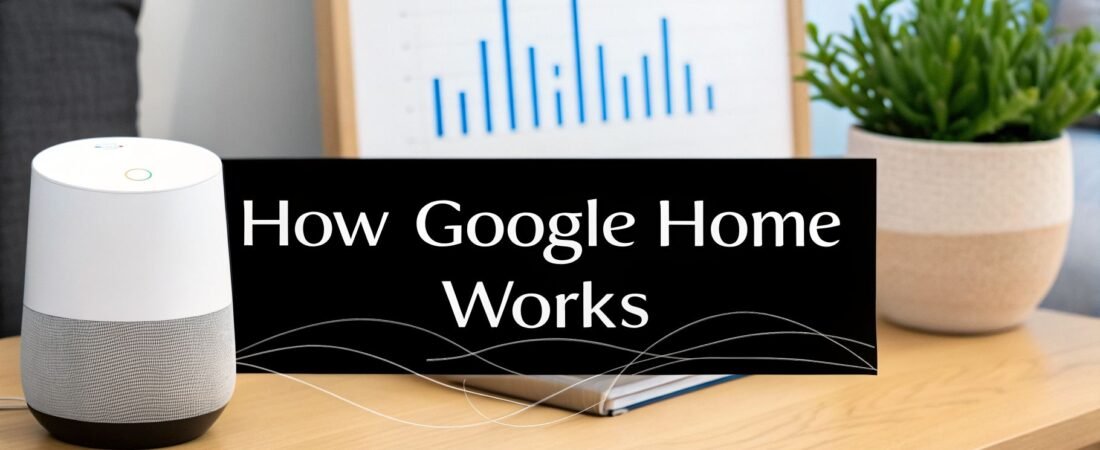
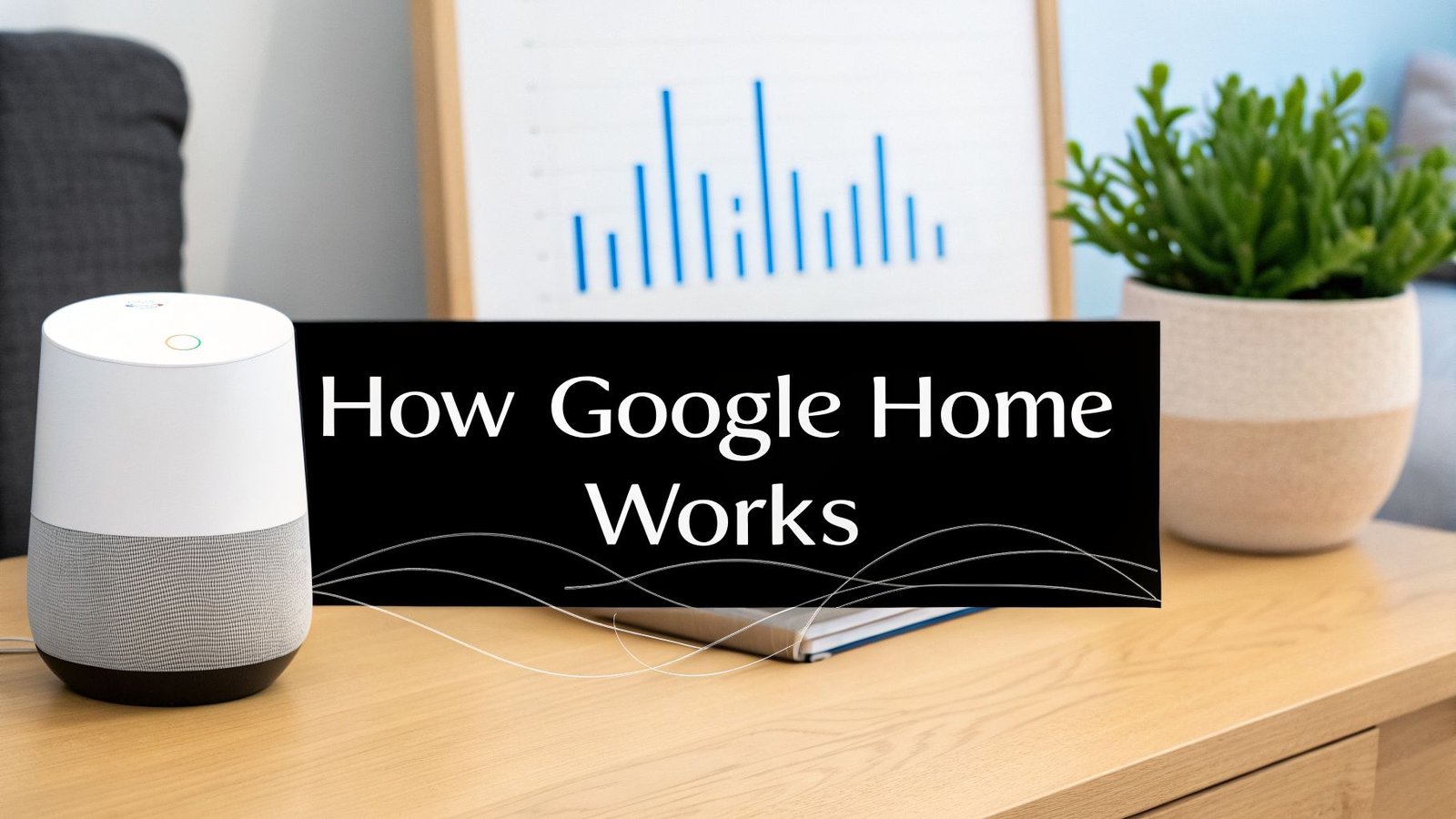
At its heart, the way a Google Home device works boils down to a simple, three-step dance: Listen, Think, and Act. It’s a lightning-fast cycle that feels almost like magic, but it’s really just a clever sequence of events that turns your voice into action in a matter of seconds.
The 3 Steps Behind Every Voice Command
Ever ask your Google Nest for the weather and wonder how it answers so quickly? It’s not magic, but a beautifully engineered process. Once you understand what’s happening behind the scenes, the device stops being a mysterious black box and becomes a tool you can truly appreciate.
Every single thing your speaker does, from playing a song to answering a trivia question, follows this core three-phase operation.
Step 1: Listen For Your Command
First things first, the device has to hear you. Your Google Home is equipped with far-field microphones specifically designed to pick your voice out from across the room, even with the TV on. But don't worry—it’s not recording everything 24/7.
Think of it as being in a low-power, passive state, just waiting for one thing: the "hotword." It’s like a doorman at an exclusive club who ignores the street noise but snaps to attention the moment they hear the secret password. For your speaker, that password is "Hey Google" or "Okay Google." Only after it detects that phrase locally on the device does it "wake up" and start actively recording your actual command.
Step 2: Think and Process
With your command captured, the "Think" phase kicks in. A small, compressed audio file of your request is sent securely over your Wi-Fi to Google's massive data centers. This is where the real heavy lifting happens and Google Assistant—the AI brain of the operation—gets to work.
In the cloud, your speech is instantly converted to text. The AI then analyzes the words to figure out what you actually want (your "intent") and searches its vast knowledge base for the right answer or the correct action to take. It’s like having a super-librarian who understands your question perfectly and finds the exact right book in a library the size of the internet.
This entire Listen, Think, and Act flow is what makes your smart speaker work.

The simple graphic above shows how your command travels from a sound wave in your room, to the cloud for processing, and back to your speaker as a finished task.
Step 3: Act on Your Request
Finally, we get to the "Act" phase. Once Google's cloud has the right response, it sends a tiny, efficient data packet back to your device at home, telling it exactly what to do.
If you asked a question, this is where the system uses sophisticated text to speech (TTS) technology to read the answer aloud in a natural-sounding voice. If you wanted to hear a song, it gets the signal to start streaming from Spotify or YouTube Music. If you asked it to dim your smart lights, it sends that command across your local network to the lightbulb itself. This closes the loop and brings your request to life.
For a quick overview, here's how those three steps come together.
Google Home's 3-Step Operation Cycle
| Phase | What Happens | Analogy |
|---|---|---|
| 1. Listen | The device passively waits for the "Hey Google" hotword, then records your command. | A doorman waiting for a specific password before opening the door. |
| 2. Think | Your voice command is sent to Google's cloud, transcribed, and analyzed by the AI. | A librarian who understands your question and finds the perfect answer. |
| 3. Act | The cloud sends instructions back to your device to speak, play music, or control a smart device. | The librarian hands you the right book or gives you the specific information you asked for. |
This entire cycle, from the moment you speak to the moment you get a response, happens so fast it feels seamless—and that's entirely by design.
Exploring the Hardware and Software Inside Your Device
So, how does your Google Home actually work? It’s easy to think of it as a single, self-contained gadget on your countertop, but the real magic comes from a clever partnership between the physical device and the massive intelligence of Google's cloud.
The "brain" of the entire operation isn't inside the speaker at all. It's Google Assistant, a powerful AI that lives in Google's data centers. This cloud-based design is brilliant because it means your device gets smarter every single day without you having to do a thing. Google is constantly updating the Assistant, so its knowledge is always growing and its capabilities are always expanding.
This separation of the physical device from its digital brain allows a small, affordable speaker to tap into nearly limitless computing power.
The On-Device and Cloud Partnership
Your Google Home device splits its duties between what it does locally and what it sends to the cloud. Think of it like a front-desk receptionist working with a huge back-office team.
The receptionist—your device—has one main job: listening for the "Hey Google" hotword. This hotword detection happens entirely on the device itself. A small, super-efficient chip is always passively listening for that specific phrase, but it doesn't send any audio to Google until it hears it. This is a crucial design choice for privacy, ensuring your conversations stay private until you intentionally summon the Assistant.
Once you say the magic words, the back-office team—Google Assistant in the cloud—springs into action. It takes on the heavy lifting of figuring out what you said and how to respond. This synergy is what makes the whole system feel both instant and incredibly intelligent.
The Hardware That Makes It All Work
Beyond the smart software, the physical hardware is engineered to make your interactions feel completely natural. These components are what turn a simple speaker into a truly useful smart home hub.
Far-Field Microphones: Your device is packed with two or more highly sensitive microphones. They use a technique called beamforming to zero in on your voice while tuning out background noise like the TV or a barking dog. It’s how it can hear you clearly from across the room.
LED Indicator Lights: Those colorful little dots on top aren't just for looks; they’re a vital communication tool. They give you visual cues, letting you know when the device is listening (lights on), processing your request (lights spinning), or when the mic is muted for privacy (lights turn orange).
Touch-Sensitive Surface: The top of the speaker is often a capacitive touch surface. It lets you do things like adjust the volume, play or pause music, or dismiss an alarm with a simple tap, giving you a silent way to interact when you don't want to use your voice.
While these physical features create a great user experience, the real reason for Google Home's widespread adoption lies in its software and massive ecosystem. The smart home industry is exploding, with some projections showing the global market could hit $1,404.59 billion by 2034. Here in the U.S., Google Assistant is a dominant force, with an estimated 85.4 million users as of 2023.
The Power of the Cloud: Because Google Assistant operates from the cloud, it can connect to an ecosystem of over 50,000 smart devices from thousands of different brands. When you say, "Hey Google, turn on the living room lights," the Assistant knows exactly how to talk to your specific Philips Hue or LIFX bulbs over the internet.
This incredible compatibility is a huge selling point for homeowners building a connected home. Of course, picking the right starting point is key. If you're comparing your options, you might find our guide on finding the best smart speakers for your home helpful.
Ultimately, it’s this seamless blend of local hardware for listening and powerful cloud software for thinking that makes Google Home such a capable and user-friendly centerpiece for any modern home.
How Your Google Home Connects to the World
A smart speaker is only as smart as its connections. For your Google Home to pull off its daily magic—from answering trivia to dimming the lights—it juggles a few different wireless technologies behind the scenes. Getting a handle on these connections is the key to understanding how it all works so seamlessly.
The main workhorse here is Wi-Fi. You can think of it as the superhighway connecting your Google Home device to the internet. This link is non-negotiable; it's what allows the device to reach the Google Assistant brain in the cloud for just about everything you ask it to do.

Without a solid Wi-Fi connection, your speaker is little more than a paperweight. Every question, command, and music request has to travel from your device, through your router, to Google's servers, and back again. That’s why a stable home network is so crucial for a lag-free experience. If you find your network is struggling, our guide on how to choose a Wi-Fi router can help you get things up to speed.
Direct Device-to-Device Links With Bluetooth
Next up is Bluetooth, which handles the short-range, direct connections. Its most practical use is turning your Google Nest speaker into a standard Bluetooth speaker. You can pair your phone or laptop directly to it and stream audio from any app, even those that don't have built-in Google Cast support.
This is perfect for those times when a guest wants to play a song from their phone without jumping on your Wi-Fi, or you want to listen to a locally saved podcast. It's a simple, direct audio connection that acts as a fantastic backup plan.
Thread: The Future of Smart Home Connectivity
The real game-changer in newer Google Nest devices is Thread. If Wi-Fi is the main highway open to all internet traffic, think of Thread as a private, express lane built just for your smart home gadgets. It’s a low-power mesh networking technology designed specifically for devices like sensors, smart locks, and light bulbs.
In a Thread network, your devices talk directly to each other instead of all shouting at your Wi-Fi router. This creates a robust and self-healing "mesh," where every Thread-enabled device helps strengthen and extend the network's reach.
The real magic of Thread is its speed and rock-solid reliability. Because devices communicate locally, commands are executed almost instantly. When you tell Google to turn on the lights, it happens in a flash because the command doesn't need a round trip to the cloud.
This local communication also makes your entire system more resilient. If one smart plug in the mesh network happens to go offline, the signal simply finds another route to get where it needs to go.
A Quick Comparison
To make sense of it all, here’s a simple breakdown of how Wi-Fi, Bluetooth, and Thread each play a unique role in your smart home network.
Google Home Connectivity Protocols Compared
| Protocol | Primary Use Case | Key Benefit |
|---|---|---|
| Wi-Fi | Internet access for Google Assistant and streaming online media. | The essential bridge to cloud intelligence and services. |
| Bluetooth | Direct device-to-speaker audio streaming. | A quick and universal way to play audio from a phone or tablet. |
| Thread | Direct device-to-device communication for smart home gadgets. | Creates a fast, reliable, and self-healing local network. |
These three protocols aren't competing; they're a team. Your Google Home intelligently picks the right tool for the job, whether it's grabbing a weather forecast from the internet via Wi-Fi or instantly turning off a light via Thread.
As more devices embrace the universal smart home standard, Matter (which uses Thread as one of its primary networks), this local control will become the new normal. It’s paving the way for a future where smart devices from any brand can finally work together, all orchestrated by your Google Home.
Orchestrating Your Home with Integrations and Routines
Knowing how a Google Home device talks to the internet is only half the story. The real fun begins when you see it conduct an entire orchestra of smart devices, turning your house into a truly connected home.
This is where a simple smart speaker evolves from a gadget into a central command hub. It all hinges on the "Works with Google" program, which acts like a universal translator for thousands of different smart products.
Thanks to this program, you can buy a smart plug from one brand, smart bulbs from another, and a thermostat from a third, yet control them all from the same app or with a single voice command. They all speak the same language, and Google Assistant is the interpreter.
The Power of Routines
While controlling one device at a time is useful, you unlock the real potential of your smart home with Routines. Routines are custom automations that trigger a whole series of actions from just one command.
Think of it like this: instead of telling the violins, then the cellos, then the trumpets to play their parts individually, you simply tell the conductor to start the first movement. One command, a perfectly coordinated result. A "Movie Night" Routine can dim the lights, turn on the TV, and open Netflix all at once, saving you from fumbling with three separate commands.
Routines shift your mindset from controlling individual devices to managing entire scenarios. You start thinking in terms of activities—like waking up, leaving for work, or cooking dinner—and build automations that make your home work for you.
This is what turns a house full of smart gadgets into a genuine smart home. The Google Home app includes a few pre-built Routines to get you started, but building your own is how you can perfectly tailor your home to your life.
Building Your First Routine: A Step-by-Step Example
Let's walk through creating the classic "Good Morning" Routine. With one phrase, you can have your home ready for the day before your feet even hit the floor.
- Open the Google Home App: Head to the "Automations" tab at the bottom of the screen, then tap the "+" icon to start a new Routine.
- Add Your Starter: This is your trigger. Select "Voice command" and type in a few phrases you might use, like "Good morning" or "Time to get up."
- Add Your Actions: Now for the fun part. Tap "Add action" and choose what you want to happen. You can stack as many as you like.
- Adjust lights: Select your bedroom smart lights and have them gently fade on to 30% brightness.
- Adjust thermostat: Tell your smart thermostat to warm up to a comfortable 70°F.
- Get info and reminders: Have the Assistant read you today's weather forecast, your commute time, and your first calendar event.
- Play media: Finish the sequence by having it play the morning news or your favorite wake-up playlist.
- Save the Routine: Give everything a final look, hit save, and you're all set. The next morning, just say, "Hey Google, good morning," and watch it all happen automatically.
Practical Routine Ideas for Your Home
Once you get the hang of it, you'll start seeing opportunities for automation everywhere. The best approach is to think about the small, repetitive tasks you do every day. Here are a few popular ideas to get you started:
- "I'm Leaving" Routine: As you're heading out, this single command can turn off all the lights, lower the thermostat, and make sure your security system is armed.
- "Dinner Time" Routine: Set the mood by dimming the dining room lights, turning off the TV, and starting a relaxing dinner playlist.
- "Bedtime" Routine: A great way to wind down. This can turn off all the main lights, lock the front door, confirm your morning alarm is set, and play some ambient sleep sounds.
With a compatible ecosystem of over 50,000 smart devices, the possibilities are practically endless. By pairing the huge "Works with Google" library with the power of Routines, your Google Home device truly becomes the brain of your smart home.
Managing Your Privacy and Personal Data

Let's be honest: the idea of placing an always-on microphone in your living room can feel a little unnerving. It's probably the biggest hesitation people have, and it brings up some really important questions about data and privacy. A huge part of understanding how does google home operate is getting a handle on the controls you have over your information.
The most common fear is that your speaker is recording every conversation. The good news is that's not how it works. Your device is essentially in a standby mode, listening locally for just one thing: the "Hey Google" or "Okay Google" hotword. It only starts sending audio to Google’s servers after you’ve intentionally woken it up.
Taking Control of the Microphone
For those times when you want zero ambiguity, Google built in a physical solution. Every Google Home and Nest speaker has a physical mute switch on the device itself.
When you slide that switch, it physically cuts power to the microphones. This isn't a software setting that could be overridden; it's a hardware-level disconnect. You'll see orange or red lights turn on, giving you an immediate visual confirmation that it’s impossible for the device to hear anything. It’s a simple, effective way to get total peace of mind.
Your Voice History in Your Hands
When you do interact with the Assistant, you have complete transparency and control over what happens to that voice data. Google does save your commands to help personalize the service and improve its voice recognition, but this history belongs to you.
You can manage all of it right from the Google Home app or your Google Account settings. From there, you have the power to:
- Review past commands: See a running list of every question you've asked.
- Listen to recordings: Hear the exact audio of your requests to understand what the Assistant heard.
- Delete your history: You can wipe individual recordings, an entire day's worth of activity, or all of it. You can even tell Google to automatically delete any activity older than 3, 18, or 36 months.
This puts you firmly in control of your data. Of course, securing your home involves more than one device. For broader strategies, take a look at our guide on essential IoT security best practices for your smart home.
Securing Your Personal Information with Voice Match
So, what's the point of Google collecting this data at all? It's primarily about making the Assistant smarter. Your voice commands help the AI understand different accents, dialects, and ways of speaking, which makes it more accurate for everyone. It also unlocks powerful personalization.
In a house with more than one person, a feature called Voice Match is an absolute must. By training the Assistant to recognize individual voices, you can protect your personal information from being shared with others.
When you ask for your calendar appointments or to play your favorite playlist, Voice Match verifies it's you before responding. If a guest or your child asks for "my schedule," the Assistant knows not to share your private details.
This clever bit of voice-based security means a shared device can still act as a truly personal assistant for everyone in the family, keeping private information safe and sound.
Troubleshooting Common Issues and Pro Tips
Sooner or later, even the best tech has a bad day. As you get the hang of how Google Home operates, you'll likely run into a few strange behaviors. The good news is that most of these little hiccups are surprisingly easy to sort out yourself.
Have you tried turning it off and on again? It's a cliché for a reason. If your speaker becomes unresponsive, drops its Wi-Fi connection, or suddenly won't talk to your smart lights, a quick reboot is your best first step. Unplug both the Google Home device and your Wi-Fi router for a full minute before plugging them back in. This gives their internal hardware a chance to properly reset.
Pro Tips to Get More Out of Your Speaker
Once you've got the basics down, you can start making your smart home work even better for you. It really comes down to understanding how your device "listens" and communicates.
1. Think About Speaker Placement
Where you put your speaker makes a huge difference. For the best voice recognition, find a central spot in the room, but keep it a few inches away from walls to avoid that muffled, booming sound. Also, try to keep it away from other sources of loud noise, like your TV's soundbar or a rattling air conditioner vent, which can easily drown out your voice.
2. Use Broadcast as a Home Intercom
The "Broadcast" feature is a genuine game-changer, especially for families. Just say, "Hey Google, broadcast 'dinner is ready,'" and your announcement will play on every single Google speaker in the house. It's the perfect way to get everyone's attention without having to shout up the stairs.
3. Build Smarter Routines
When you start building custom Routines, my advice is to keep it simple at first. Just think about a series of tasks you do every single day. One great trick is to add a small delay between commands (like, "wait 5 seconds") to give your devices time to catch up. This is especially helpful if a routine involves turning multiple smart lights on or off at once.
A good Routine should feel like it’s just simplifying something you were already doing. The goal is to automate a real-world sequence, saving you from a multi-step process you used to do by hand.
Creating Multi-Room Audio with Speaker Groups
One of the coolest things you can do is group multiple speakers together to play perfectly synchronized music throughout your home. This feature alone can turn a few scattered smart speakers into a true whole-home audio system.
Setting this up is incredibly easy right from the Google Home app:
- From the main device screen, tap the “+” icon.
- Choose the option to “Create speaker group.”
- Just check the boxes next to all the speakers you want to link together.
- Give your new group an intuitive name, like "All Speakers" or "Downstairs."
Once you hit save, you can say things like, "Hey Google, play my workout playlist on All Speakers," and the music will fire up everywhere. Mastering little tips like these is what takes you from being a basic user to a power user, making your smart home feel genuinely helpful.
Frequently Asked Questions About How Google Home Operates
Once you get the basics down, you’ll probably have a few more specific questions about how your Google Home works day-to-day. Let's walk through some of the most common ones that pop up.
Can Google Home Understand Different Accents and Languages?
Yes, and it’s gotten surprisingly good at it. Google has poured a massive amount of data into training the Assistant, so it can recognize a huge range of accents within the languages it supports. It’s always learning from real-world interactions, which means it gets better all the time.
For bilingual homes, you can even set up multiple languages in the Google Home app. This lets you and your family switch between them on the fly without ever touching a setting.
What Is the Difference Between Google Home and Google Assistant?
This is easily one of the most common points of confusion, but the distinction is pretty simple when you break it down.
- Google Home (or Nest): This is the hardware—the physical speaker sitting on your shelf. It's the microphones, the processor, and the lights.
- Google Assistant: This is the software "brain" that lives in Google's cloud. It’s the intelligence that actually understands what you're saying and finds the answer.
Think of your Google Home speaker as the vessel that gives you a direct line to the Assistant. The Assistant itself isn't tied to just that speaker; it's the same AI you find on your phone, your smart TV, and even in your car.
Does Google Home Work Without an Internet Connection?
For almost everything you want it to do, a Google Home device absolutely needs a stable Wi-Fi connection. Asking questions, controlling your smart lights, and streaming music all require it to reach out to the cloud.
That said, it isn't a complete paperweight offline. You can still use it as a basic Bluetooth speaker to play music directly from your phone. Just remember that its core smart features depend on that internet link. Without it, things can get messy, especially since Google Home relies so heavily on services like Google Calendar for routines and reminders. If you notice a disconnect, you might be troubleshooting Google Calendar sync issues to get things running smoothly again.
Ready to build a smarter, more efficient home? The Automated Home Guide provides expert reviews, in-depth guides, and practical tips to help you navigate the world of home automation. Visit us at https://automatedhomeguide.com to get started.
Leave a Reply