If you've ever looked at your water bill and wondered where it all went, you're not alone. The first step in learning how to reduce water usage at home isn't about making drastic sacrifices—it’s about playing detective. You need to figure out where your water is actually going.
For most of us, the culprits are hiding in plain sight: toilets, showers, faucets, the washing machine, and, of course, the garden hose. By zeroing in on these high-use areas, you can make a few smart changes that lead to some seriously significant savings.
Pinpointing Your Home's Biggest Water Wasters
Before you can start trimming your water bill, you need a baseline. It's tempting to think a little drip here or an extra-long shower there doesn't add up, but the numbers tell a different story. A few key fixtures and habits are almost always responsible for the lion's share of your water consumption.
This isn't about a complete lifestyle overhaul. Think of it more like a quick, strategic audit of your home. We're looking for the biggest offenders in your water budget so we can plug the leaks with simple, effective fixes.
To get a clear picture, let's break down the common sources of high water usage and some surprisingly easy ways to tackle them.
The table below highlights the usual suspects in most homes. It shows you where the water is going and gives you an immediate action plan to start saving.
Top Water Wasters and Quick Fixes at Home
| Water Source | Typical Usage | Quick Fix Solution | Potential Annual Savings |
|---|---|---|---|
| Toilets | 5-7 gallons per flush (older models) | Install a dual-flush converter or a new WaterSense-labeled toilet. | 13,000+ gallons |
| Showers | 2.5 gallons per minute (standard) | Swap your old showerhead for a low-flow model (under 2.0 GPM). | 2,700 gallons per person |
| Faucets | 2.2 gallons per minute | Install faucet aerators and turn off the tap when brushing teeth or scrubbing dishes. | 200+ gallons per month |
| Washing Machine | 40+ gallons per load (older models) | Wash only full loads and upgrade to an ENERGY STAR certified washer when it's time to replace. | 3,000+ gallons |
| Leaks | 1 drip per second | Check for silent toilet leaks with food coloring and repair dripping faucets immediately. | 3,000 gallons (from one faucet) |
Looking at this, it becomes pretty clear that small, targeted changes can have a massive impact. A single upgrade or habit shift can save thousands of gallons a year, which is great for both the environment and your wallet.
The Hidden Costs of Inefficiency
The real surprise for most people is how much water is wasted without them even noticing. That slow, quiet drip from a bathroom faucet? It’s not as innocent as it seems.
A single dripping faucet can waste up to 3,000 gallons (11,356 liters) of water annually. That’s enough to take more than 180 showers.
The financial hit from this kind of waste is often bigger than we think. In the US, the average family of four uses around 400 gallons of water per day. A huge portion of that is lost to outdated fixtures and unnoticed leaks—something the global surge in water demand makes even more critical.
This is where modern technology can be a game-changer. Smart leak detectors, for example, can spot a problem the moment it starts and even shut your water off automatically. These devices alone have been shown to cut household water waste by 20-30%.
Think of this as your starting point. By understanding exactly where your water is going, you're ready for the next step: conducting a full audit and implementing high-impact upgrades. The goal is to slash your water use in a way that feels effortless, proving that major savings are well within your reach.
Conducting a Data-Driven Home Water Audit
If you’re serious about cutting down your water bill, you need to stop guessing and start measuring. Guesswork—thinking a shorter shower here or a new faucet there will solve the problem—rarely makes a real impact. A proper home water audit is your roadmap, showing you exactly where every drop is going so you can zero in on the hidden leaks and inefficient fixtures that are quietly draining your bank account.
This isn't as intimidating as it sounds. Your audit starts with a tool you already have: your water meter. It's the single best source of truth for your home's water consumption.
Master Your Water Meter to Find Leaks
Your water meter is your secret weapon for hunting down silent leaks. I'm not talking about a dripping faucet you can hear from the next room, but the sneaky ones that can waste thousands of gallons without a trace. A running toilet, for example, can silently leak over 200 gallons per day. That adds up, fast.
Here’s a simple check I recommend to everyone. It takes just a little time and can save you a fortune.
- First, find your meter. It’s usually in a utility box by the curb or sometimes in a basement or utility closet.
- Next, make sure absolutely no water is being used. Turn off all faucets, the washing machine, the dishwasher, and any outdoor sprinklers.
- Now, look closely at the meter. Most have a small leak indicator (often a little triangle or star) that spins when water is flowing. If it's moving even slightly, you've got a leak somewhere.
If your meter doesn't have an indicator, just jot down the number on the dial. Wait an hour (without using any water!), then check it again. If the reading has gone up, you've confirmed a leak.
My Go-To Trick: The most common culprit for silent leaks is a bad toilet flapper. To check this, put a few drops of food coloring in the toilet tank (not the bowl). Wait about 15 minutes without flushing. If you see any color seeping into the bowl, you've found a leak that's siphoning water and money right down the drain.
Once you know a leak exists, you can play detective. Start by checking under sinks, behind the toilet, and around appliance hookups for any telltale signs of moisture. This turns a vague problem into a clear, fixable one.
This whole process—from identifying waste to fixing the problem and seeing the savings—is a simple, powerful cycle.

As you can see, it's a continuous loop of improvement that puts you in control of your utility bills.
Evaluate Your Fixtures and Appliances
Beyond active leaks, your audit needs to put a spotlight on any outdated hardware. If you live in an older home, chances are your fixtures were installed long before water conservation became a priority.
It's time to take inventory of the big water users:
- Toilets: Look for a manufacturing date, often stamped into the porcelain at the base of the toilet. If it was made before 1994, it could be using a staggering 3.5 to 7 gallons with every single flush. Modern, efficient toilets use 1.28 gallons or even less.
- Showerheads: This is an easy one. Just unscrew the showerhead and look for the flow rate, which is measured in gallons per minute (GPM). Federal standards now cap it at 2.5 GPM, but older models can be far thirstier.
- Faucets: Check your kitchen and bathroom faucets for their GPM stamp, too. A quick and inexpensive fix is to install a faucet aerator, which can easily reduce water flow by 30% or more without you even noticing a difference in pressure.
This approach is a lot like doing a home energy audit, where you systematically find waste and make targeted upgrades. If you're interested in that, you can find a ton of helpful info in our home energy audit checklist.
Embrace Smart Water Monitoring Technology
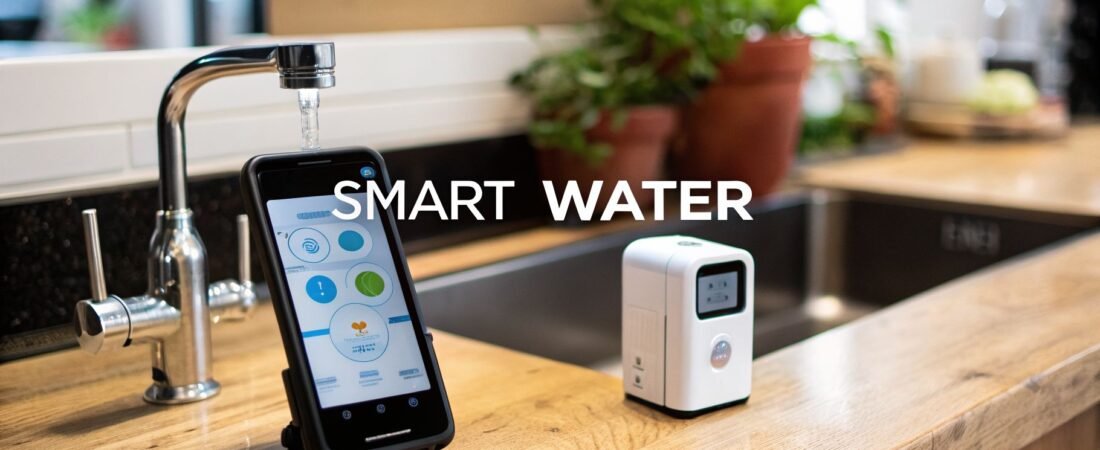
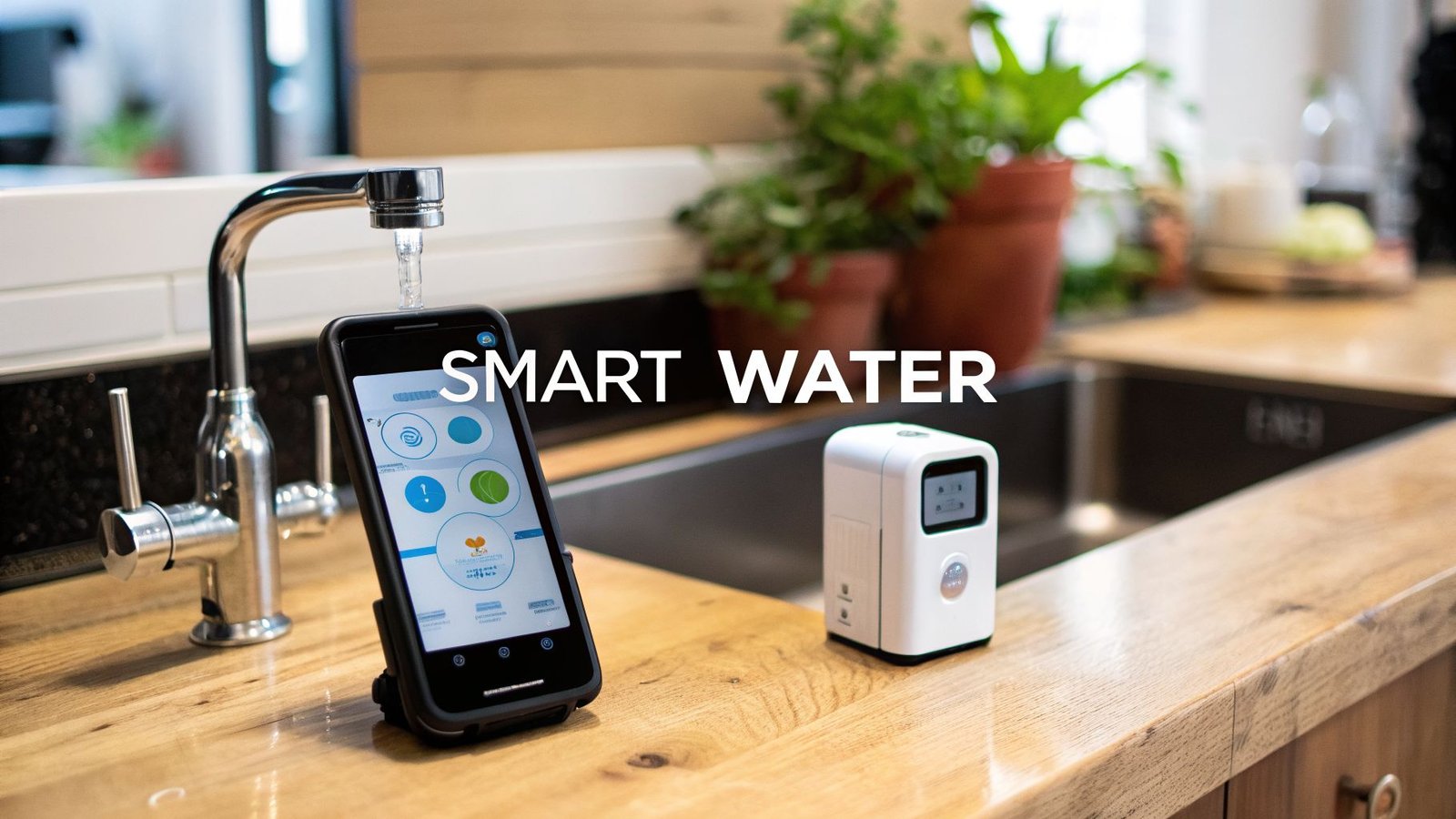
For those who really want to get granular with their data, a smart water monitor is the ultimate tool. Devices from trusted brands like Phyn and Moen install directly onto your main water line and connect to your Wi-Fi, giving you an incredible amount of insight right on your phone.
These monitors don't just track overall usage; they give you a real-time breakdown by fixture. You can see exactly how much water your morning shower used, what the dishwasher consumed, and how many gallons it took to water the lawn.
Even better, they provide powerful, proactive leak detection. By learning the unique water pressure "signature" of your home, these systems can tell the difference between a toilet flush and a tiny, persistent drip. If they detect a major pipe burst or a small, ongoing leak, you get an instant alert. Many even have an automatic shut-off feature, so you can stop a catastrophic flood from anywhere in the world. It’s a game-changer that moves you from reacting to problems to preventing them entirely.
Choosing High-Efficiency Fixtures and Appliances

Now that you've pinpointed where your home is guzzling the most water, it’s time for the satisfying part: making some smart upgrades. Swapping out old, inefficient fixtures and appliances is one of the single most effective strategies for cutting your water bill. Think of these not as expenses, but as investments that pay for themselves over and over again.
Your guiding star in this process should be the WaterSense label. This certification from the EPA is your guarantee that a product is at least 20% more water-efficient than its standard counterparts, all without sacrificing performance. It’s the easiest way to ensure you're getting real savings.
Rethink Your Toilets for Maximum Impact
If you’re looking for the biggest win, start with your toilets. It’s not the most glamorous upgrade, but it delivers the most dramatic results. Toilets are the undisputed champs of indoor water use, quietly accounting for nearly 30% of the average home's consumption. If your house was built before the mid-1990s, there's a good chance your toilets are flushing five, six, or even seven gallons down the drain every single time.
This is where a simple swap makes a world of difference. The UN has noted that global water-use efficiency improved by 23% between 2015 and 2022, a change driven in large part by simple household upgrades like this. By replacing an old toilet with a WaterSense model that uses 1.28 gallons per flush or less, you can cut its water use by more than half.
For an average family, this one upgrade can save an incredible 13,000 gallons of water a year. It's a staggering figure, explored in detail by global water stress analyses. You can discover more insights about global water usage on Our World in Data.
For even more control, I always recommend a dual-flush model. These give you a low-volume flush (often around 0.8 gallons) for liquids and a standard flush for solids, perfectly matching water use to the need.
Upgrade Your Showerheads and Faucets
Right behind toilets, showers are the next major water draw. A standard showerhead from a decade ago likely puts out 2.5 gallons per minute (GPM). That might not sound like much, but it means a quick 10-minute shower sends 25 gallons of heated water straight to the sewer.
Switching to a WaterSense-certified showerhead, which flows at 2.0 GPM or less, can make a huge impact without you ever feeling the difference. In fact, many people prefer them. Modern designs use special technology to mix air into the stream, creating a surprisingly strong and full-feeling spray while using a fraction of the water.
The same idea applies to your sinks. Installing low-flow aerators on your kitchen and bathroom faucets is probably the cheapest, fastest, and easiest water-saving project you can tackle.
- What is an aerator? A small, screened cap that screws onto the end of your faucet.
- How does it work? It infuses the water stream with air, which maintains pressure while cutting the flow rate.
- The result? You can slash your faucet's water use by 30% or more, saving hundreds of gallons every month with almost zero effort. I once helped a friend install these on three bathroom faucets—it took less than 15 minutes and cost about $10. The drop on their next water bill was immediate and noticeable.
The Surprising Efficiency of Modern Appliances
Many people still believe that washing dishes by hand saves more water than a dishwasher. With modern appliances, that's rarely the case. While an old dishwasher from the '90s could use 10-15 gallons per load, a new ENERGY STAR certified model sips as little as 3-4 gallons. Washing that same sink full of dishes by hand? You could easily use over 20 gallons.
The trick is to use your dishwasher correctly:
- Always run a full load. This maximizes the efficiency of every drop of water and watt of electricity.
- Scrape, don't rinse. Modern dishwashers and detergents are designed to blast off stuck-on food. A quick scrape into the compost bin is all you need.
This same efficiency leap applies to laundry. An old top-loading washing machine can churn through 40 gallons of water per load. A new, high-efficiency front-loader can get the same job done with just 13 gallons. For a family doing laundry several times a week, the savings are massive. If you're in the market for an upgrade, our guide to the best energy-efficient appliances is a great place to start your research.
While you don't need a futuristic home to see big savings, it’s exciting to see where technology is headed—from smart toilets that fine-tune every flush to greywater systems that reroute shower water to your garden. But for now, starting with these strategic fixture and appliance swaps is the most practical and impactful first step you can take.
Overhauling Your Lawn and Garden for Serious Water Savings

If you're looking for the single biggest place to slash your water bill, your best bet is to head outside. For the average household, especially in drier regions, outdoor irrigation can easily account for a staggering 50% or more of total water use.
The good news? This is where you can make some truly massive gains. Transforming your yard isn't about giving up and surrounding your house with gravel. It’s about working with your local climate instead of against it, using smarter plants and even smarter technology to get a beautiful landscape that barely sips water.
Rethink Your Landscape with Water-Wise Plants
The cornerstone of a low-water garden is simply picking plants that belong there. This approach, often called xeriscaping, is all about using native and drought-tolerant species that are already adapted to your area’s rainfall and soil. They just work better.
Instead of pouring water and money into a thirsty, non-native lawn, think about replacing parts of it. You could create beautiful beds of hardy groundcovers, ornamental grasses, or flowering perennials that need little to no extra water once they're established. A good local nursery can be your best friend here—they’ll know exactly what thrives in your neck of the woods.
A personal tip: I once helped a family in a dry climate replace a third of their traditional grass lawn with a mix of native wildflowers and lavender. Not only did their yard come alive with bees and butterflies, but their summer water bill also dropped by nearly 40%. It was a huge win, both visually and financially.
Even for the lawn you keep, the secret to using less water often starts in the ground itself. Healthy soil is like a sponge, holding onto moisture for much longer. Adding compost or other organic matter works wonders for water retention. You can learn more about the right soil amendments for lawns to get your soil in top shape.
Upgrade Your Sprinklers to a Smart System
Let's be honest: traditional sprinkler systems can be incredibly wasteful. We’ve all seen them running in the rain or spraying more water onto the sidewalk than the grass. All that overspray, wind drift, and runoff adds up to a lot of wasted water.
Thankfully, modern irrigation tech has come a long way. Smart sprinkler controllers from brands like Rachio and Orbit are total game-changers. They connect to your Wi-Fi and pull real-time local weather data—factoring in temperature, humidity, and recent or upcoming rain—to create a watering schedule that’s perfectly tuned to what your yard actually needs.
This means your system will automatically skip a cycle if it rained last night or if a big storm is on the way. These controllers routinely cut outdoor water use by 30-50%, often paying for themselves within a season or two.
Pinpoint Water Delivery with Drip Irrigation
For everything else—your garden beds, trees, and shrubs—nothing beats the efficiency of drip irrigation. Instead of flinging water through the air, drip systems use a network of tubes to deliver water slowly, right at the base of each plant. The results are pretty dramatic.
- Massive Water Savings: Almost no water is lost to evaporation or wind, which is why it's common to see a 70% reduction in water use compared to old-school sprinklers.
- Healthier Plants: Watering the roots, not the leaves, helps prevent common fungal diseases. The slow, deep watering also encourages plants to develop stronger, more resilient root systems.
- Fewer Weeds: You’re only watering your plants, not the empty spaces between them. This keeps the surrounding soil dry and makes it much harder for weeds to sprout.
Setting up a drip system is a very doable weekend project. You can find all-in-one kits at most home improvement stores. The real magic happens when you create different "zones" on separate timers, allowing you to give thirsty tomato plants a different amount of water than your drought-hardy rosemary. It’s the ultimate way to make sure every single drop counts.
Building an Automated Smart Water Ecosystem
While efficient fixtures and smarter watering habits make a huge difference, technology is what truly ties everything together. This is where you move beyond manual checks and start building a smart water ecosystem—a connected network of devices that automates conservation and protects your home. It’s the shift from reacting to a high water bill to proactively managing every drop.
Imagine you're on vacation, hundreds of miles away, and you get a text alert: a major leak has been detected in your laundry room. Instead of panicking, you open an app and shut off your home's main water supply with a single tap. That’s not science fiction; it's the reality of an integrated system and a core part of a modern water-saving strategy.
Integrating Devices into a Single Platform
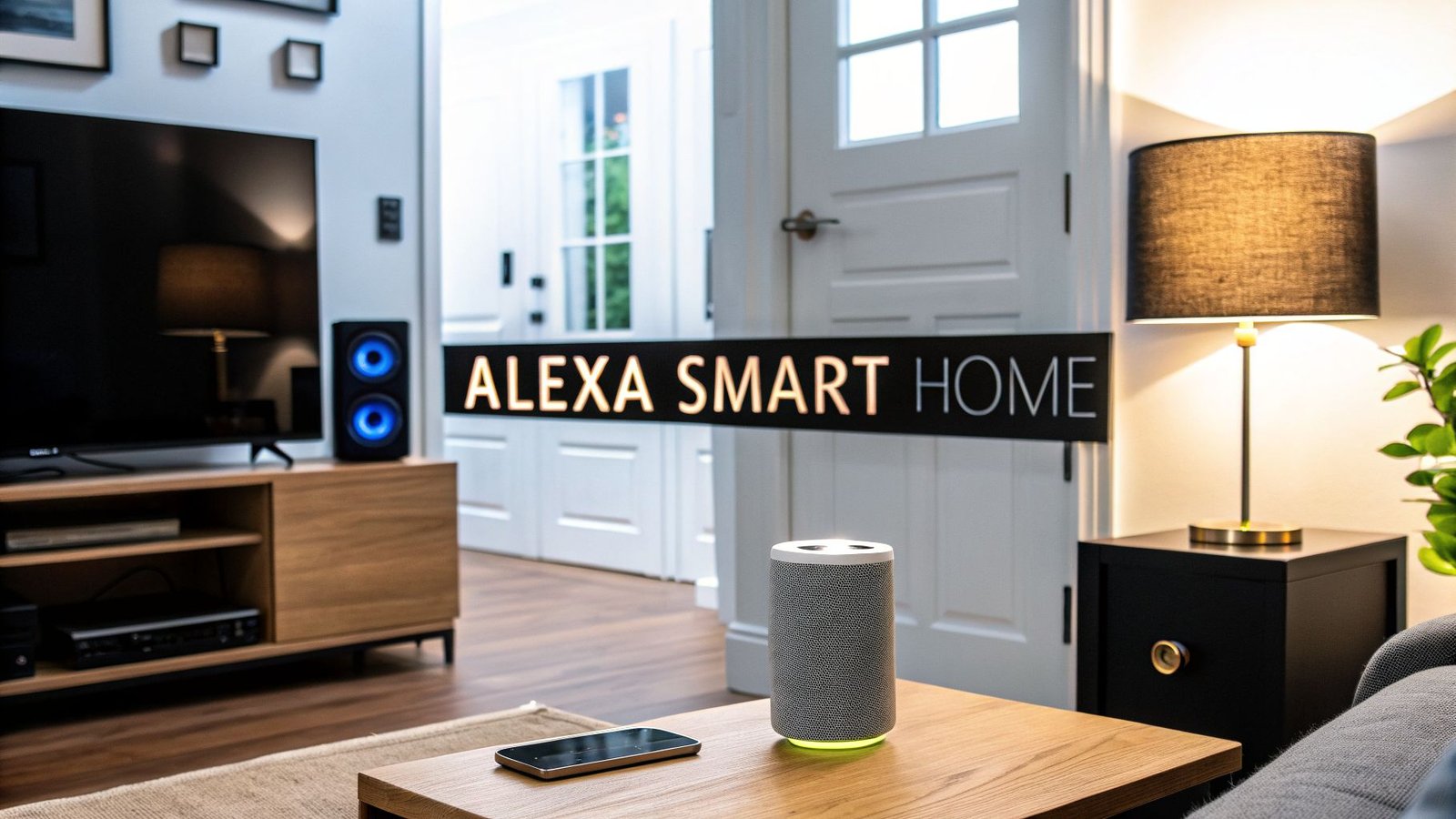
The real magic happens when all your smart water gadgets start talking to each other. By using a central hub like Google Home or Amazon Alexa, you can orchestrate all your devices from one app and create routines that make saving water feel completely effortless.
A great example is linking your smart irrigation controller to a local weather feed. If the forecast calls for more than half an inch of rain, your system can automatically skip the next watering day. You’ll never have to cringe at the sight of your sprinklers running during a downpour again.
You can also get creative with notifications. A smart shower device could be set to send an alert to your phone—or even make a voice announcement on a smart speaker—if it detects a shower running for an unusually long time. It’s a gentle, effective nudge for the whole family.
Creating Smart Water Routines
Once everything is connected, you can build powerful automations based on "if this, then that" logic. These routines handle the day-to-day thinking for you, turning good intentions into automatic actions.
Here are a few ideas I’ve seen work wonders:
- Vacation Mode: Set up a routine that triggers when you arm your security system to "Away." It can instantly shut off the main water valve and pause all irrigation schedules, eliminating any risk of waste or leaks while you're gone.
- Leak Response: This is a big one. Program your smart water monitor to immediately shut off the main valve the moment it detects a significant leak. This one routine can literally save you from thousands of dollars in water damage.
- Usage Alerts: Not sure where your water is going? Set a daily consumption threshold. If your home uses more water than expected, you'll get an alert. It’s a great way to catch things like a running garden hose before it turns into a major bill.
This integrated approach is at the heart of initiatives like the 50 Liter Home Coalition, which found that a whole-home system of smart fixtures and appliances could reduce indoor water use by over 20% without negatively impacting quality of life. Participants felt like they were using more water, not less.
Proactive Monitoring and Control
Ultimately, a smart water ecosystem is about giving you proactive control. You’re no longer waiting for a water stain on the ceiling to discover a problem; you have the tools to spot issues in real-time. For a deep dive into the core of this setup, our guide on the best smart water leak detectors is the perfect place to start.
This level of control is especially valuable outdoors. When you integrate smart irrigation with soil moisture sensors, your system waters only when the ground is actually dry. This not only cuts waste but also leads to healthier plants by preventing root rot from overwatering. As you plan your yard, think about incorporating tips for creating a sustainable landscape with eco-friendly practices to take your conservation efforts to the next level.
Building out this ecosystem gives you data, automation, and most importantly, peace of mind.
Common Questions About Home Water Conservation
Once you start thinking about how much water you're using, a lot of questions naturally come to mind. It’s one thing to want to save water, but it's another to know where to start and what really makes a difference.
To cut through the noise, I've put together answers to the most common questions I hear from homeowners. Think of this as the practical, no-nonsense advice you need to get going.
How Much Money Can I Actually Save by Conserving Water?
This is always the first question, and for good reason. The answer is almost always more than you'd expect. The savings show up in two places on your utility bills: the water bill itself, and just as importantly, your energy bill. Heating water is expensive, so every drop of hot water you save is a double win.
Let’s run the numbers for a typical family of four to see how it adds up:
- Toilet Upgrades: Swapping out two old toilets from the pre-1994 era (which can use 5 gallons per flush) for new WaterSense models (1.28 gallons per flush) can easily save you over $140 a year on water alone.
- Leak Repair: That one annoying dripping hot water faucet? Fixing it can save around $45 a year in heating costs, not to mention the cost of the water itself.
- Smarter Irrigation: If you have a sprinkler system, installing a smart controller that adjusts based on the weather can cut your outdoor watering by half. In many climates, that’s an easy $200 to $500 back in your pocket over a single season.
As you can see, a few smart changes pay for themselves surprisingly quickly and have a real impact on your monthly budget.
Is Installing a Smart Water Monitor a DIY Project?
It depends. Your ability to install one yourself comes down to which type of monitor you buy and how comfortable you are with a little work around the house.
Easy DIY: "Strap-On" Models
These are designed for the average homeowner. A strap-on monitor just clamps around your main water pipe and uses ultrasonic sensors to detect water flow inside. All you usually need to do is clean a small section of the pipe and attach the device. No plumbing skills are required, making it a fantastic starting point.
Pro-Install: "Cut-In" Models
These devices are more invasive but often offer higher precision and can include an automatic shut-off valve—a lifesaver in a major leak. True to their name, they have to be physically "cut in" to your main water line. Unless you have serious plumbing experience, this is a job for a professional.
My Personal Takeaway: For most people, a DIY strap-on model is the perfect entry point. You get valuable insights and leak alerts without the cost or headache of hiring a plumber. It's all the data you need to get started.
What Is the Single Best First Step for Saving Water?
If I had to pick just one thing for the biggest, fastest impact, it would be a toss-up between two actions, depending on what your home looks like.
- Upgrade Your Oldest Toilet: If you have a toilet from before 1994, replacing it is your number one priority. It's a single upgrade that delivers huge, automatic savings every day without you having to change a single habit.
- Find and Fix Leaks: The best return on your effort is always fixing something that's broken. Start with the food coloring trick in your toilet tanks and check your water meter for silent leaks. A single running toilet can waste more water and money than almost any other problem in the house.
Fixing a leak costs next to nothing, and a new toilet pays for itself in savings. You can't go wrong with either of these as your first move.
Can I Save Water While Living in an Apartment?
Absolutely! Even if you can't make permanent plumbing changes, you have a ton of power to cut down on water use. The key is to focus on your habits and simple, non-permanent upgrades.
- Report Leaks Immediately: Don't let a dripping faucet or running toilet slide. Tell your landlord right away. It’s their job to fix it, and it stops a massive amount of waste.
- Get a Better Showerhead: This is an easy, five-minute swap. Unscrew the old one, screw on a new high-efficiency model, and just be sure to keep the original to put back on when you move out.
- Use Faucet Aerators: These little screens are cheap and screw right onto your kitchen and bathroom faucets. They can cut water flow by 30% or more, and you won't even feel a drop in pressure.
- Embrace Water-Wise Habits: This is the free part. Turn off the water when you brush your teeth, only run full loads in the dishwasher and washing machine, and aim for shorter showers. These small acts add up faster than you think.
Renting doesn't mean you're on the sidelines. Every gallon saved makes a difference, no matter where you live.
At Automated Home Guide, we are committed to helping you create a safer, more efficient home. For more expert tips and reviews on the latest smart home technology, visit us online.



Leave a Reply