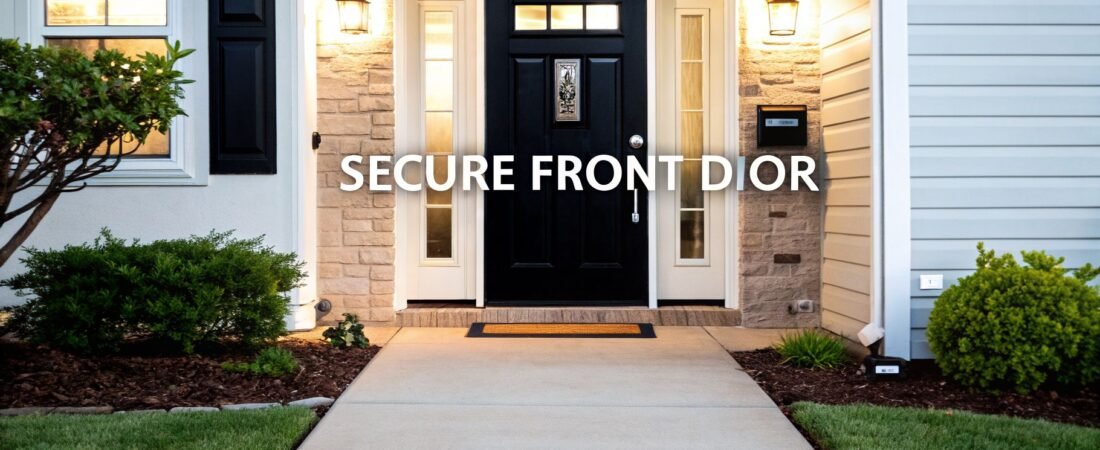
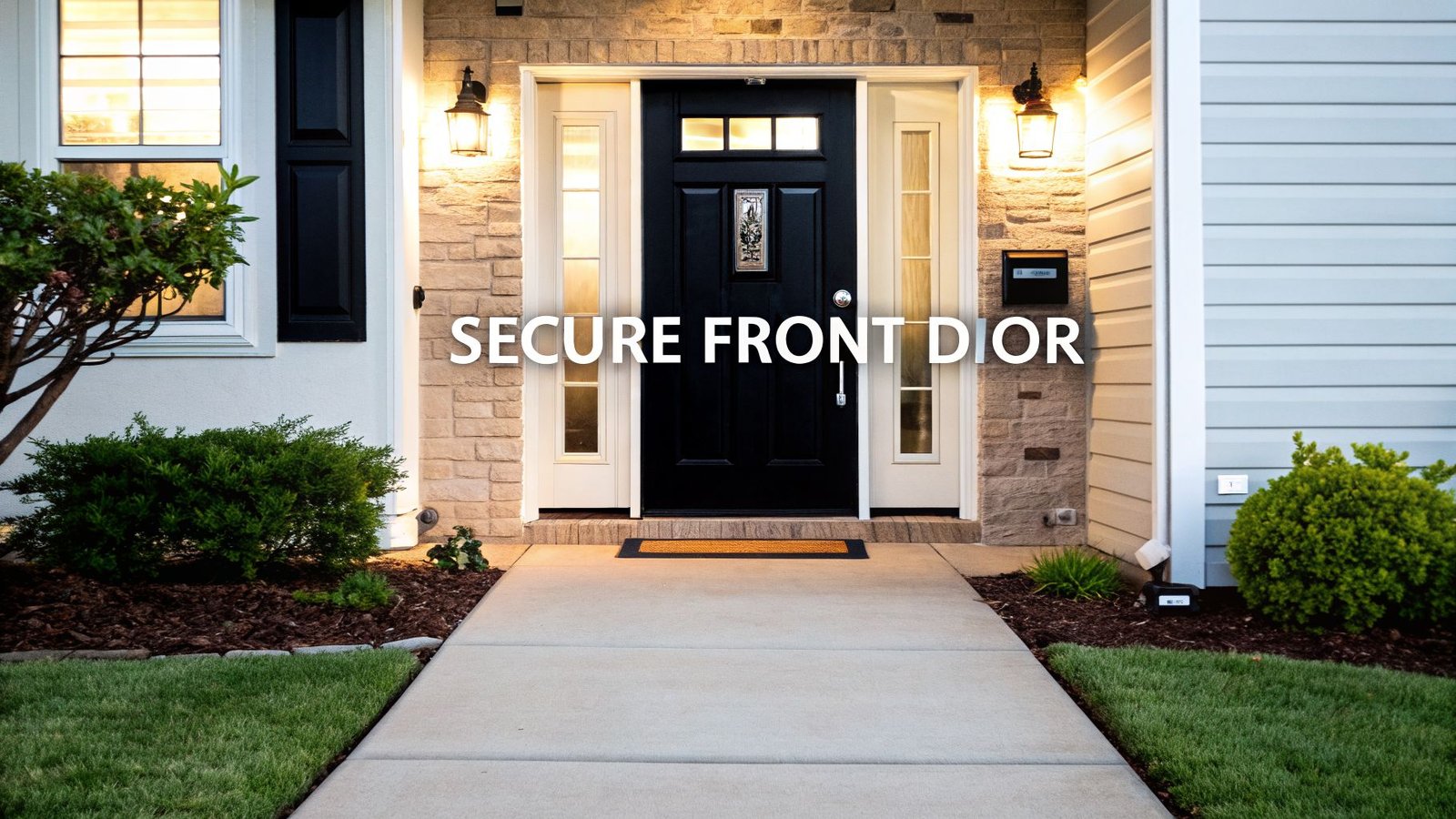
Securing your front door isn't just about picking a good lock. It’s about creating layers of defense. The most effective approach combines old-school physical strength with modern smart technology. A solid door with a high-grade deadbolt can stop a brute-force attack cold, while a video doorbell and smart lock give you eyes, ears, and control from anywhere. This one-two punch is how you truly protect your home's main entry point.
Your Quick Guide to Total Front Door Security
Your front door is more than just an entryway; it’s the first and most important line of defense for your home. A simple lock and key might have felt like enough in the past, but today’s security challenges call for a much smarter strategy. When you think about how to secure your front door, you need to look at the entire system—the door itself, the frame it sits in, the lock holding it shut, and the technology that keeps an eye on it all.
A truly secure door has no weak links for an intruder to exploit. This guide will walk you through the essential components, helping you figure out where to focus your efforts for the biggest security payoff.
Understanding Your Security Options
First things first: not all security upgrades are created equal. Some are designed for passive resistance, while others provide active, real-time intelligence. The best setups always blend both.
- Physical Reinforcements: These are the absolute fundamentals. We're talking about a solid-core door, a top-quality deadbolt, and a properly reinforced frame. Their entire job is to stand up to physical force.
- Smart Technology: This layer adds a brain to the brawn. Devices like video doorbells, smart locks, and door sensors alert you to who's there, let you grant access remotely, and keep a digital log of every event.
- Visibility and Deterrence: This is the element people often forget. Good, motion-activated lighting and clear sightlines to your door are incredibly powerful deterrents. Burglars love to work in the shadows; don't give them any.
Making sense of these options can be tricky. Here’s a quick comparison to help you weigh your choices based on their function, cost, and the specific benefits they bring to the table.
Key Front Door Security Upgrades Compared
This table breaks down the most common upgrades so you can see how they stack up.
| Security Upgrade | Primary Function | Typical Cost | Key Benefit |
|---|---|---|---|
| Grade 1 Deadbolt | Physical brute-force resistance | $40 – $100 | Offers the highest certified protection against picking, drilling, and kicking. |
| Solid-Core Door | Impact and forced entry resistance | $300 – $1,500+ | Prevents intruders from simply kicking through a weak, hollow panel. |
| Video Doorbell | Monitoring and deterrence | $100 – $250 | Lets you see and speak to anyone at your door, from anywhere, while recording all activity. |
| Smart Lock | Access control and monitoring | $150 – $400 | Provides keyless entry, remote locking/unlocking, and detailed activity logs. |
| Reinforced Strike Plate | Strengthens the door frame | $10 – $20 | A cheap but critical upgrade that stops the lock from being kicked out of a flimsy frame. |
Each of these components plays a distinct role, but they work best when integrated into a single, cohesive system.
This visual guide shows exactly how these security layers should work together to create a formidable defense.

As the flowchart shows, a truly secure plan starts with a strong physical foundation. From there, you enhance it with smart integrations, layering them together to cover all your bases.
The Growing Importance of Door Security
The push for stronger entryways isn't just a trend; it's a direct response from homeowners wanting better protection. The proof is in the numbers. The global security door market is growing steadily, with experts projecting a compound annual growth rate (CAGR) of 4.9% through 2032.
This isn't just about standard steel doors, either. The market includes advanced composite materials and even doors engineered to resist fire and other hazards. It's a clear signal that people are no longer settling for the bare minimum when it comes to their home's primary point of entry.
Building a Physically Strong Foundation
Smart gadgets are great, but they won't do much against a well-placed kick. Before you even think about tech, your door has to be able to physically withstand an attack. The real starting point for securing your front door is its physical integrity—the door, its frame, and the locks all have to work together as one solid unit.
I've seen firsthand what a difference this makes. A friend of mine had a break-in attempt, but their reinforced door stopped it cold, leaving nothing but a boot scuff on the frame. Their next-door neighbor wasn't so lucky. A single hard kick splintered their flimsy door frame, and the intruder was inside in seconds. The lock wasn't the problem; it was the weakness of the entire door system.
To build this kind of solid foundation, you need to understand the core principles of physical security. It's all about finding and hardening the weakest points, and on most front doors, those weak spots are surprisingly common and easy to fix.
Start with the Door Itself
First, take a hard look at your door. A lot of homes, particularly older ones, are fitted with hollow-core doors. These are little more than a lightweight frame filled with cardboard or even just air, and they offer almost zero resistance to force.
Your first and most important upgrade should be a solid-core door. Made from materials like steel, fiberglass, or solid wood, these doors are incredibly tough to break through.
- Steel Doors: These offer the best strength for the money and are a fantastic, secure option.
- Fiberglass Doors: You get excellent durability, and they can be made to look just like wood without the constant upkeep.
- Solid Wood Doors: They're heavy and strong, but they tend to be the most expensive and require regular maintenance to prevent warping or cracking.
Switching to a solid-core door isn't a small upgrade; it's the very bedrock of your home's defense.
The Lock That Does the Heavy Lifting
Next up is the hardware. The lock in your doorknob is mostly for keeping the door shut, not for actual security. The real workhorse is a high-quality deadbolt.
For serious protection, you need to install an ANSI Grade 1 deadbolt. This is the highest security rating for residential locks, meaning it's been tested to resist a tremendous amount of force, as well as attacks like drilling and lock picking.
A Grade 1 deadbolt is built to take a beating. It’s designed to withstand repeated, powerful strikes, which makes it one of the best deterrents against a brute-force attack. If you make only one upgrade to your lock, this should be it.
When you're picking one out, check that the bolt itself extends at least one inch from the door's edge. That extra length ensures it goes deep into the door frame, creating a much stronger anchor that’s incredibly difficult to break loose.
Fortify the Frame the Right Way
A strong door and a great lock are practically useless if the frame they're mounted to is weak. The strike plate—that little metal plate on the frame where the deadbolt slides in—is the most common point of failure. Most builders install them with flimsy, half-inch screws that barely grab the thin wood of the door jamb.
Thankfully, this is a simple but vital fix. Get rid of that standard strike plate and replace it with a heavy-duty, four-screw security plate. Then, and this is the crucial part, secure it with 3-inch screws. Those long screws will go right through the flimsy jamb and anchor directly into the solid wall stud behind it. This one small change can literally multiply the amount of force your door can withstand. Our detailed guide on how to prevent home break-ins goes into even more strategies for reinforcing all the entry points around your home.
Consider an Extra Layer of Protection
If you're looking for another layer of security, especially for doors with decorative glass panels, a security screen door is an excellent investment. The market for these products speaks for itself. Valued at roughly USD 2.5 billion in 2025, the security screen door market is projected to grow substantially. The United States alone accounts for about 40% of this market, which shows just how much homeowners are prioritizing robust protection. It's a clear signal that people are looking for proven ways to harden their homes against intruders.
Layering on Smart Tech for Active Security
A reinforced door is your first line of defense—a silent guardian built to stop brute force. But what about seeing a threat before it gets to that point? This is where smart technology completely changes the game. It takes your front door from a passive barrier to an active, intelligent security hub.
By weaving together a few key devices, you get real-time awareness and control over your main entry point. Think of it as a digital ecosystem: a smart lock manages access, a video doorbell lets you see who's there, and sensors alert you the second the door is opened. This network keeps you informed and in charge, whether you’re just in another room or halfway across the world.

Start with a Smarter Lock
The smart lock is the heart of your new setup. It either replaces your existing deadbolt or sits right on top of it, offering a level of control and convenience that traditional keys just can't match. No more fumbling for keys in the dark or that nagging feeling that you forgot to lock up when you left.
You've got a few different types to consider, and the right one really depends on your lifestyle:
- Keypad Locks: These are perfect for families or for giving trusted people (like a dog walker) access without a physical key. Just assign a code.
- Biometric Locks: A simple fingerprint scan is all it takes to get inside. It's fast, secure, and you can't lose your fingerprint.
- Bluetooth/Wi-Fi Locks: These let you control everything from your phone. Bluetooth works when you're nearby, while Wi-Fi gives you the power to lock or unlock your door from literally anywhere.
I recently had a contractor working at my house and was able to give him a temporary access code that only worked during his scheduled hours. The moment the job was done, I disabled it from my phone. That's a level of immediate control a physical key could never give you. If you're looking to dive deeper, we've broken down the https://automatedhomeguide.com/best-smart-door-locks/ on the market today.
See Who's at the Door with a Video Doorbell
Next up is the video doorbell—your digital doorman. It puts eyes and ears on your front porch around the clock. The moment someone approaches your door or rings the bell, you get a notification on your smartphone, letting you see and speak to them in real-time.
Placement here is everything. You'll want to mount it where you have a clear, wide-angle view of your entire entryway and can see a person's face clearly. This isn't just about catching package thieves; it’s a powerful deterrent. Most opportunistic burglars will scout for cameras first, and seeing one is often enough to convince them to move on to an easier target.
A smart lock isn't just a gadget; it’s an audit trail. It logs every single lock and unlock event, giving you a complete activity history right on your phone. That data offers incredible peace of mind.
Complete the System with Door Sensors
The final, and often overlooked, piece of this smart puzzle is the humble door sensor. These are simple, two-part devices that you attach to the door and its frame. When the door is opened, the magnetic connection between the two pieces is broken, which instantly triggers an alert to your phone.
This simple mechanism unlocks some powerful security automations. For example, you can create a rule where if the front door opens between 10 PM and 6 AM, all your smart lights flash on and an alarm sounds on your phone. It’s an immediate, automated response that can easily startle an intruder and wake you up.
For those wanting to take it a step further, you can look into an Introducing Smart Anti Theft System that bundles these features into a more comprehensive package.
Smart Security Device Feature Breakdown
To help you decide what's right for you, this table breaks down the core features and best uses for each device.
| Device | Key Features | Connectivity (Wi-Fi/Bluetooth/Z-Wave) | Best For |
|---|---|---|---|
| Smart Lock | Remote lock/unlock, temporary access codes, activity logs, auto-lock | Wi-Fi, Bluetooth, Z-Wave/Zigbee | Controlling access for family, guests, and service providers. |
| Video Doorbell | Two-way audio, motion detection, live video streaming, night vision | Wi-Fi | Screening visitors, deterring package theft, and recording activity. |
| Door Sensor | Instant open/close alerts, triggers for other smart devices | Bluetooth, Z-Wave/Zigbee | Creating automated security routines and getting immediate breach alerts. |
When you combine these three elements—a smart lock, a video doorbell, and door sensors—you're not just securing a door. You're creating an integrated, intelligent system that gives you complete situational awareness and control.
Using Visibility and Light as a Deterrent
While a reinforced door and smart tech are your primary lines of defense, don't overlook one of the simplest and most effective deterrents out there: light. Most people looking for an easy target prefer to operate under the cover of darkness. By lighting up your entryway and getting rid of potential hiding spots, you make your home a much harder and less appealing target.

This isn’t just about flipping on the porch light and calling it a day. A truly effective lighting strategy creates layers of light that work together, leaving no dark corners for an intruder to hide in. Good lighting naturally discourages unwanted visitors and makes it much more likely that any suspicious activity gets noticed—by you, a neighbor, or even someone just driving by.
Create Layers of Light
The best way to think about your outdoor lighting is in three overlapping layers. Each one plays a different role in securing the area around your front door.
First, you have your ambient lighting. This is the low-level, steady glow that defines pathways, steps, and your porch area. Think solar-powered path lights or low-wattage landscape fixtures. Their job isn't to blast the area with light, but to provide a baseline of visibility for safe navigation.
Next comes your task lighting. This is the main light right at your front door, like a porch sconce or an overhead fixture. It needs to be bright enough for you to clearly see who’s at the door and find your keys without fumbling. A fixture with a "dusk-to-dawn" sensor is a fantastic, set-it-and-forget-it upgrade here.
Finally, you have your accent and security lighting. These are the heavy hitters—motion-activated floodlights aimed at key zones like the corners of your house, the start of your driveway, or any other dark spots. A sudden blast of bright light is incredibly jarring and is often more than enough to send a would-be intruder scurrying away.
Combining these three types of light creates a comprehensive shield that robs intruders of the darkness they rely on. For more ideas on what this can look like, check out our guide on effective outdoor security lighting ideas to find a setup that fits your property.
Eliminate Hiding Spots with Smart Landscaping
Your lighting is only as effective as the sightlines it creates. Overgrown shrubs, dense bushes, and low-hanging tree branches create the exact kind of blind spots you're trying to get rid of. I once reviewed security footage for a neighbor where a burglar crouched completely hidden behind a big, untrimmed azalea bush right next to the front door, waiting for the street to clear before making his move.
That’s why basic landscape maintenance is such a crucial, low-cost security upgrade. Take a walk around your property and try to see it from the perspective of someone trying to approach without being seen.
A well-maintained yard is a secure yard. By trimming back overgrown foliage, you're not just improving curb appeal—you're actively removing cover for potential threats. Your goal is a clear line of sight from the street to your front door.
Take these simple steps to clean up those potential hiding spots:
- Trim bushes and shrubs near your entryway so they stand no higher than three feet.
- Prune the lower branches of any nearby trees to at least seven feet off the ground.
- Think about swapping dense shrubs near your door with thorny, less-inviting plants like barberry, which act as a natural, prickly deterrent.
This is a simple weekend project that can make a huge difference, dramatically boosting the effectiveness of your security cameras and lighting. It ensures anyone approaching your home is out in the open and fully exposed—a very uncomfortable position for someone with bad intentions.
Developing Secure Everyday Habits

You can install the toughest deadbolt and the smartest lock on the market, but they're only as good as the person using them. The truth is, the final piece of the puzzle isn't steel or silicon—it's your daily routine. All the hardware in the world won't matter if simple human error leaves you vulnerable.
I’ve seen it time and time again: a break-in doesn't happen with a crowbar, but with a simple unlocked door or a poorly hidden key. The good news? Building secure habits costs nothing and makes every other security measure you've put in place exponentially more effective.
Rethink the Spare Key—Immediately
Let's get one thing straight: the spare key under the doormat, inside the fake rock, or on top of the doorframe is the oldest trick in the book. And burglars know it well. Finding that key gives them a quiet, damage-free entry, instantly making your expensive lock useless.
It's a huge gamble, and it's time to find a better way.
- Embrace Guest Codes: This is the modern, secure solution. If you have a smart lock, create temporary digital codes for visitors, the dog walker, or a contractor. You can see exactly when the code is used and delete it the second it’s no longer needed.
- Lean on a Trusted Neighbor: If you absolutely need a physical backup, don't leave it on your property. Give a spare to a neighbor you genuinely trust.
- Use a Real Lockbox: For emergency access, get a contractor-grade key lockbox. Don’t just leave it in plain sight—secure it to a solid surface in a discreet location, like behind a shed or on a back faucet.
Make Locking Up Automatic
It sounds almost too simple, but a shocking number of break-ins happen through unlocked doors. We get comfortable, especially when we’re home or just running out for a moment. Opportunistic thieves count on this complacency.
The single most important habit you can build is to always lock your door.
Make it a reflex. Lock the deadbolt when you settle in for the night, when you’re out in the backyard, and every single time you leave the house—no exceptions. This simple action is your first and best defense. For an extra layer of certainty, look for a smart lock with an "auto-lock" feature that engages the deadbolt after a preset time.
Treat your video doorbell as a digital peephole. There's no reason to open your door to an unexpected or unrecognized visitor. Use the two-way audio to vet them safely from behind a locked door, day or night.
Your Pre-Vacation Security Checklist
Leaving your home empty for a few days or weeks requires a specific game plan. A dark, quiet house with a pile of mail out front is a blinking neon sign for burglars. My personal routine before any trip is all about making the house look lived-in.
Before you head out, run through this checklist:
- Stop Mail and Packages: An overflowing mailbox or a stack of deliveries on the porch screams, "Nobody's home!" Use the USPS Hold Mail service and reschedule any expected packages for after your return.
- Automate Your Lights: Don't just leave one lamp on for a week. Use smart plugs or bulbs to create a randomized schedule that turns lights on and off in different rooms—the living room in the evening, the bedroom at night. It's far more convincing.
- Tell a Neighbor: Let someone you trust know you'll be gone. Ask them to keep an eye out for anything unusual and give them your contact info for emergencies. That extra set of eyes can make all the difference.
Frequently Asked Questions on Front Door Security
Even the best-laid plans run into questions. When you start digging into a project like securing your front door, it's totally normal to have a few "what ifs" pop up before you spend any time or money. Let's tackle the questions I hear most often from homeowners, with some straight-to-the-point advice to help you move forward confidently.
Getting a handle on the real differences between your options is the most important part. Is a smart lock really better? What’s a reasonable budget? Can I actually do this myself? Answering these will make the entire project go a whole lot smoother.
Is a Smart Lock More Secure Than a Traditional Deadbolt?
This is a great question, and the answer isn't a simple yes or no—it really comes down to different kinds of security.
From a purely physical standpoint, a top-tier, ANSI Grade 1 traditional deadbolt is an absolute tank. Its one and only job is to resist brute force, and a good one is much tougher to kick in or drill than a cheap, off-brand smart lock.
But a high-quality smart lock brings a whole different set of advantages to the table. It’s all about intelligence: real-time alerts if the door is tampered with, the ability to lock it remotely from your phone (no more wondering if you forgot!), and detailed logs of who entered and when.
The best approach is to get the best of both worlds: a premium smart lock that is also a Grade 1 or Grade 2 deadbolt. This gives you that rock-solid physical strength combined with the brains and awareness of a smart system. You’re layering brute-force resistance with active monitoring.
So, the most secure option isn't one or the other. It’s a great deadbolt that has smart technology built into it.
How Much Should I Budget to Properly Secure My Front Door?
You can spend a little or a lot, and frankly, even small investments here make a huge difference. You don't have to do it all at once. I usually advise people to think about it in a few budget ranges.
The Foundation: Basic Reinforcements ($50 – $100)
This is where you get the most bang for your buck. For this amount, you can easily cover:
- A certified Grade 1 deadbolt.
- A heavy-duty, reinforced strike plate with 3-inch screws.
The Smart Upgrade: Mid-Range Security ($250 – $500)
This tier adds that layer of active security and convenience. A budget like this typically gets you:
- A quality video doorbell from a brand you trust.
- A reliable smart lock that includes features like a keypad and an auto-lock function.
The Full Overhaul: Comprehensive Security ($600 – $1,200+)
This is for a complete front entry makeover. With this budget, you could be looking at:
- A brand-new, professionally installed solid-core door (made of steel or fiberglass).
- A premium, integrated smart lock and deadbolt combo.
Think of this as a one-time investment in your peace of mind. Start where you're comfortable, and you can always add more later.
Can I Install These Security Upgrades Myself?
For many of these upgrades, absolutely! Most of the most effective security products are designed for DIY installation, assuming you have some basic tools and are comfortable following instructions.
Projects that are generally very DIY-friendly include:
- Replacing an existing deadbolt: New locks are almost always made to fit standard door cutouts.
- Installing a reinforced strike plate: If you can use a drill, you can do this.
- Mounting a video doorbell: This is often a simple swap if you have existing doorbell wiring.
- Adding door sensors: Most of these are peel-and-stick and take just a few minutes to set up.
That said, know when to call in a pro. If you’re installing a whole new door and frame, or if you just don't feel confident, hiring a locksmith or contractor is money well spent. A lock that's installed incorrectly is a major security risk all on its own.
My Front Door Has Glass Panels. How Can I Secure It?
A door with glass panels—whether it’s a small decorative window or a larger pane—creates an obvious vulnerability. A burglar can break the glass, reach in, and simply unlock the deadbolt from the inside, making your powerful lock useless.
You have a couple of solid ways to deal with this weak point.
Some people immediately think of a double-cylinder deadbolt, which needs a key on both the inside and outside. But you absolutely must check your local fire codes before even considering this. These are often illegal in residential homes because they create a deadly hazard in a fire, trapping people inside.
A much better and safer option is to apply security window film. This is a clear polyester film that you stick to the inside of the glass. It won't make the glass unbreakable, but it holds all the shattered pieces together in the frame. This makes it incredibly difficult, loud, and time-consuming for someone to actually create a hole to reach through. It’s a fantastic, cost-effective way to fortify a glass door without changing how it looks.
At Automated Home Guide, we're committed to helping you create a safer, smarter home. For more expert tips, in-depth reviews, and practical how-to guides, explore our resources at https://automatedhomeguide.com.

Leave a Reply