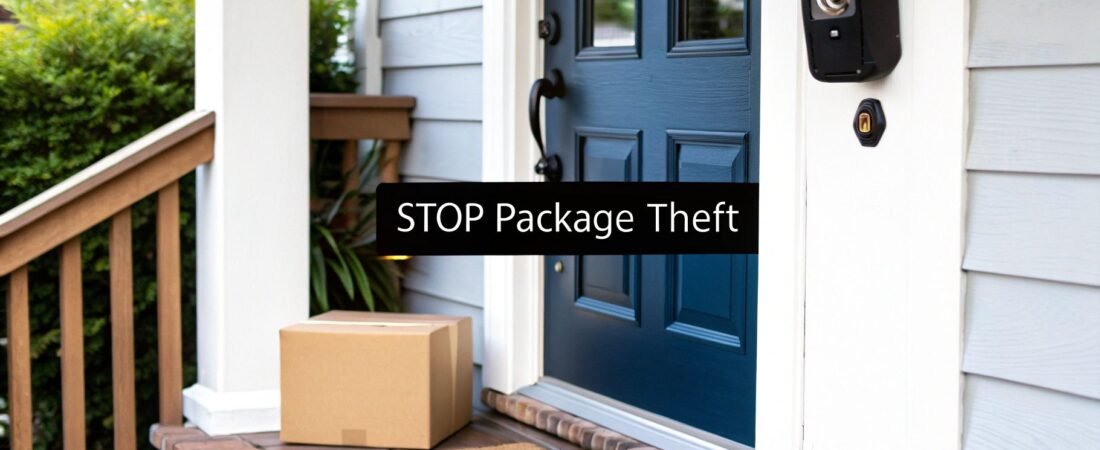
There’s nothing quite like that sinking feeling when you check your porch for a package that’s supposed to be there, only to find an empty space. It’s infuriating, and it feels like a violation of your home's safety. To really put a stop to package theft, you need to think in layers: combining things thieves can see, like cameras, with physical roadblocks like a lockbox, and staying on top of your deliveries with carrier apps.
The Soaring Problem of Porch Pirates
The convenience of online shopping has, unfortunately, created a booming industry for opportunistic thieves we now call "porch pirates." They simply drive through neighborhoods looking for the easiest score—packages sitting out in the open. What used to be a rare headache has exploded into a daily threat for millions of us.
And this isn't a small problem. It's a massive one. In just one year, package theft hit 58 million Americans, with the value of stolen goods climbing to an eye-watering $12 billion annually.
The numbers are pretty staggering when you dig in. Recent studies show that 41% of all Americans have had a package stolen at some point. It's become so common that 1 in 4 adults reported a theft in the last year alone. If you want to see the full breakdown, the comprehensive package theft report on Security.org is worth a read. It all points to one clear conclusion: just hoping your package will be safe isn't a strategy anymore.
Why Is Your Porch Such a Prime Target?
For a porch pirate, it all boils down to a simple risk-versus-reward calculation. A box sitting on a porch is the definition of low-risk, high-reward. They can be in and out in seconds, usually in broad daylight while you're at work or out running errands.
Several things can make your home a more likely target:
- Easy to See: If your porch is clearly visible from the street, a thief can spot a delivery without even getting out of their car.
- Predictable Routines: Most of us have regular work schedules, which creates a pretty reliable window of time when the house is empty.
- No Obvious Security: A porch with no cameras, warning signs, or other security measures basically sends an invitation to thieves that this is an easy grab.
The whole game is to flip that risk-reward calculation on its head. Your goal is to make grabbing a package from your porch seem like too much trouble and too high a risk, convincing them to just move on.
Once you understand how they think, you can start building a solid defense. This guide will walk you through the practical steps you can take to secure your deliveries and get your peace of mind back.
Your First Line of Defense: Smart Surveillance
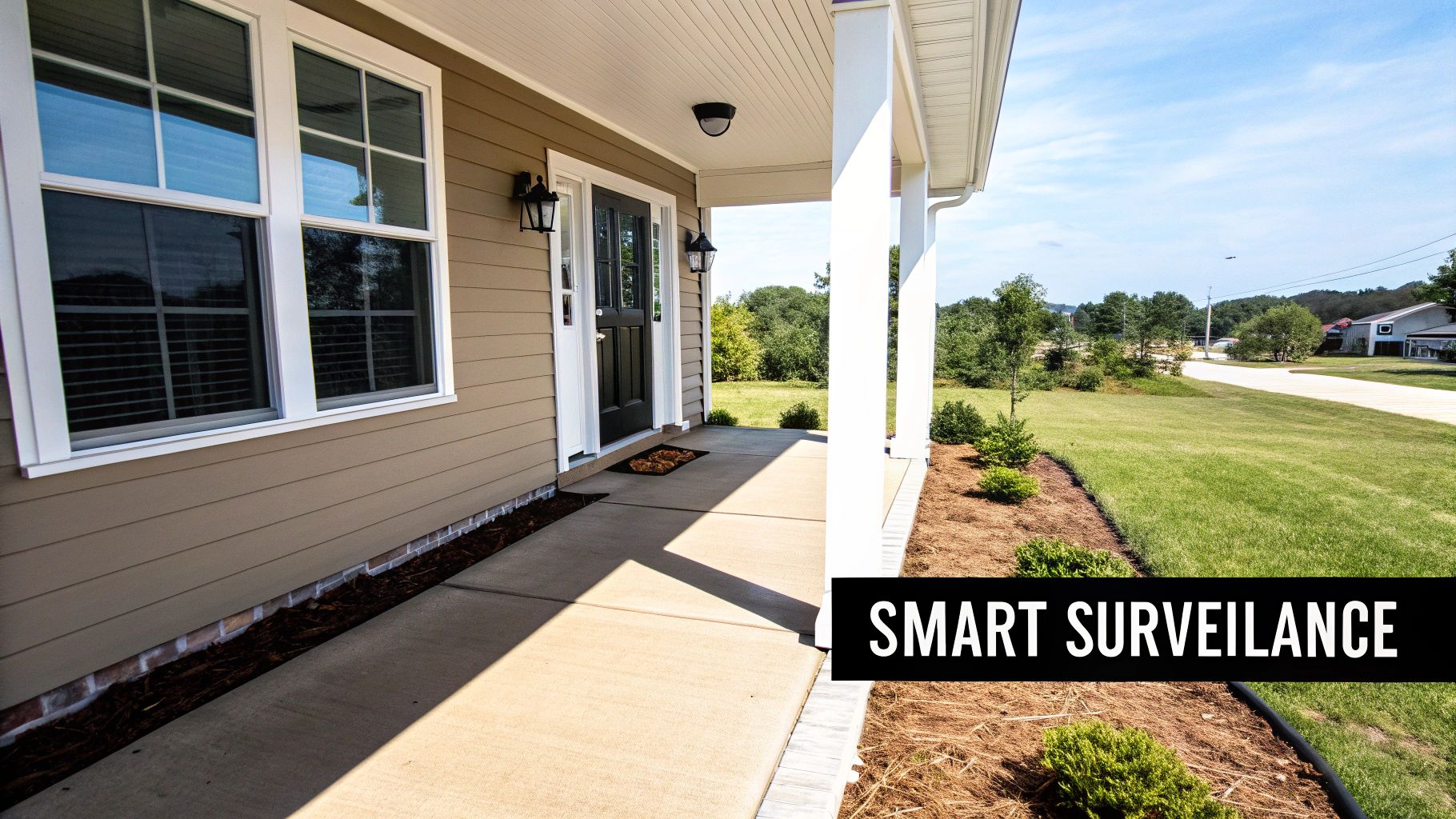
When a porch pirate eyes a potential target, the first thing they do is a quick risk assessment. Is the porch empty and unmonitored? Easy target. Is there a camera lens staring back at them? They’ll probably move on. This is why smart surveillance isn't just about catching a thief after the fact; it's about making them think twice before they even step onto your property.
The simple presence of a camera can be a powerful deterrent. Time and again, studies have shown that homes with visible security systems experience far less property crime. For instance, some reports have shown that Ring Video Doorbells can help cut down theft reports by as much as 55% in some neighborhoods. Thieves are opportunists, and a camera signals that the opportunity just isn't worth the risk.
Choosing Your Surveillance Tools
To truly secure your porch, you need to create a visible and active security presence. Three devices really form the core of a solid modern setup: video doorbells, outdoor security cameras, and motion-activated floodlights. Each one plays a slightly different, yet crucial, role in protecting your deliveries.
-
Video Doorbells: This is your front-and-center solution. It replaces your old doorbell and gives you a wide-angle view of anyone who comes to your door, pinging your phone the moment motion is detected. Our guide on the https://automatedhomeguide.com/best-video-doorbell-cameras/ can help you sift through the options.
-
Outdoor Security Cameras: A doorbell keeps an eye on the immediate entryway, but a good outdoor camera watches the perimeter. By placing one to overlook your driveway or the entire path to your door, you can spot a potential thief long before they get close to a package.
-
Motion-Activated Floodlights: These are a fantastic two-in-one deterrent. The sudden blast of bright light is usually enough to spook a would-be thief into running, and the built-in camera captures it all in crystal-clear, well-lit video.
For a truly seamless setup, you might consider a professional home security system installation to make sure all your devices are placed for optimal coverage and work together perfectly.
Key Takeaway: A layered approach is always best. Think of it this way: the outdoor camera watches the approach, the video doorbell guards the package's location, and the floodlight adds a startling, active deterrent.
Comparing Smart Surveillance Features
Choosing the right device can feel overwhelming, so I've put together this quick comparison to highlight the strengths of each option.
| Feature | Video Doorbell | Outdoor Security Camera | Motion-Activated Floodlight |
|---|---|---|---|
| Primary Goal | Monitor front door interactions | Watch over a broad area | Actively startle and record |
| Field of View | Wide, but focused on entryway | Very wide, covers yards/driveways | Wide, tied to light coverage |
| Main Deterrent | Visible camera, two-way audio | Visible camera presence | Sudden bright light, siren |
| Best For… | Seeing who's at the door, package drop-offs | Monitoring property perimeter | High-traffic areas, startling intruders |
Ultimately, the best systems often combine two or more of these devices to cover all the bases, leaving no blind spots for thieves to exploit.
Strategic Placement for Maximum Impact
Just having a camera isn't enough—where you put it makes all the difference. You have to think like a thief. Where are the blind spots? What's the easiest path to the porch? Your goal is to eliminate those weak points.
Position your main outdoor camera high enough to get a sweeping view of the approach to your home, covering the sidewalk, driveway, and the entire walkway. This lets you see someone long before they're anywhere near your packages.
For your video doorbell, placement is key for getting a useful image. I've found that installing it around 48 inches (4 feet) off the ground is the sweet spot. It's high enough to clearly capture faces but still low enough to see any packages left on the doormat.
Fine-Tuning Your System with Smart Features
Today's cameras are packed with smart features that turn them from simple recording devices into active guardians. Using these tools is what really elevates your defense.
AI Person Detection is a must-have. It's the feature that tells the difference between a person walking up to your door and a stray cat or a tree branch swaying in the wind. This means you get alerts that actually matter, not a constant stream of false alarms.
Custom Motion Zones are another game-changer. This feature lets you digitally draw a box around the specific areas you want to monitor, like your porch and walkway, while ignoring motion on the public sidewalk or street. It puts you in control of what triggers an alert.
Finally, don't underestimate the power of Two-Way Audio. If you get an alert about someone snooping around, you can instantly speak through your camera's speaker right from your phone. A simple, firm "Can I help you?" is often all it takes to send a porch pirate scrambling, because they know they've been caught in the act.
Physically Securing Your Deliveries
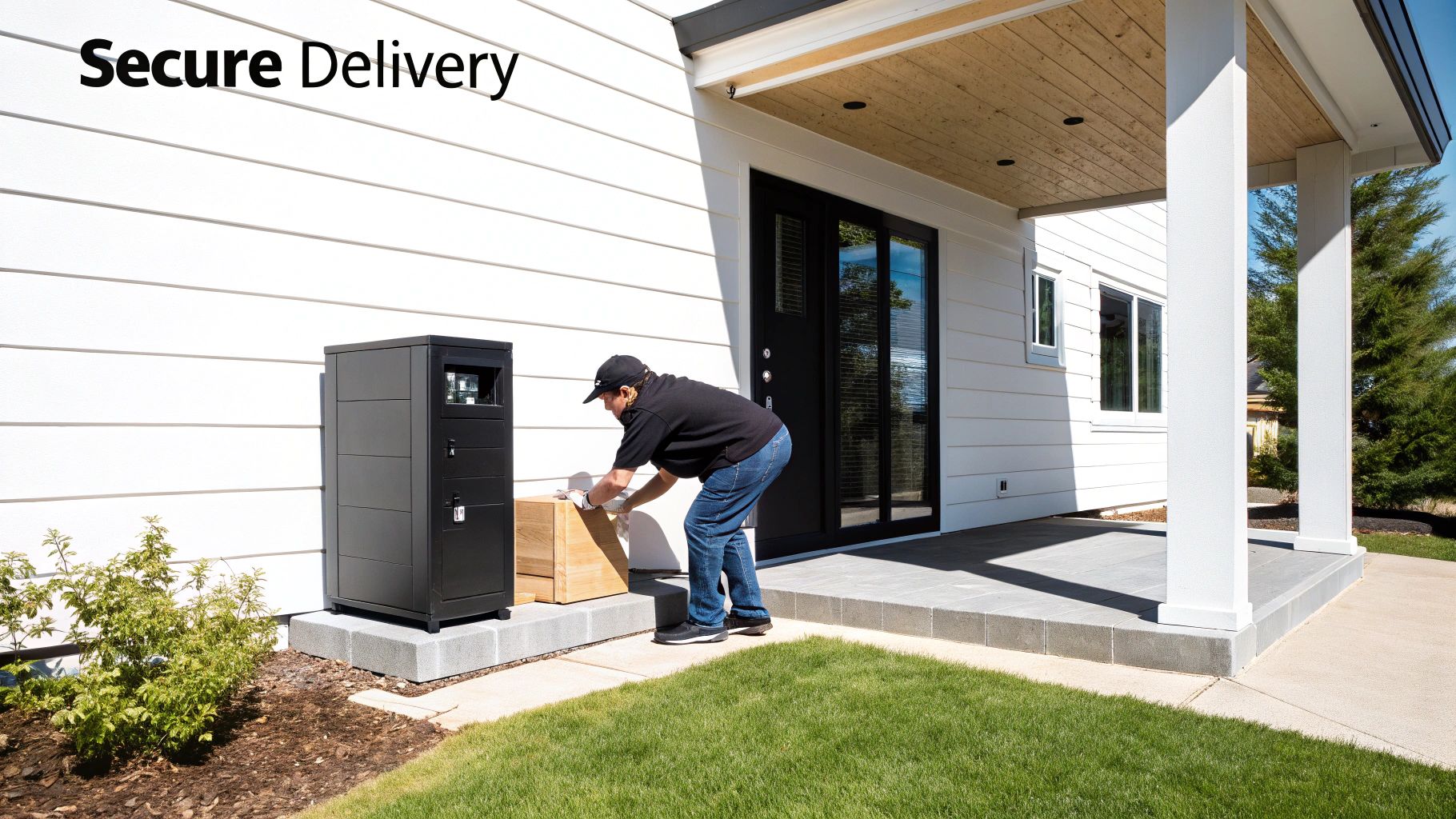
While cameras and floodlights are great for spooking would-be thieves, they're really just deterrents. To truly stop a package from getting swiped, you have to physically block a criminal from ever getting their hands on it. This is where you shift from just watching your porch to actively defending it.
Instead of just recording a theft in progress, you’re putting up a real-world barrier that makes the package impossible to grab. This is the ultimate security layer. Even the boldest porch pirate who ignores your cameras will have to walk away empty-handed. Luckily, we've got some pretty clever smart home solutions to make this happen.
Smart Delivery Boxes and Parcel Lockers
Think of this as a personal, weatherproof vault right on your doorstep. That’s exactly what smart delivery boxes are. These are tough, reinforced lockers designed to accept a package and then lock it down securely until you get home. Delivery drivers can use a simple one-time code, or the box can lock automatically as soon as it senses a delivery.
This simple change completely closes the window of opportunity for thieves. A package sitting out in the open can be snatched in less than ten seconds, but a thief isn't going to spend time trying to crack open a heavy-duty steel box. This is why early adopters of devices like the Loxx Boxx saw their theft rates plummet by 80%. When you take away the easy smash-and-grab, you thwart the very crime that costs Americans billions, according to data from CapitalOneShopping.com.
Thinking about getting one? Here's what to keep in mind:
- Size and Capacity: Make sure it’s big enough for the kinds of packages you usually get. Nothing's worse than a box that's too small for your biggest delivery.
- Power Source: You'll see battery-operated models and hardwired ones. This will affect where you can place it and how often you'll need to maintain it.
- Carrier Compatibility: Most are designed to be universal, but it never hurts to double-check that they work smoothly with USPS, UPS, FedEx, and Amazon.
The Power of Smart Locks for Secure Entryways
If a big box on the porch isn't your style, a smart lock is another fantastic way to physically secure your deliveries. These devices replace your old deadbolt and let you grant temporary, keyless access to your home. You can create a unique, one-time code for a driver or just unlock the door from your phone when they ring the bell.
This works incredibly well if you have a small, enclosed entryway or mudroom. The driver can place the package just inside the door without ever gaining full access to your home. It's a perfectly controlled and secure method that keeps your items out of sight and protected from both thieves and bad weather. If this sounds like a good fit, you should explore our guide on the best smart door locks to find a model that works for you.
Smart locks turn your front door into a dynamic access point. You're no longer limited to leaving things outside; you can create a secure, temporary drop-off zone with just a few taps on your phone.
Leveraging Your Garage for In-Home Delivery
For anyone with a garage, a smart garage door opener might just be the most seamless and secure delivery solution out there. Services like Amazon Key In-Garage Delivery work directly with compatible openers, letting vetted drivers place your packages safely inside your garage.
It's a surprisingly simple process:
- First, you link your Amazon account to your smart garage door opener's app.
- When the driver arrives, they get temporary, one-time access to open the garage.
- They place the package inside, close the door, and you get a notification—often with a video clip—confirming everything went smoothly.
This method is about as secure as it gets. The package is never left vulnerable outside, and the driver's access is strictly controlled, logged, and usually recorded. You're basically turning a large, secure space you already own into a personal delivery hub. The only things you need are a compatible opener and to be comfortable with a delivery service accessing that specific part of your home.
Proactive Strategies for Delivery Management
While smart cameras and lockboxes are great for defending your porch, some of the smartest moves you can make happen long before the delivery truck even pulls onto your street. It’s all about taking an active role in managing your deliveries, which can shrink the window of opportunity for a thief to almost nothing.
This means shifting from a reactive mindset—waiting for the "delivered" notification and just hoping for the best—to a proactive one. You can actually direct the entire process by telling carriers exactly when and where to drop off your stuff. These tools are powerful, almost always free, and put you firmly in control.
Take Control with Carrier Delivery Managers
Major carriers like UPS, FedEx, and the USPS have incredibly useful online portals that give you a surprising amount of control over shipments heading your way. Signing up for these is one of the single best things you can do to secure your packages.
Think of these platforms as a direct line of communication with the delivery company. Once you verify your address, you can manage pretty much any package coming to your home.
Here’s a taste of what you can typically do:
- Get Granular Alerts: Don't just get a "delivered" notice. Get texts or emails for every step of the journey, including when the truck is officially out for delivery in your neighborhood.
- Reschedule a Delivery: Know you won't be home on Tuesday? No problem. You can often push the delivery to a day you will be there to grab it right away.
- Provide Delivery Instructions: This is huge. You can leave specific notes for the driver, like "Place package behind the large potted plant on the left" or "Please leave at the side door, not the front."
- Set a Vacation Hold: If you're going out of town, you can tell carriers to hold all your packages at their facility until you get back. This prevents that tempting pile of boxes from advertising that you're not home.
I tell everyone this: signing up for UPS My Choice, FedEx Delivery Manager, and USPS Informed Delivery is non-negotiable. It takes about 15 minutes to set them all up, and in return, you get the power to intercept and redirect packages before they ever become a target.
Rethink Your Delivery Destination
Your front porch might be the default drop-off point, but let’s be honest—it’s rarely the most secure. If you can take the porch out of the equation entirely, you’ve basically solved the problem.
Luckily, there are more alternative delivery spots available today than ever before. Many are not only safer but also more convenient, fitting into your daily routine instead of making you rush home.
Ship to Your Workplace
One of the easiest and most effective workarounds is simply having packages delivered to your office. Most employers are perfectly fine with you receiving occasional personal deliveries.
The benefits here are pretty obvious:
- There's almost always someone at a front desk to sign for it.
- The package is immediately brought into a secure, indoor environment.
- You completely eliminate the risk of your package sitting outside for hours.
Just give your company's policy a quick check first. For a lot of people I've talked to, this one simple change completely stopped their package theft problem overnight.
Use Secure Off-Site Pickup Locations
If shipping to work isn't an option, a growing network of secure pickup points offers a fantastic alternative. These services are built specifically to hold your items safely until you can swing by and grab them.
-
Amazon Lockers: You've probably seen these self-service kiosks in places like Whole Foods, 7-Eleven, or local grocery stores. When you check out on Amazon, just select a nearby locker as your shipping destination. When the package arrives, they’ll send you a unique code to pop the locker open. It’s simple and incredibly secure.
-
Carrier Access Points: Both UPS and FedEx have vast networks of local businesses (like drugstores or shipping centers) that serve as official pickup locations. Using their delivery manager apps, you can often reroute an incoming package to a nearby Access Point for free. All you need is your ID to collect it.
Choosing one of these alternatives completely changes the game. Your package goes from being a vulnerable box left in the open to a secure asset waiting for you in a protected location. It’s a small logistical tweak that brings a huge amount of security and peace of mind.
What to Do When a Package Is Stolen
Even with the best prevention plan, a determined thief can sometimes slip through. It's a sinking feeling, that moment you realize the package you were expecting is gone. But don't just get mad—get methodical. Acting quickly gives you the best shot at getting your money back and helps stop it from happening again.
The very first thing to do is double-check that it was actually delivered and then stolen. Carriers sometimes mark packages as "delivered" a few hours before they actually show up. And occasionally, there's a delay you might not know about. It’s worth taking a moment for understanding shipment exceptions to see if a simple logistical hiccup is the real culprit. And, of course, check with your neighbors—it might just be sitting on their porch by mistake.
Gather Your Evidence Immediately
Okay, you've confirmed it was delivered and now it’s gone. If you have security cameras, that footage is pure gold. Don't assume it will stay in the cloud forever—download it right now.
Most security camera apps make this pretty simple. Just find the event in your timeline and look for a "download" or "share" button to save the clip to your phone or computer.
- Pinpoint the theft: Find the exact moment the package was taken.
- Save the whole clip: Make sure you grab the video in the highest quality possible. You want a clear shot of the thief's face, clothes, or any vehicle they used.
- Grab a few screenshots: Pull out the clearest still images from the video. These are perfect for quickly sharing with police or on neighborhood watch pages.
Pro Tip: When you export the video, make sure it includes a few seconds before the thief walks up and a few seconds after they leave. This can provide crucial context, like which direction they came from or if they hopped into a getaway car just out of frame.
Contact the Right People in the Right Order
With your proof in hand, it’s time to make some calls. The order you do this in really matters. Your first contact should almost always be with the retailer or seller, not the shipping company.
Think about it: your contract is with the company you bought the item from. They took your money, and it’s their responsibility to ensure the product gets to you. Big retailers like Amazon have streamlined this process. They'd rather send a quick replacement or issue a refund than deal with a messy claim. They have the leverage to sort things out with the shipping carrier on their end.
Once you’ve dealt with the seller, it's time to file a police report. A lot of people skip this, but it’s a crucial step.
Filing a Police Report and Alerting the Community
I know what you're thinking: "The police have bigger things to worry about." But filing a report isn't really about getting that one officer to track down your missing socks. It's about data. It creates an official record of a crime in your neighborhood, and that’s how police identify patterns.
Your video evidence is what makes this report count. Shockingly, fewer than 25% of victims bother to report package theft. This lack of reporting means police don't have the data to see just how bad the problem is in a specific area. When they see a dozen reports from the same block, all with similar suspect descriptions, it elevates the issue from a minor annoyance to a legitimate crime spree they can act on.
Here’s what to do:
- Use your local police department’s non-emergency line or their online reporting system.
- Be ready with all the key details: date, time, value of the item, and a description of what happened.
- Let them know you have video. Ask them how to submit the file; it makes a world of difference.
Finally, don't underestimate the power of your neighbors. Post a description of the incident on a local forum like Nextdoor or a Ring Neighbors group. If you feel comfortable, share a clear screenshot of the suspect. This puts everyone on high alert and can quickly reveal if the same person is hitting multiple houses, building a stronger case for law enforcement.
When it comes to stopping package theft, there isn't one magic bullet. The real secret is to create layers of security that work together, making your porch an unattractive target for thieves. Think of it less like buying a single gadget and more like building a complete system. A smart camera is a great start, but when you pair it with a secure lockbox and active delivery management, you've created a real fortress.
This approach combines a few key ideas into a single, cohesive strategy:
- Visible Deterrents: Obvious cameras and bright, motion-activated lights are the first line of defense. They send a clear message: "This house is being watched," which is often enough to make a thief walk right on by.
- Physical Barriers: This is where you make it physically difficult to grab a package. Smart locks, heavy-duty delivery boxes, or even secure in-garage delivery options create a barrier that stops a determined thief in their tracks.
- Smarter Delivery Management: Why let a package sit on the porch at all? Use carrier apps to reroute deliveries or schedule them for when you're home. The less time a box is vulnerable, the better.
- Neighborhood Watch 2.0: Sharing security footage and alerts with your neighbors creates a powerful network. When the whole community is on the lookout, it makes the entire area safer for everyone.
If you do find yourself with a missing package, knowing what to do next is crucial. This chart lays out the immediate steps to take.
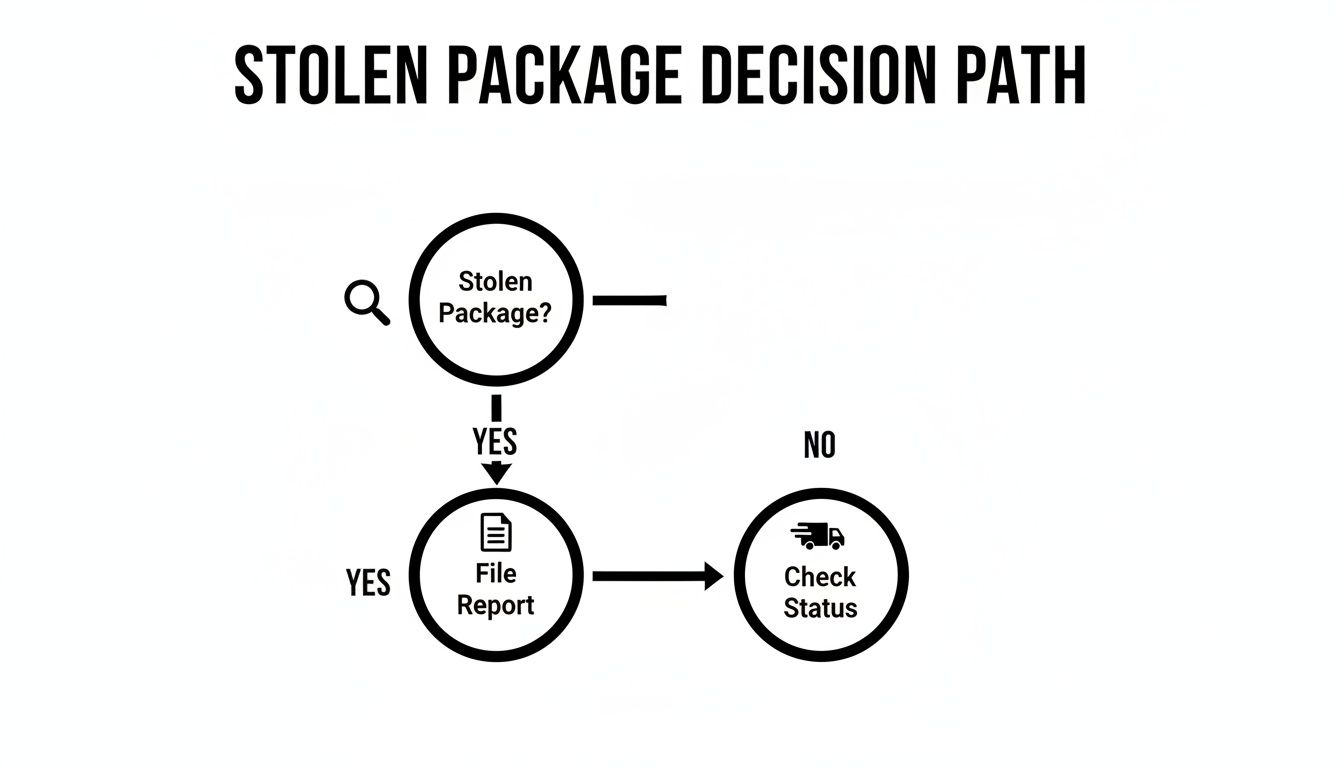
As you can see, the key is to act fast, either by double-checking the delivery status or moving straight to filing a report with the carrier and police.
The Community Effect
The power of this layered approach really multiplies when your neighbors get on board. It’s fascinating, but research from sources like Capital One Shopping shows that package theft drops significantly once smart security adoption in a neighborhood hits around a 30% threshold.
It proves that individual actions create a collective shield, making the whole area a hard target.
Ultimately, you’re not just buying a few pieces of tech; you're designing a comprehensive defense. Each layer backs up the others, so if a thief isn't scared off by the camera, they're stopped by the lockbox. That’s how you get real peace of mind.
A truly protected home is the one that blends smart technology with smart habits. If you're ready to build out your own security ecosystem, our deep dive into smart home security systems is the perfect place to start mapping out your plan.
Answering Your Top Questions
Even with the best plan, you're bound to run into a few specific snags. Let's tackle some of the most common questions people ask when they're trying to outsmart porch pirates.
Are Fake Security Cameras a Good Idea?
Honestly, a fake camera is better than no camera at all, but only just. Experienced thieves can often spot a dummy camera a mile away—they look for the missing power cords, the lack of a subtle red indicator light, and the cheap plastic construction.
For not much more money, a real, functional camera gives you a powerful deterrent and provides actual evidence if someone does steal your stuff. It's an investment in genuine peace of mind, not just the appearance of it.
My Apartment Won't Allow a Video Doorbell. What Now?
This is a classic problem for renters, but don't worry, you've still got plenty of moves. The trick is to focus on what you can control, not what you can't.
Your best bet is to become a master of delivery management. Get familiar with the FedEx, UPS, and Amazon apps. You can often reroute a package to a secure pickup point (like a FedEx Office or an Amazon Locker) or even have it delivered to your workplace.
Also, talk to your landlord. You might be able to install a smart lock on your own door for in-home deliveries, or you could rally your neighbors to ask management for a building-wide solution, like a dedicated package room.
For renters, the game is all about changing the delivery location. If your package never lands in a vulnerable lobby or shared hallway in the first place, the risk of it getting stolen plummets.
Do "You're on Camera" Signs Actually Deter Thieves?
You might be surprised, but yes, they often do. Think of it from the thief's perspective. They're usually looking for the easiest, lowest-risk target on the block. A simple sign that says your property is under video surveillance can be enough to make them think twice and just move on to the next house.
When you pair that sign with actual cameras, it becomes a potent part of a layered security strategy. The sign sends the first warning, and the camera backs it up. It’s a cheap, incredibly simple way to boost your home's defenses.


Leave a Reply