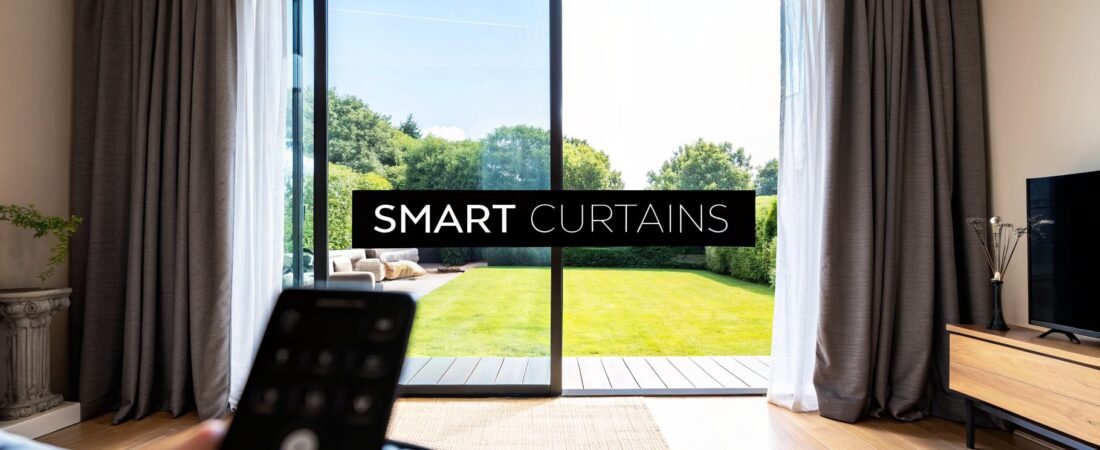
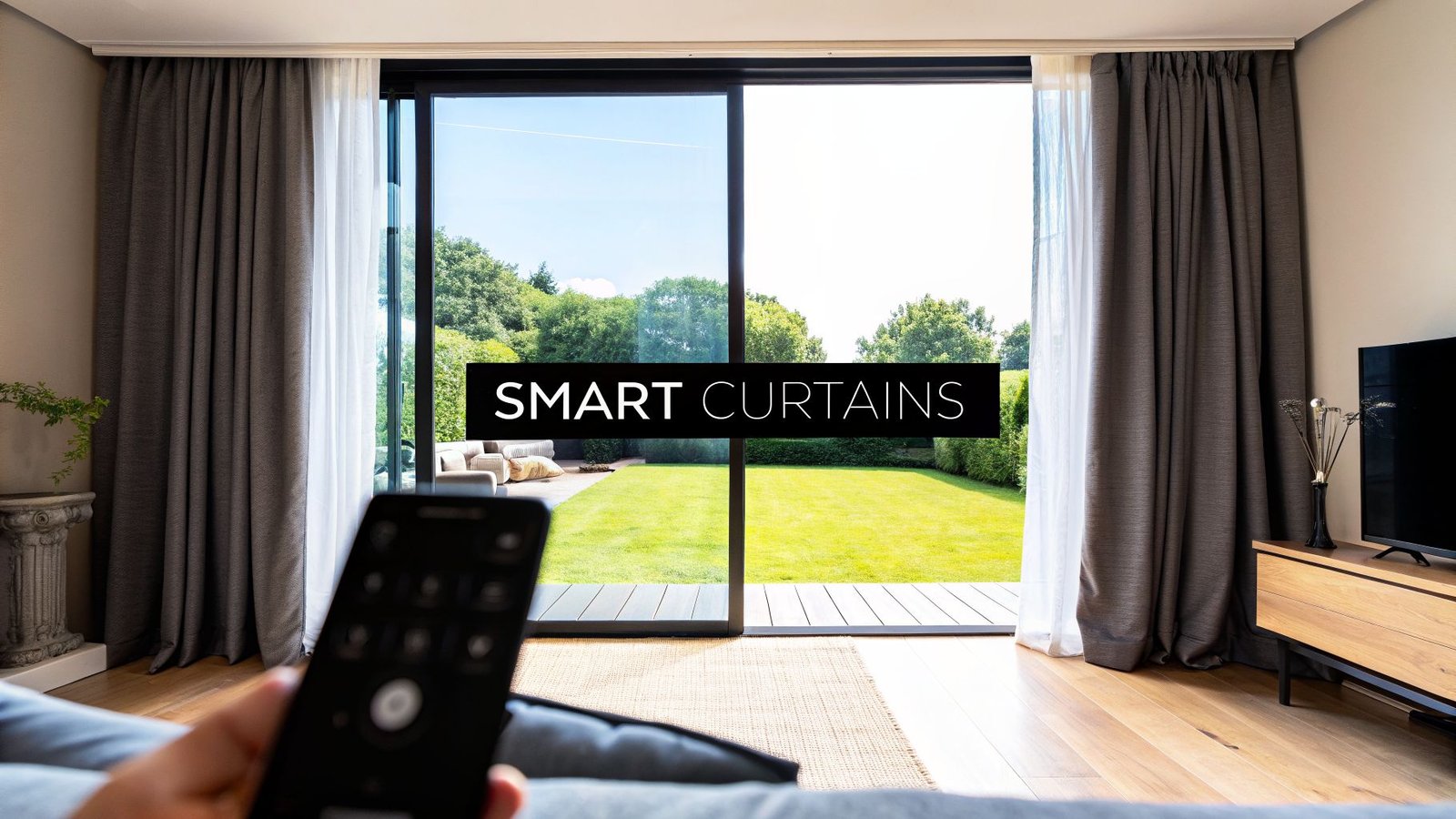
Let's get one thing straight: a motorized smart curtain is far more than just a regular curtain with a motor attached. It's a fundamental upgrade that ties your window treatments directly into your smart home, letting you control light, privacy, and ambiance with a tap on your phone or a simple voice command.
More Than Just a Motorized Curtain

It’s one thing to read about it, but another to experience it. Imagine waking up naturally as your bedroom curtains silently part to let in the morning sun, rather than being jolted awake by a blaring alarm. Or, when you're settling in for a movie, saying "Hey Google, it's movie time," and watching the room darken automatically. This isn't science fiction; it’s a practical and increasingly affordable reality for any home.
What we're really talking about is taking a static feature of your home—the humble curtain—and making it an active, intelligent part of your daily life. It’s the perfect blend of elegant design and smart technology that genuinely makes things easier.
In this guide, we’ll move past the "wow" factor and get into the nuts and bolts. We’ll show you exactly how these systems work and how they can make a real difference in your day-to-day.
What Smart Curtains Actually Do For You
The magic isn't just in the motor; it's in the "smart" integration that connects the physical curtain track to your digital world. This opens up a whole new level of control and automation that delivers some surprisingly practical benefits.
- Unbeatable Convenience: Finally, you can easily open and close those curtains on tall or hard-to-reach windows. Manage all the curtains in a room at once with a single command instead of walking around to each one.
- Real Energy Savings: Set your curtains to automatically close during the hottest part of summer afternoons. This simple act can significantly reduce the strain on your air conditioning, which you’ll notice on your next energy bill.
- A Smarter Approach to Security: When you're on vacation, schedule your curtains to open and close at normal times. This creates a convincing "lived-in" look that can be a powerful deterrent for potential break-ins.
- Life-Changing Accessibility: For anyone with mobility challenges, smart curtains are a game-changer. They provide an effortless way to control light and privacy, offering a greater sense of independence at home.
A motorized smart curtain turns your windows into dynamic shields that react to your schedule, your voice, and even the position of the sun. Your home becomes more responsive, comfortable, and efficient.
Think of it as an investment in a more streamlined, secure, and comfortable lifestyle. We're about to pull back the curtain (pun intended) on everything you need to know, from the core mechanics and smart home protocols to buying checklists and installation. Let's get started.
How Do Motorized Smart Curtains Actually Work?

Ever wondered what's happening behind the scenes when you tell Alexa to open the drapes? It's less magic and more clever engineering. Think of your smart curtain setup as a miniature, automated train system for your window. The motor is the locomotive, the track is the railway, and your command—whether from a remote, an app, or your voice—is the conductor giving the "all aboard."
This system simply automates the chore of pulling cords or sliding fabric. A small motor drives a belt or a geared mechanism inside the track, gliding your curtains open or shut with a smooth, even pull. It’s a simple concept, but the execution is what makes it feel so sophisticated.
The real value isn't just the movement itself. It’s the quiet, dependable automation that makes a room feel more responsive and alive. You're transforming a static window treatment into an active part of your home's daily rhythm.
So, let's pull back the curtain (pun intended) and look at the key pieces that work together to make this happen.
The Motor Is The Engine
This is the heart of the whole operation. Don't picture a clunky, loud engine; these motors are compact, efficient, and engineered to be incredibly quiet. A quality system typically operates at less than 45 decibels—that's quieter than the hum of a modern refrigerator. You'll mainly find two types of motors on the market.
Track-Mounted Motors: These are compact, self-contained units that clip onto the end of the curtain track. They use a toothed belt that loops through the track to pull the curtain carriers. This design is fantastic for retrofitting existing curtains and is the most common style you'll see in DIY kits.
Tubular Motors: Just like the name implies, these are long, tube-shaped motors that disappear completely inside the curtain rod. The result is a clean, seamless look with no visible motor box. Because they're built for strength, tubular motors are the go-to choice for custom installations, especially for handling very heavy fabrics.
The whisper-quiet performance you get from these systems often comes down to high-quality internal components, like a direct drive motor, which helps minimize noise and mechanical wear for better long-term reliability.
Choosing Your Power Source
Just as critical as the motor is how you'll get electricity to it. This choice has a direct impact on installation, maintenance, and day-to-day use. Each option serves a different need, so it’s important to match the power source to your specific situation.
To make it easier, let's break down the pros and cons of the three main options for powering your smart curtains.
Choosing Your Power Source: A Comparison of Options
This table compares the three main power sources for motorized smart curtains to help you decide which is best for your installation needs and lifestyle.
| Power Source | Best For | Installation | Maintenance |
|---|---|---|---|
| Hardwired | New builds, major renovations, very large or heavy curtains. | Requires a professional electrician to run wires. | Virtually none; provides consistent, reliable power. |
| Rechargeable Battery | Retrofitting existing homes, DIY projects, renters. | Simple and fast; no wiring needed. | Needs recharging every 6-12 months via a USB cable. |
| Solar Panel | Eco-conscious homeowners, windows with ample sunlight. | Easy; panel attaches near the window and plugs into the motor. | Minimal; supplements the battery, extending time between charges. |
After you've sorted out the power, the final piece of the puzzle is communication. This is the wireless language—like Wi-Fi, Zigbee, or Z-Wave—that your curtain motor uses to "talk" to your smart home hub, phone, or voice assistant.
This choice is what enables all the smart features, and it’s a big one. If you want to dive deeper, our guide on choosing the right smart home protocol is a great place to start. It’ll help you figure out how your new curtains will fit into your broader smart home ecosystem.
Integrating Smart Curtains with Your Connected Home
Having a motor is great, but the "smart" part of smart curtains is all about connection. This is what elevates them from a neat gadget to a seamless part of your daily life, working in concert with the rest of your home.
For your curtains to join your smart home ecosystem, they need to speak the same language as your other devices. This communication happens over wireless protocols, and picking the right one is crucial for a system that’s both responsive and reliable.
Choosing Your Communication Language
Think of smart home protocols as different languages. For your smart lights, thermostat, and curtains to work together, they all need to be fluent in the same one. The three main options you'll run into are Wi-Fi, Zigbee, and Z-Wave.
Wi-Fi: This is the path of least resistance. Your home already has a Wi-Fi network, so a curtain motor with built-in Wi-Fi can connect directly to your router. No extra hardware needed, which makes it a fantastic choice for automating just a single room or two.
Zigbee and Z-Wave: These are low-power networks built specifically for smart home gear. Instead of bogging down your main Wi-Fi network, devices using Zigbee or Z-Wave create their own dedicated web of communication. This leads to rock-solid stability and faster response times, especially as you add more and more devices.
So, what's the bottom line? For a simple setup with just a few smart curtains, Wi-Fi is perfectly fine. But if you're planning a whole-home system with dozens of lights, locks, and sensors, a dedicated Zigbee or Z-Wave network is the smarter, more robust choice.
Using Zigbee or Z-Wave does require a central translator, often called a smart home hub. If you're heading down that road, our in-depth https://automatedhomeguide.com/smart-home-hub-comparison/ is the perfect place to start.
Voice Control: The Ultimate Convenience
Once your curtains are connected, you unlock the magic of hands-free control. By linking your system to a voice assistant like Amazon Alexa, Google Assistant, or Apple HomeKit, you can operate them with simple commands.
But it gets much better than just saying, "Alexa, open the living room curtains." The real power comes from creating custom scenes and routines that orchestrate multiple actions at once. Imagine kicking off movie night with a single phrase.
"Hey Google, it's movie time."
With that one command, your curtains glide shut, your smart lights dim to a cozy 10% brightness, and your TV and soundbar fire up. That’s when your smart house starts feeling truly intelligent. If you're curious about the tech behind this or want to tackle a project yourself, this motorized shades DIY guide offers some fantastic insights.
Creating Automated Schedules and Routines
Beyond voice commands, true automation is where smart curtains really shine. By setting up schedules, your curtains can work for you 24/7, becoming an active part of your home's security and energy efficiency strategy without you lifting a finger.
Here are just a few ideas to get you started:
Wake-Up Routine: Instead of a jarring alarm, program your bedroom curtains to slowly open over five minutes starting at 7:00 AM. This gentle, natural light is a much more pleasant way to start your day.
Energy-Saving Schedule: In the summer, have your west-facing curtains automatically close from 2:00 PM to 5:00 PM. This simple act blocks the harshest afternoon sun, giving your AC a break and trimming your energy bills.
Security Automation: Heading out of town? A "Vacation Mode" can randomly open and close curtains throughout the day, creating a convincing illusion that someone is home and deterring potential intruders.
This level of intelligent automation is what truly separates a simple motorized curtain from a genuinely smart one. It's about building a home that actively anticipates your needs, improves your comfort, and even saves you money.
More Than Just a Cool Trick: Real-World Wins of Smart Curtains
It’s easy to think of motorized curtains as just a cool party trick—telling them to open or close with your voice is definitely neat. But the real magic happens when you look past the novelty and see how they can genuinely improve your daily life. They become an active part of your home, saving you money, making your house more secure, and even protecting your belongings.
Let's start with the most practical benefit: lower energy bills. Your windows are like giant gateways for heat, letting it pour in during the summer and escape in the winter. Smart curtains give you a simple, automated way to manage that.
Think about it: by programming your curtains to close automatically during the hottest part of a summer afternoon, you can cut unwanted heat gain by up to 33%. Your AC unit doesn't have to work nearly as hard, and you’ll see the difference in your monthly bills.
This flowchart can help you pinpoint which benefit—whether it’s saving energy, boosting privacy, or just adding comfort—is your main driver for going smart.

As you can see, a single upgrade can solve several different problems, depending on what you’re trying to achieve.
Make Your Home Look Lived-In, Even When It’s Not
An empty house with curtains drawn shut for days on end is a dead giveaway to burglars. This is where smart curtains become a brilliant, low-effort security tool. By creating automated schedules, you can make your home look occupied even when you're on vacation.
Instead of a static, lifeless appearance, your home will seem active and natural.
- Morning: Curtains in the living room open up to greet the day.
- Evening: As dusk settles, they close for privacy.
- "Vacation Mode": The best systems even have a feature that slightly randomizes these open and close times each day, making the effect even more convincing.
This simple illusion makes your home a much less appealing target. It’s a set-it-and-forget-it strategy that delivers serious peace of mind.
Protect Your Furnishings and Improve Accessibility
The benefits don't stop there. Those same automated schedules that save you money and secure your home also act as a shield for everything inside it. The sun’s ultraviolet (UV) rays are relentless, causing fading and long-term damage.
Over time, direct sunlight can ruin:
- Hardwood floors
- Furniture and upholstery
- Artwork and family photos
- Expensive rugs
By programming your curtains to block the harshest midday sun, you’re essentially preserving the life and value of your furnishings. On top of that, smart curtains are a game-changer for anyone with mobility issues or for those hard-to-reach windows. They offer effortless control, providing a real sense of independence and comfort. If you want to explore more ways to cut your utility costs, our guide to building an energy-efficient smart home has plenty of other great ideas.
Your Essential Motorized Smart Curtain Buying Guide

Diving into the world of smart curtains can feel overwhelming, but it doesn't have to be. Let's cut through the noise. Picking the right system really boils down to getting just a few key details right from the start.
This isn't about chasing trends; it's about finding a solution that fits your windows, your tech, and your wallet. We'll walk through a simple, practical checklist to make sure you choose a system you’ll be happy with for years to come.
Nail Your Measurements and Match the Motor
First things first: grab a tape measure. This is the one step where "close enough" isn't good enough. Inaccurate measurements are the number one cause of headaches, leading to tracks that don't fit, annoying light gaps, or an overworked motor that gives up way too soon.
Before you even think about brands or features, you need to measure your window and decide on the mounting style.
- Inside Mount: If you want the track to sit neatly inside the window frame, measure the frame's interior width and height. Take three measurements for each dimension (top, middle, bottom for width; left, center, right for height) and use the smallest value. This ensures the track will clear any imperfections in the frame.
- Outside Mount: For a more dramatic look that maximizes light when the curtains are open, you'll mount the track on the wall above the window. Measure the full width of the window trim and add 3-6 inches to each side. For the height, decide where you want the curtains to end, then plan to mount the track at least 4-6 inches above the top of the window frame.
Once you have your dimensions, the next piece of the puzzle is your curtain fabric. A heavy set of blackout drapes weighs a lot more than breezy, sheer panels, and the motor needs to be up to the task. Always check the motor's weight capacity, which is typically listed in pounds (lbs).
The biggest mistake I see people make is underestimating their curtain weight. A motor that's constantly straining will be noisy and will fail much, much faster. It's always a good idea to choose a motor with a little more power than you think you need.
With the physical hardware sorted out, it's time to get into the "smart" part of smart curtains.
Check for Smart Home Compatibility
Let's be honest, the real magic happens when your curtains can talk to the rest of your home. The whole point of a smart curtain is seamless integration, so you need to make sure it plays nicely with the smart ecosystem you already use.
This means double-checking that the system you want explicitly supports your voice assistant of choice:
- Amazon Alexa
- Google Assistant
- Apple HomeKit
If you're running a more advanced setup with a hub like SmartThings, Hubitat, or Home Assistant, you'll need to dig a bit deeper. Wi-Fi-based curtains are often the easiest to connect, but systems using Zigbee or Z-Wave can offer rock-solid reliability once they're paired with your hub.
Set a Realistic Budget
Motorized smart curtains aren't a one-price-fits-all product. The cost can range from a few hundred dollars for a single window DIY project to thousands for a professionally installed, whole-home solution. Knowing where your needs fall will help you set a practical budget.
- DIY Retrofit Kits ($100 – $300 per window): These are fantastic, budget-friendly options that let you motorize the curtain track you already own. It's a great way to try out the technology, though you might sacrifice some quietness and polish compared to a dedicated system.
- Mid-Range Systems ($400 – $800 per window): This is the sweet spot for many people, featuring brands like Somfy and SwitchBot. You're getting a complete package—track, motor, and remote—with quieter performance and more robust smart home features.
- High-End Custom Solutions ($1,000+ per window): Welcome to the premium tier, dominated by brands like Lutron. Here, you're paying for whisper-quiet operation, flawless integration, and a white-glove professional installation experience.
To give you a clearer picture of what your money gets you, the table below compares what you can expect from each tier.
Smart Curtain System Feature Comparison
This table breaks down the technical specs to help you decide which system level is the right investment for your home.
| Feature | Entry-Level System (e.g., DIY Kit) | Mid-Range System (e.g., Somfy, SwitchBot) | High-End System (e.g., Lutron) |
|---|---|---|---|
| Motor Noise Level | 40-50 dB (Noticeable) | 30-40 dB (Quiet) | < 30 dB (Whisper-Quiet) |
| Weight Capacity | Up to 20 lbs | Up to 75 lbs | 100+ lbs |
| Connectivity | Wi-Fi, often requires a bridge | Wi-Fi, Zigbee, RTS | Proprietary RF (Requires hub) |
| Installation | DIY | DIY or Professional | Professional Only |
| Key Feature | Affordability | Balanced Performance & Features | Flawless Integration & Silence |
Looking at these systems side-by-side makes it much easier to see the trade-offs. An entry-level kit is perfect for a guest room, while a high-end system makes sense for a primary bedroom or home theater where silence is golden.
By methodically working through these four areas—measurements, compatibility, budget, and specs—you're setting yourself up for a successful purchase. Taking the time to plan ensures you'll get a smart curtain system that not only works perfectly but also adds a real touch of convenience and elegance to your daily life.
A Global Trend: The Rise of the Automated Home
Not too long ago, curtains that opened with the touch of a button felt like something straight out of a sci-fi movie—a luxury reserved for high-tech mansions. That picture has completely changed. Automated window treatments are now a common sight, a clear sign of how we're starting to view our homes as living, breathing spaces that can adapt to our daily routines.
This isn't just about a cool gadget anymore. It's about a fundamental shift in what people expect from their living environment. The explosive growth in demand shows that homeowners are seeing the real, practical value of smart curtains, which goes far beyond just opening and closing them without getting up.
We've moved past the early adopter phase. Smart home technology is quickly becoming a standard feature in the modern home, and motorized curtains are a perfect example of this. They blend sophisticated technology with something we use every single day.
What makes them "smart" is the real game-changer. It's not just about adding a motor to a track; it's about connecting that motor to your life. The market is overwhelmingly choosing systems that can be controlled by voice, run on timers, and fit right into a larger smart home setup.
A Market Gaining Serious Momentum
If you're wondering whether this is just a passing fad, the numbers tell a very clear story. This is a market with serious staying power.
The global motorized smart curtain market was valued at around USD 4.07 billion in 2026, and it's on track to hit USD 5.31 billion by 2031. That’s a steady climb, with a compound annual growth rate (CAGR) of 5.47%, which points to sustained interest from homeowners. You can get more details about the expanding smart curtain market and what's driving this growth.
Here’s an even more telling detail: the market for the "brains" of the operation—the IoT-enabled motors that connect to your network—is growing at an even faster clip of 8.52% CAGR. This shows that people aren't just buying automated curtains; they're specifically seeking out fully integrated, intelligent systems they can control from anywhere.
Regional Growth and What It Means for You
While this is happening worldwide, some regions are really hitting the accelerator. The Asia-Pacific market, for instance, is seeing explosive growth. This is fueled by a boom in new high-end construction where automated features are often included as a standard perk, alongside a strong manufacturing base that makes the technology more accessible.
For the average person, this global momentum is fantastic news. More competition means a wider variety of products, more innovation, and better prices.
Choosing to install motorized smart curtains today isn't just about adding a neat feature to your home. It's about investing in a mature technology that’s already well on its way to becoming a household standard. You're simply bringing your home up to speed with where technology is already headed.
Frequently Asked Questions
Jumping into a new home upgrade always brings up a few questions. To help you get a clear picture, we've put together answers to the things homeowners most often ask about motorized smart curtains.
Can I Motorize the Curtains I Already Own?
In most cases, yes, you absolutely can. That's what retrofit kits are for. These kits typically include a motor that clamps onto your existing curtain rod or track. The main thing to double-check is compatibility—make sure the motor fits your track's design and can handle the total weight of your curtains.
What Happens if the Power Goes Out?
You won’t be stuck with your curtains open or closed. Nearly all motorized systems have a manual override, meaning you can just give the fabric a gentle tug to operate them by hand, the old-fashioned way. If your system has a rechargeable battery pack, it will keep working just fine until the battery runs down.
It's a common worry, but you can rest easy. Smart curtains are built for real life, not just perfect conditions. A power outage won't lock you out of controlling your own windows.
Are Motorized Smart Curtains Noisy?
This is probably one of the biggest myths, but modern smart curtains are surprisingly quiet. A good quality motor will operate at a noise level below 45 decibels, which is softer than a whisper. Noise level is definitely a key spec to look for when you're comparing different models.
This focus on quiet, seamless operation is one reason the technology is taking off. The market in the Asia-Pacific region, for instance, is set to grow by an 8.28% CAGR between 2026 and 2031, as automation becomes a standard feature in new homes. You can read the full research on automatic curtain market trends to see how the industry is evolving.
How Much Do They Actually Cost?
The price really runs the gamut, depending on what you're looking for. Here’s a rough breakdown:
- DIY Retrofit Kits: If you're adding a motor to your existing curtains, you can find kits starting around $100 to $300 for a single window.
- Mid-Range Systems: For a complete, all-in-one system from a well-known brand, you’ll likely spend between $400 and $800 per window.
- High-End Custom Solutions: If you're going for a professionally installed setup with premium fabrics and top-of-the-line motors, the cost can easily be $1,000 or more per window.
Ready to bring that touch of automation to your windows? At Automated Home Guide, we live and breathe this stuff. We provide the expert insights and real-world reviews you need to choose the perfect system for your home. Explore our guides and see what’s possible at https://automatedhomeguide.com.
Leave a Reply