
The real difference between a programmable thermostat and a smart thermostat boils down to one thing: a programmable model sticks to a fixed schedule you set yourself, while a smart thermostat actually learns your habits and adjusts on its own. The decision really hinges on whether you're a hands-on scheduler or you'd rather have the tech do the heavy lifting for you.
Understanding the Key Differences
Picking the right device is all about figuring out how you want to manage your home's temperature. Programmable thermostats are great if your routine is consistent—a true "set it and forget it" solution. Smart thermostats, on the other hand, offer a more dynamic, hands-off approach that optimizes your climate control without you touching a thing. Your lifestyle, budget, and how much you value connectivity will point you to the right choice.
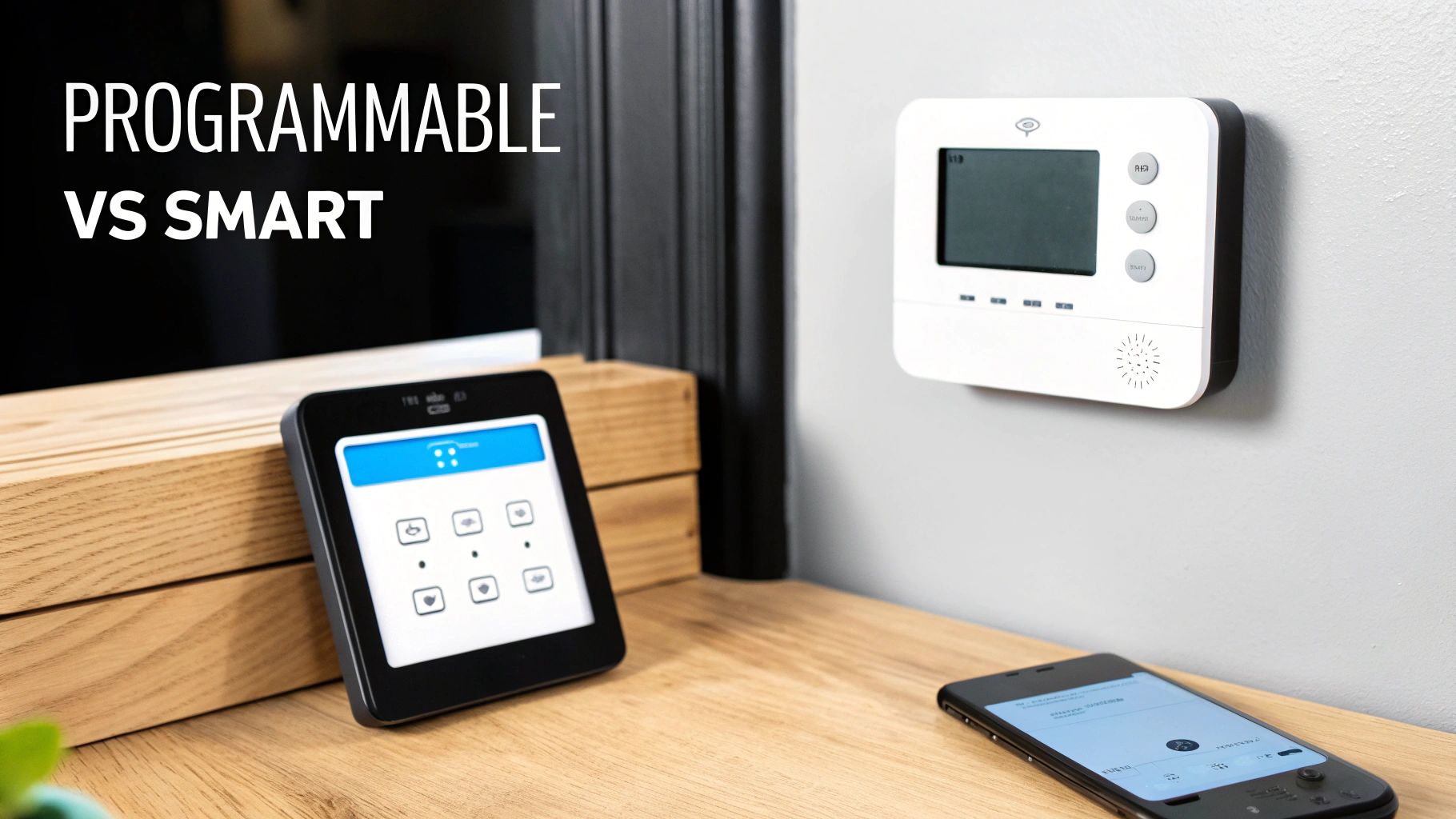
Smart thermostats also play well with other connected devices. If you're building a connected home, checking out a smart home hub comparison can help you see how everything fits together.
To make things clearer, let's break down the main distinctions feature by feature.
Comparing Programmable and Smart Thermostat Features
This table gives a quick, at-a-glance look at what sets these two types of thermostats apart.
| Feature | Programmable Thermostat | Smart Thermostat |
|---|---|---|
| Control Method | Manual scheduling on the device | App-based remote control & AI learning |
| Learning Ability | None; follows fixed schedules | Adapts to routines and preferences |
| Energy Savings | Potential savings up to 10% if used correctly | Higher savings potential through optimization |
| Connectivity | Typically offline | Wi-Fi connected for remote access |
| Typical Cost | $25 – $100 | $100 – $300+ |
Ultimately, both can save you money, but their approaches are fundamentally different.
A programmable thermostat gives you the tools to save energy, but a smart thermostat does the work for you by analyzing your habits and making intelligent adjustments.
So, Why Stick with a Programmable Thermostat?
Programmable thermostats are the tried-and-true workhorses of home climate control. Think of them as a straightforward tool for a specific job: managing your home's temperature on a fixed schedule. Their biggest selling point is their simplicity and directness. You don't need Wi-Fi, an app, or a tech degree—just a predictable daily routine.
The whole concept revolves around scheduling. You’ll typically run into a few common types:
- 7-Day: This one’s the most flexible, letting you set a different schedule for every single day of the week. It’s a great fit for households where Monday looks nothing like Wednesday.
- 5-2 Day: Perfect for the classic work week. You get one schedule for Monday through Friday and another for the weekend.
- 5-1-1 Day: A slight variation on the 5-2, this gives you a weekday schedule, a separate one for Saturday, and another for Sunday.
This simple structure is all about setting specific temperatures for key times—when you wake up, head out the door, come home, and go to bed. The idea is to automate energy savings without any fuss.
The Trade-Off: Control vs. Complexity
The real beauty of a programmable thermostat is its predictability. You set the schedule, and it just works. No algorithms, no surprises. This "set it and forget it" approach is ideal if you value a hands-on, offline solution and aren't keen on smart devices tracking your habits.
But that manual control is also its biggest weakness.
A programmable thermostat is only as smart as the person who programmed it. If you set it up wrong or constantly override the schedule, you can kiss those energy savings goodbye. It basically becomes a fancy manual thermostat.
Getting the initial setup right can be a bit of a headache. These devices hit the market in a big way back in the 1990s, promising lower energy bills. The reality? Many people found them confusing to program and never bothered, which meant they didn't actually save much money. For a deeper dive into how thermostat tech has evolved, it's worth checking out some industry analysis on thermostat technology.
How Smart Thermostats Redefine Home Comfort
Where programmable thermostats stick to a rigid schedule, smart thermostats break the mold completely. They introduce adaptive learning, which is a fancy way of saying they actually pay attention to your daily life. Using sensors and clever algorithms, they build a heating and cooling schedule that perfectly matches your real habits, not just a timer you set once and forgot about.
This is the real game-changer in the programmable vs. smart thermostat debate. Instead of you telling it what to do, a smart thermostat learns your routine—when you leave for work, when you get home, and even which rooms you spend the most time in.
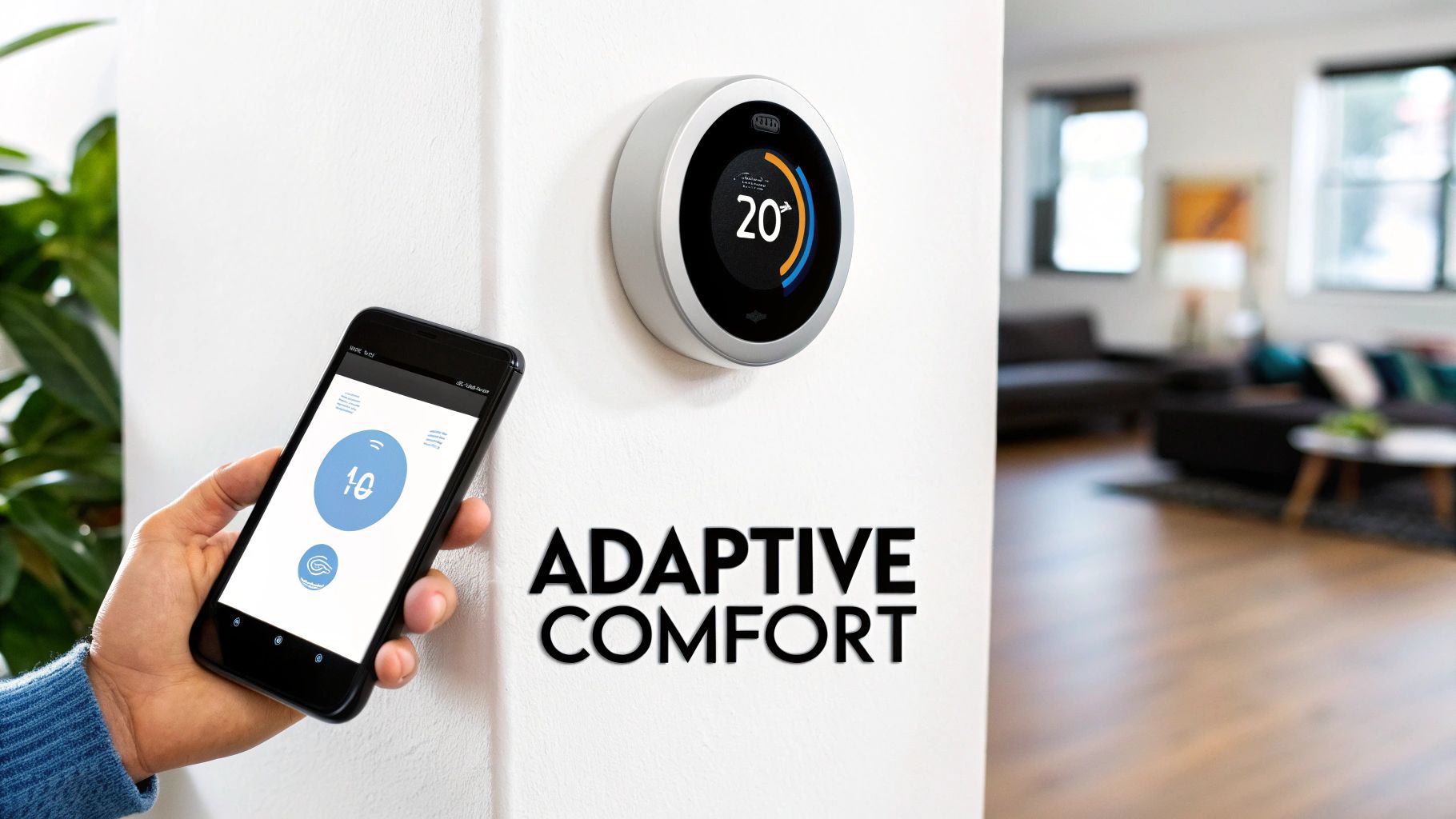
It’s this truly hands-off approach, powered by a few key innovations, that delivers a new level of convenience and efficiency.
Core Smart Thermostat Features
Smart technology fundamentally changes how you manage your home's climate. A few features stand out:
- Geofencing: This uses your phone's location to figure out if you're home or away. The system automatically switches to an energy-saving mode the moment you leave and starts getting the house comfortable again just before you arrive. No wasted energy, no coming home to a cold house.
- Remote App Control: Lying on a beach and realize you left the AC blasting? No problem. You can adjust the temperature from anywhere right from an app on your phone.
- Smart Home Integration: Smart thermostats play well with others. They connect easily with voice assistants like Amazon Alexa and Google Assistant, so you can just say, "Alexa, turn the heat up to 72 degrees," without getting off the couch.
The real magic of a smart thermostat isn't just controlling it from your phone; it's that it automates energy savings based on your actual life, creating a system that practically thinks for itself.
This kind of dynamic, helpful tech has caught on in a big way. The global smart thermostat market was valued at USD 4.81 billion in 2023 and is expected to balloon to USD 13.80 billion by 2030. This boom shows a clear shift toward smarter, more efficient homes. For a deeper dive, check out the data on the smart thermostat market's rapid expansion.
On top of all that, these devices also check local weather forecasts to make smarter adjustments ahead of time and give you detailed energy reports, so you can finally see exactly where your money is going each month.
Analyzing Cost vs. Energy Savings
When you’re weighing a programmable thermostat against a smart one, the price tag is usually the first thing that jumps out. It’s a pretty clear difference right from the start. A solid programmable thermostat might set you back anywhere from $25 to $100, making it a very affordable upgrade.
On the other hand, smart thermostats are a bigger initial purchase, typically running from $100 to over $300. But looking only at the upfront cost is a bit shortsighted. The real story unfolds when you look at the energy savings over time.
A well-programmed thermostat can trim your energy bills by up to 10%, which is nothing to sneeze at. The catch? You have to program it diligently and stick to the schedule without constantly overriding it, which is where most people fall short.
Smart thermostats shine because they take human error out of the equation. Features like adaptive learning and geofencing mean the system adjusts itself based on your actual life, not a rigid schedule you set up months ago. You can dive deeper into how this works in our guide on smart thermostat energy savings.
Calculating Your Return on Investment
So, how do you figure out which is the better investment for you? You need to look at your potential return on investment (ROI) by considering a few personal factors:
- Local Climate: If you live somewhere with blistering summers or frigid winters, a smart thermostat's fine-tuned optimization will pay for itself much faster.
- Utility Rates: The higher your electricity or gas prices, the more each degree of savings matters, and the quicker your smart thermostat earns its keep.
- Energy Rebates: Don't forget to check with your local utility provider! Many offer rebates of $50 or more for installing an ENERGY STAR certified smart thermostat, which can take a serious chunk out of that initial cost.
Think of a smart thermostat as a long-term investment in your home's efficiency. A programmable model is a simple, effective upgrade, but a smart thermostat actively works to pay for itself by constantly fine-tuning your energy use.
The market trend is a clear indicator of where things are headed. In 2021, the U.S. smart thermostat market was valued at a whopping USD 1.09 billion and is expected to climb to USD 3.86 billion by 2029. This isn't just hype; it's driven by technology that learns your habits to automatically optimize heating and cooling, leading to more significant, hands-off savings. You can find more details on this growth in the U.S. smart thermostat market report on Fortune Business Insights.
Installation and Daily Use: A Tale of Two Experiences
When you pit a programmable thermostat against a smart one, the differences pop up right from the moment you open the box and continue into how you interact with it every single day.
Getting Set Up
Installing a programmable thermostat is usually a pretty simple affair. For most people, it's a quick DIY job—unscrew the old one, connect a few color-coded wires to the new one, and you're probably done in under an hour. It's designed to be a straightforward swap.
Smart thermostats, on the other hand, can throw you a curveball. The biggest potential snag is the C-wire, or common wire, which gives the thermostat the constant power it needs to run its Wi-Fi, screen, and sensors. A lot of older homes just don't have one, which means you either need to get creative with a power adapter kit or call in an electrician. It’s a common hurdle, but not an insurmountable one. For a more in-depth look at the process, our smart thermostat installation guide walks you through everything.
Your Day-to-Day Experience
Once it's on the wall, how you live with it becomes the real story. Let's be honest, the user interface on most programmable thermostats feels like a relic from the past. You're often stuck poking at a series of small, clunky buttons and trying to decipher a basic digital screen just to set a simple schedule.
Smart thermostats are a complete departure from that. They're built around sleek, intuitive mobile apps that let you control your home's temperature from your couch, the office, or even from a beach on vacation. The experience is fluid and visual, fitting right into the way we live with our technology today.
The core difference in daily use boils down to one word: access. With a programmable thermostat, you have to be standing in front of it to make a change. A smart thermostat puts total climate control right in the palm of your hand, no matter where you are.
At the end of the day, your thermostat is the brain of your entire HVAC system. Before upgrading, it's always a good idea to make sure your furnace and AC are in good working order. Getting professional heating and air system services for a quick check-up ensures everything is compatible and running efficiently, so you can truly get the most out of your new thermostat—whether it’s smart or just programmable.
Which Thermostat Is Right for Your Lifestyle
Picking between a programmable and a smart thermostat really boils down to your daily routine, how much you want to spend, and how comfortable you are with new tech. There's no single "best" answer; it’s about finding the one that fits your life. If your schedule is consistent—think a classic 9-to-5—a programmable model is probably all you need.
You can just set it and forget it. If you leave for work and come home at roughly the same time every day, a simple, pre-set schedule will handle your heating and cooling efficiently. It's a straightforward, budget-friendly option for anyone who wants a reliable device that just works, no internet connection required.
On the other hand, a smart thermostat is a game-changer for households where no two days look the same. It’s perfect for freelancers, shift workers, or busy families with ever-changing plans. The ability to adjust on the fly from anywhere is invaluable. Plus, if you travel often, features like vacation mode simplify the task of preparing your home before vacation and keep energy waste to a minimum.
Think of it this way: a programmable thermostat is a tool you command. A smart thermostat is more like a partner that adapts to you, which makes it far better at maximizing savings in dynamic living situations.
This decision tree infographic can help you see which path makes the most sense for your household.
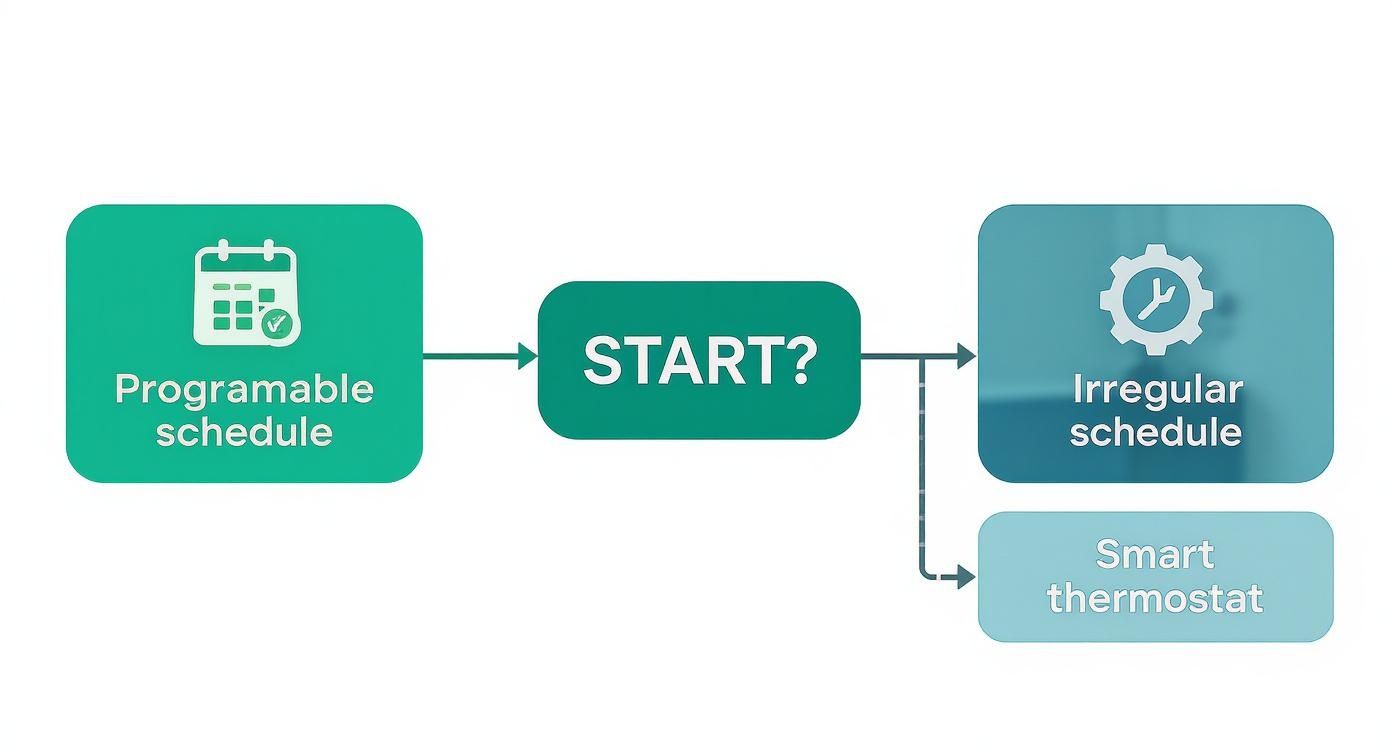
As the infographic shows, the biggest factor is how predictable your schedule is. A fixed routine points toward a programmable thermostat, while an irregular one almost always calls for smart technology to get the most savings and convenience.
Frequently Asked Questions
When you're trying to decide between a programmable and a smart thermostat, a few last-minute questions always seem to pop up. Let's get you some clear, straightforward answers so you can make a choice you feel good about.
Do I Need a C-Wire for a Smart Thermostat?
This is probably the most common question I get. Many smart thermostats do need a C-wire (common wire) to get the continuous power they need for Wi-Fi and that fancy display. If you have an older home, you might not have one, but don't let that stop you.
It's not a dealbreaker anymore. Most top brands now include a power adapter kit right in the box, which solves the problem down at your furnace. You can also find specific models built to run without a C-wire at all.
Are Smart Thermostats Secure?
It's a valid concern. You're connecting a device that controls your home's comfort to the internet, after all. The good news is that reputable brands take this seriously, using encryption to protect your data and your connection. Any data they do collect is usually anonymized and just helps them make their learning algorithms better.
The single best thing you can do for security is to practice good digital hygiene. Always set a strong, unique password for the thermostat's app and turn on two-factor authentication if it's offered. It’s a simple step that makes a huge difference.
Can a Smart Thermostat Work with an Old Furnace?
Yes, most of the time it can. Smart thermostats are designed to work with standard low-voltage HVAC systems, whether they're brand new or decades old. The real issue is almost always the wiring—specifically, that missing C-wire—not the age of your furnace or air conditioner.
Before you add anything to your cart, do yourself a favor and use the manufacturer's online compatibility checker. It only takes a minute and will confirm whether your system is a match.
At Automated Home Guide, our goal is to help you make smart choices for your connected home. You can find more guides and resources to build the perfect setup for your lifestyle at https://automatedhomeguide.com.

Leave a Reply