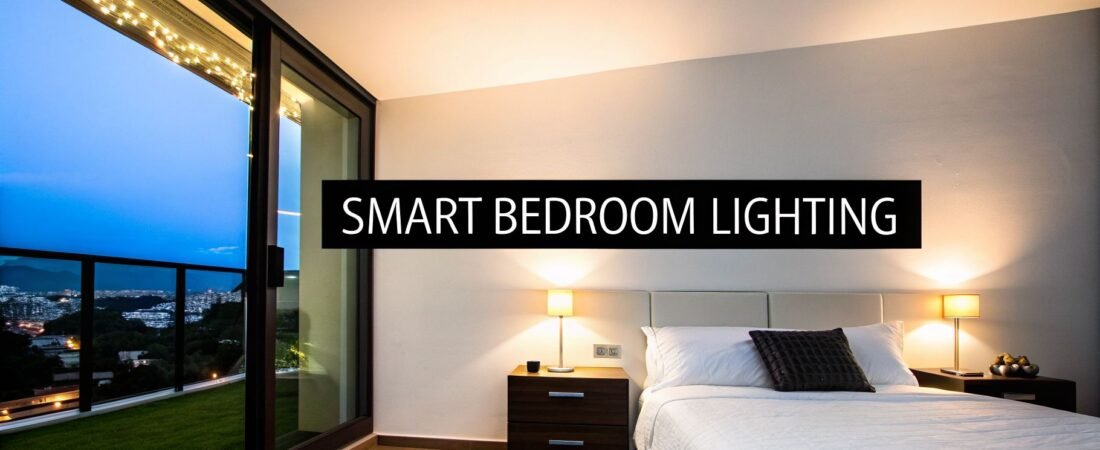
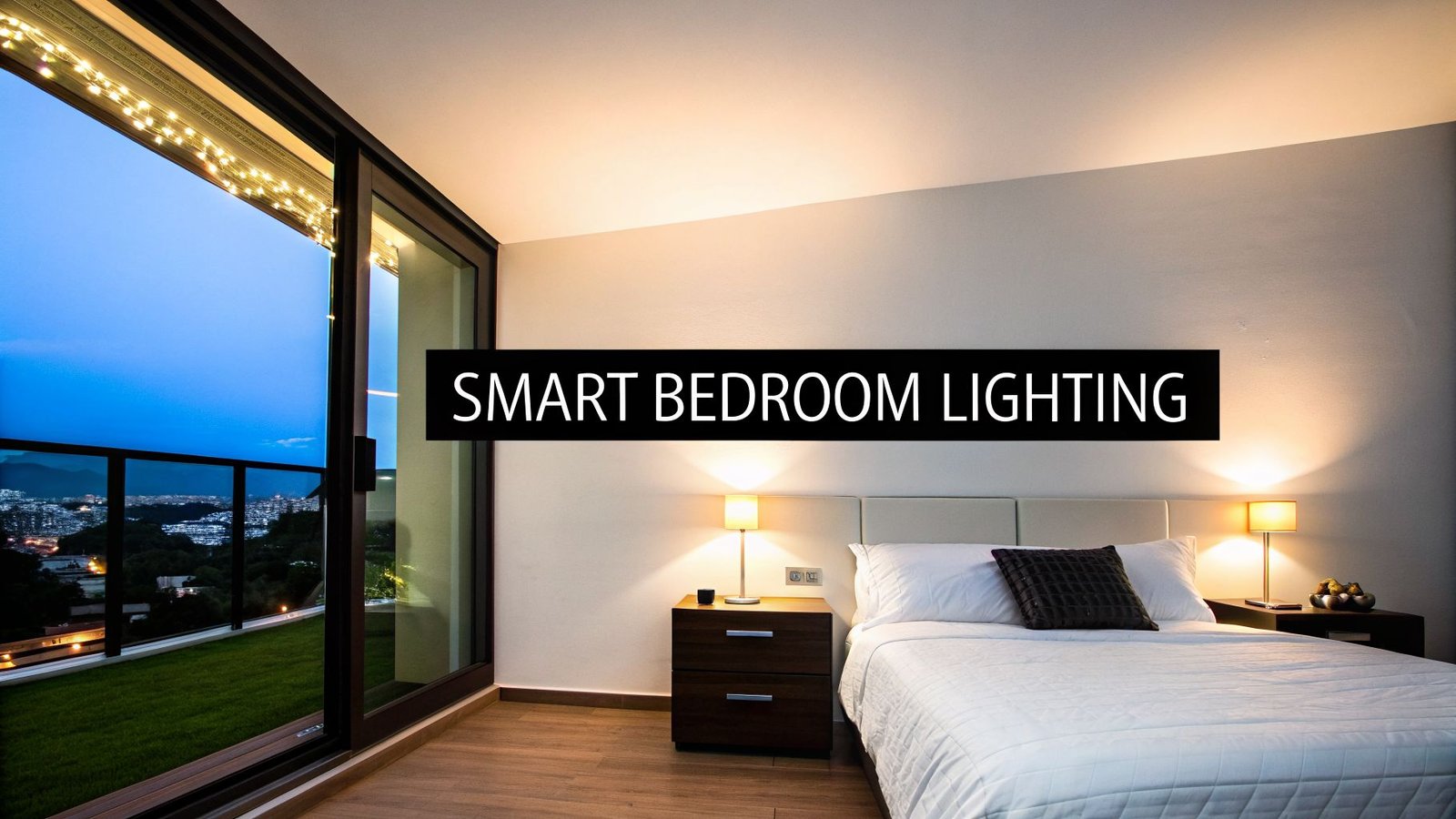
Picture this: your bedroom lights aren't just for seeing in the dark anymore. Instead, they've become a personalized system that helps you wake up, wind down, and feel your best. That’s the huge leap you take when you move from standard bulbs to smart bedroom lighting. It’s an upgrade that turns a simple utility into an active part of your daily life.
What Is Smart Bedroom Lighting and Why Is It Worth It?
Think of it like the difference between a flip phone and a smartphone. Both make calls, but one opens up a whole new world of possibilities. Smart bedroom lighting does the same for your most personal space, moving beyond a simple "on" or "off" switch to give you dynamic control.

At its heart, smart lighting is a clever mix of energy-saving LED technology and wireless connectivity (like Wi-Fi or Bluetooth). This combo lets you control not just the brightness but often the color temperature of your lights—from a cool, energizing white to a warm, cozy amber. And you can do it all from an app on your phone or with a simple voice command.
The market for this technology is booming for a reason. It's projected to become a massive USD 46.01 billion industry by 2033, and indoor lighting already made up 60% of the market back in 2023. This isn't just about cool gadgets; it's about people wanting more convenience, comfort, and control in their homes.
To really see the difference, it helps to compare the old with the new.
Smart Lighting vs Traditional Lighting at a Glance
This table breaks down exactly what you gain when you make the switch.
| Feature | Traditional Lighting | Smart Bedroom Lighting |
|---|---|---|
| Control | Manual on/off switch on the wall or lamp | App, voice, automated schedules, remote access |
| Brightness | Fixed or limited dimming via a special switch | Fully dimmable from 1% to 100% |
| Color | Fixed color (warm white or cool white) | Adjustable color temperature and millions of RGB colors |
| Energy Use | Higher consumption (especially with incandescent bulbs) | Highly efficient LEDs, automated shut-offs save more |
| Automation | None | Fully programmable scenes, schedules, and routines |
| Cost | Low initial cost for bulbs and fixtures | Higher initial cost, but long-term energy savings |
As you can see, smart lighting is about so much more than just illumination.
The Core Drivers of Smart Lighting Adoption
So, why are so many people making this a must-have upgrade for their homes? It really comes down to a few powerful benefits that directly impact your life in the bedroom.
- Better Sleep and Wellness: Smart lighting can support your body's natural sleep-wake cycle (your circadian rhythm). You can set your lights to mimic a natural sunrise to wake up gently, and have them automatically dim to a warm, soft glow in the evening to help your brain know it's time to wind down.
- Unbeatable Convenience: Ever get comfy in bed only to realize you left the overhead light on? A simple "Hey Google, good night" solves that. You can also check if you left lights on from halfway across the world, giving you incredible peace of mind.
- Create the Perfect Vibe: Instantly change the entire feel of your room. With just one tap, you can go from bright, focused light for reading to a soft, colorful glow for movie night.
This technology isn't just for tech geeks anymore. It's an accessible and practical investment that truly enhances the most important sanctuary in your home. Smart lighting is a perfect example of how smart furniture is revolutionizing our homes by seamlessly blending everyday function with intelligent, modern design.
The Real Benefits of Smart Bedroom Lighting
Let's be honest, smart lighting can seem like a gimmick at first. But when you bring it into the bedroom, it’s about so much more than just turning lights on and off with your phone. It’s about creating a space that actively supports your well-being, keeps you secure, and even saves you a bit of money.
This is where your lighting stops being a simple utility and starts working for you.

Think of it this way: your old light switch is like a faucet that's only hot or cold. Smart lighting is a sophisticated mixer tap, letting you dial in the perfect temperature and flow for any situation. That fine-tuned control is where the magic really happens.
Sync Your Body with Circadian Rhythm Lighting
This is probably the biggest game-changer. Smart lighting can work in sync with your body’s natural circadian rhythm—your internal 24-hour clock. This clock is profoundly affected by light. Bright, blue-hued light signals your brain to wake up, while dim, warm light says it’s time to wind down.
Most of our homes get this completely backward. We're often flooded with harsh, blue light from screens and overhead fixtures right before we try to sleep. Smart lighting lets you fix that.
- A Better Wake-Up: Instead of a blaring alarm, imagine your lights gradually brightening to mimic a gentle sunrise. This eases you out of sleep, so you feel more refreshed and ready for the day.
- A Natural Wind-Down: In the evening, your lights can automatically dim and shift to warm, amber tones. This tells your brain it’s time to start producing melatonin, the hormone that makes you sleepy.
Beyond simple convenience, smart bedroom lighting offers significant advantages in regulating our circadian rhythms and truly enhancing sleep quality. By aligning your environment with your body's natural cycle, you create the ideal conditions for deeper, more restorative rest.
By automating this shift, you’re helping to reinforce a consistent sleep schedule, which is fundamental to good health. It’s not about on or off; it's about the right kind of light at the right time.
Create Personalized Ambiance with Scenes
Your bedroom probably serves more than one purpose. It’s where you read, watch a movie, get ready, or just chill out. With smart lighting, you can design custom "scenes" for each of these moments, changing the entire feel of the room with a single tap or voice command.
Forget a one-size-fits-all approach. You can craft the perfect atmosphere for anything you're doing.
- Reading Scene: A crisp, cool-white light focused over your shoulder to prevent eye strain.
- Movie Night Scene: Dim, colorful accent lights that create a theater vibe without reflecting on the TV screen.
- Relax Scene: An ultra-dim, warm glow that mimics candlelight to help you de-stress.
This level of control makes your bedroom a truly dynamic space that adapts to what you need, moment by moment.
Bolster Security and Gain Peace of Mind
Smart lighting is also a surprisingly effective security tool. Most systems have a feature called "Vacation Mode" or "Presence Mimicking." When you turn this on, your lights will switch on and off at different times, making it look like someone is home.
It’s a simple but powerful deterrent for would-be burglars, making your home a less appealing target while you’re away. You can even take it a step further by connecting your lights to other security gadgets. For instance, you could have your bedroom lights flash if a motion sensor is triggered on your porch, providing an immediate and visible alert.
Reduce Energy Consumption and Save Money
Finally, let’s talk about the practical side: saving money. Smart lights almost exclusively use LED technology. LEDs use up to 75% less energy and can last 25 times longer than old-school incandescent bulbs. That alone adds up to big savings.
But the "smart" part saves you even more.
- Automated Schedules: Lights left on by accident become a thing of the past. You can schedule them to turn off automatically when you head to work or when you settle in for the night.
- Motion Sensors: By adding a motion sensor to a walk-in closet or an ensuite bathroom, the lights turn on only when you’re there and off as soon as you leave. No more wasted electricity.
- Precise Dimming: Dimming your lights isn't just for mood—it also cuts down on power usage. Running a bulb at 50% brightness uses far less energy than running it at full blast.
All these little efficiencies work together to chip away at your electricity bill. It makes smart lighting an investment that pays you back in comfort, security, and real, tangible savings.
Understanding the Components of Your Smart Lighting System
Getting into smart bedroom lighting might seem complicated at first, but it really boils down to a few key pieces of hardware. Think of it like putting together a high-quality sound system—each component has a job, and they all work together to create the final experience. Once you know what each part does, you can confidently pick the right gear for your room.

These are the building blocks that will take your lighting from a simple on/off switch to something that truly works for you. Let's look at each one.
Smart Bulbs: The Stars of the Show
The easiest way to dip your toes into smart lighting is with a smart bulb. These are simply LED bulbs with wireless radios built right in. They screw into your existing lamps and fixtures just like any other bulb, making setup a breeze.
You'll come across two main types of smart bulbs:
- Tunable White Bulbs: These are fantastic for supporting your body's natural sleep-wake cycle. You can change the light's color temperature from a crisp, cool white in the morning to get you going, all the way down to a soft, warm amber glow at night to help you wind down.
- Full Color (RGB) Bulbs: If you want to play with ambiance, these are for you. They offer millions of color options, letting you set the perfect mood for any situation—think a cool blue for movie night or a fun, vibrant color for a more creative vibe.
Smart Switches and Dimmers: The Behind-the-Scenes Directors
But what if you already have beautiful light fixtures and don't want to swap out the bulbs? That’s where a smart switch or smart dimmer comes in. These devices replace the switch on your wall, making the entire light fixture "smart" from one central point.
The biggest advantage here is that the wall switch always works. It keeps things simple for guests or family members who aren't used to voice commands. It also solves a common headache: a smart switch prevents your smart bulbs from losing power when someone instinctively flips the switch off.
Smart Hubs: The Team Captain
Some smart lighting systems rely on a smart hub (sometimes called a bridge). A hub is like a dedicated traffic controller for all your smart devices. It plugs into your main internet router and then communicates with your bulbs and switches using super-efficient wireless languages like Zigbee or Z-Wave.
Think of a hub as creating a private, high-speed lane for your smart devices. This keeps them from clogging up your main Wi-Fi network and ensures your commands—like "good night"—happen instantly, without any lag.
Many newer bulbs connect directly to Wi-Fi, which is convenient, but hub-based systems are often faster and far more reliable as you add more devices. To figure out what’s best for your home, it’s worth taking a moment to learn more about the different smart home protocols that make all this work.
Motion Sensors: The Hands-Free Assistants
Motion sensors are the secret ingredient for a truly automated bedroom. These are small, often battery-powered devices you can stick almost anywhere to trigger your lights based on movement. In the bedroom, they're incredibly useful.
Imagine placing a sensor under your bed frame. When you get up for a late-night glass of water, it can trigger a soft, dim glow on the floor to light your path—no more fumbling in the dark or getting blinded by a bright overhead light. In a walk-in closet, a sensor can automatically turn the light on when you enter and off when you leave. It’s effortless.
This kind of practical automation is a huge reason for the market's growth; bulbs and sensors made up 40% of smart lighting sales in 2023. Homeowners are finding that replacing old fixtures with motion-sensing LEDs can slash energy consumption by 50-75% when combined with smart routines. You can read more about these smart lighting market trends to see how this technology is changing our homes.
Voice Assistants and Apps: The Control Center
Finally, your voice assistant (like Amazon Alexa or Google Assistant) and the manufacturer's smartphone app act as your mission control. This is how you actually talk to and manage all the hardware you've installed. You can use your voice for simple, on-the-fly commands or open the app to create detailed schedules and custom lighting scenes. This is where it all comes together.
How to Plan Your Smart Bedroom Lighting Setup
Jumping into smart bedroom lighting without a plan is a bit like starting a road trip with no map. Sure, you might end up somewhere interesting, but it probably won't be where you intended to go. A little upfront thinking ensures your setup will actually fit your lifestyle, budget, and needs for years to come.
Think of it less like buying gadgets and more like designing an experience. The real goal is a cohesive system where every light works together seamlessly, creating a space that feels both intelligent and deeply personal. Let's walk through the key steps to get you there.
Define Your Goals and Scope
First things first: what do you actually want your smart lights to do? Your answer will shape the scale and complexity of your entire project. Are you looking for a simple, convenient upgrade or a complete room transformation?
- Simple Start: If you're just tired of getting out of bed to flip a switch, a single smart bulb in your bedside lamp might be all you need. This is a fantastic, low-cost way to dip your toes in.
- Wellness Focused: Maybe your main goal is better sleep. If so, you'll want to focus on tunable white bulbs that can support your circadian rhythm, allowing for gentle sunrise alarms and calming wind-down routines.
- Fully Integrated Room: For a truly automated space, you're looking at a bigger picture. This means planning for multiple light sources, motion sensors for hands-free control, and scenes that tie into your daily schedule.
Being honest about your ambition from the get-go is key. It helps you avoid buying components you'll never use or, just as bad, creating a system that feels like it’s missing something.
Create a Layered Lighting Layout
Interior designers have a secret weapon: layering light. Relying on a single, harsh overhead fixture is the fastest way to make a room feel flat and sterile. A thoughtfully planned smart bedroom should instead mix several types of light to create a welcoming atmosphere.
A good rule of thumb is to include two or three of these layers:
- Ambient Lighting: This is your room's overall illumination, usually from a ceiling fixture or recessed lighting. Putting this on a smart dimmer gives you instant, broad control over the entire room's brightness.
- Task Lighting: This is focused light for specific activities. Think of a smart bulb in a bedside lamp for reading or bright, clear light from sconces next to a vanity mirror.
- Accent Lighting: This is the fun part. Accent lighting adds depth and personality by highlighting things like artwork, architectural details, or even plants. Smart LED strips behind a headboard or under the bed frame are perfect for this, casting a soft, colorful glow.
By combining these layers, you create a rich, dimensional lighting scheme. Light coming from different heights and directions eliminates harsh shadows and dark corners, making the entire space feel more comfortable and professionally designed.
Choose Your Wireless Technology
Alright, this is the most technical part, but getting it right is crucial for a frustration-free setup. Your smart devices need a way to talk to each other. The easiest way to think about it is that these wireless protocols are like different languages. For your system to work, all your devices need to speak the same language or have a translator (a hub).
Choosing the right wireless protocol—the "language" your lights speak—is a critical step. To help you decide, let's look at the pros and cons of the most common technologies for smart lighting.
Wireless Protocol Comparison for Smart Lighting
Understand the pros and cons of the most common wireless technologies to choose the right one for your bedroom.
| Protocol | Best For | Pros | Cons |
|---|---|---|---|
| Wi-Fi | Simple, hub-free setups with a few devices. | Easy to set up; no extra hardware needed. | Can congest your Wi-Fi network; performance may suffer with many devices. |
| Zigbee/Z-Wave | Larger, more complex systems requiring high reliability. | Creates a dedicated, fast mesh network; very reliable. | Requires a smart hub to act as a bridge to your router. |
| Matter | Future-proofing and mixing brands. | Universal standard; works across different ecosystems (Apple, Google, Amazon). | Still relatively new; fewer compatible devices currently available. |
So, what does this mean for you? For a single bedroom, a Wi-Fi-based setup can work perfectly well. But if you have any inkling that you might expand your smart home down the road, starting with a hub-based system like Zigbee or choosing Matter-compatible devices will give you a much more stable and scalable foundation.
If you're planning a more extensive setup, checking out the best smart lighting systems can really help clarify which ecosystem will best support your long-term vision.
Bringing Your Smart Bedroom to Life with Automations
This is where the magic really happens. Automations are what turn your collection of cool gadgets into a genuinely smart, intuitive system that works for you. It’s the difference between asking Alexa to turn off a light and having your bedroom anticipate your needs before you even think to ask.
Think of automations—often called "routines" or "scenes"—as simple recipes for your lights. They connect a trigger (like the time of day, a motion sensor, or your phone’s location) to an action (like dimming the lights or changing their color). With a little setup upfront, your lighting can support your sleep, security, and relaxation without you ever lifting a finger.
Create a Gentle Wake-Up Routine
It's time to ditch that jarring, blaring alarm clock for good. One of the most beloved smart lighting automations is the "Gentle Wake-Up," which mimics a natural sunrise to ease you out of sleep far more peacefully.
You can program your lights to start turning on about 30 minutes before your alarm. They'll begin at a very dim, warm red and then slowly brighten and shift toward a cool, energizing white light. This gradual change tells your body to dial down melatonin production and gently prepare for the day, helping you feel more alert and refreshed from the moment you open your eyes.
Design a Relaxing Wind-Down Sequence
Just as a good morning routine is crucial, a "Wind-Down" sequence is your secret weapon for better sleep. This automation does the exact opposite of a sunrise, signaling to your brain that it's time to switch off and rest.
About an hour before you plan to go to sleep, you can have your lights automatically:
- Dim to a much softer level, maybe around 30-40% brightness.
- Warm up to a cozy, amber color temperature (around 2200K is perfect).
- Slowly fade over the next 30-60 minutes until they turn off completely.
This subtle transition encourages your body to produce melatonin, making it much easier to fall asleep. By automating it, you create a powerful, screen-free cue that bedtime is near. If you're in the Apple ecosystem, you can learn how to set up automations in HomeKit to make these routines happen seamlessly.
The planning process outlined below is the foundation for creating these powerful automations.

As you can see, great automations don't just happen; they start with clear goals and a solid plan for your space before you even pick out the tech.
Implement Practical Automation Recipes
Beyond sleep, your smart bedroom lights can be set up for countless other scenarios. It's these practical, day-to-day improvements that are driving the explosive growth of smart homes, which are expected to jump from 20% of US households in 2020 to over 50% by 2025. With bulbs offering up to 16 million colors, you can create deeply personal scenes that genuinely make life better—some studies even show users report 25% better sleep scores.
Here are a few more ideas to get you started:
Movie Night: With a single voice command, your main overhead lights dim to 10%, while accent strips behind the TV or headboard shift to a deep, cinematic blue. This simple change reduces screen glare and instantly makes your bedroom feel like a private theater.
Security Automation: Link your lights to a door or window sensor. If a sensor is tripped after you've gone to bed, all your bedroom lights could flash red at 100% brightness—an impossible-to-miss visual alarm.
"I'm Home" Scene: By connecting your lighting system to your phone's GPS, your bedside lamps can automatically turn on to a soft, welcoming glow the moment you pull into the driveway after dark. You’ll never have to fumble for a switch in a dark room again.
Troubleshooting Common Smart Lighting Problems
Even the most carefully planned smart bedroom can hit a snag now and then. But here’s the good news: most smart lighting problems are surprisingly easy to fix. Don't let a glitch frustrate you. Think of it as a quick detective game; a few simple checks are almost always enough to get everything back online.
The most common call for help? A bulb that suddenly becomes unresponsive in its app. Before you start digging through settings, check the absolute basics. Is the lamp plugged in? And, more importantly, is the physical light switch on the wall turned on? It's a classic case—someone in the house might have flipped it off out of habit, instantly cutting the power and turning your smart bulb back into a "dumb" one.
Solving Connectivity and Performance Issues
If the physical switch isn't the problem, you're likely dealing with a weak connection. Your smart bulb relies on a steady signal, and just like your phone can drop Wi-Fi in certain corners of the house, your bulb can too.
A great first step is a simple power cycle. Just flip the physical switch off, count to ten, and flip it back on. This forces the bulb to reboot and reconnect to your network. If that doesn't solve it, try moving your Wi-Fi router a bit closer to the bedroom. If your home has notorious dead spots, adding a Wi-Fi mesh node can work wonders.
Pro Tip: If you're using a system with a hub, like Zigbee or Z-Wave, an unresponsive bulb might just be too far from the hub or its nearest neighbor. These systems create their own mesh network, so adding another smart device—like a bulb or a smart plug—between the hub and the problem light will act as a signal repeater and strengthen the entire network.
Addressing Flickering and Syncing Failures
Is a bulb flickering annoyingly? The culprit here is almost always the same thing: an old-school, incompatible dimmer switch on the wall. Traditional dimmers aren't designed to work with the complex electronics inside a smart bulb and cause all sorts of strange behavior. You either need to leave the physical dimmer cranked to 100% at all times or, better yet, replace it with a compatible smart dimmer switch.
And what about when Alexa or Google suddenly pretends it doesn't know your lights exist? This is another easy one. The link between your voice assistant and your lighting brand's cloud service can sometimes get stale and need a refresh.
Here’s the quick fix:
- Open your Amazon Alexa or Google Home app.
- Go to the "Skills" section in Alexa or "Works with Google" in the Home app.
- Find the skill for your lighting brand (like Philips Hue or Govee).
- Simply disable the skill and then immediately re-enable it. You'll be prompted to log back into your lighting account.
This process takes less than a minute and re-authorizes the connection, almost always bringing your voice commands back to life instantly. You'll find that most issues are just minor hiccups you can easily manage yourself, keeping your smart bedroom running smoothly.
Frequently Asked Questions About Smart Bedroom Lighting
Even the best-laid plans can leave you with a few lingering questions. It's completely normal. Let's tackle some of the most common things people ask before they dive into creating their own smart bedroom lighting setup.
Can I Use Smart Bulbs in My Existing Lamps and Fixtures?
Absolutely. In fact, most smart bulbs are designed to be a simple, direct swap for your old ones. They typically use standard socket sizes, like the common E26 base found in most US lamps and fixtures. Just unscrew the old bulb, screw in the new smart one, and you're good to go.
The one major thing to look out for is an old-school dimmer switch on the wall. Pairing a smart bulb with a physical dimmer is a recipe for flickering, buzzing, and all-around frustration. The best approach here is to just leave that dimmer switch set to full power and do all your dimming through the app or with your voice.
Do I Need a Smart Hub for My Lights to Work?
Not necessarily, but it's often a smart move. Plenty of great bulbs connect directly to your home's Wi-Fi, which is super convenient for getting started. For a single lamp or a small room, this works perfectly—you just use the brand's app on your phone, and that's it.
However, a dedicated smart hub (which communicates using signals like Zigbee or Z-Wave) builds a separate, private network just for your smart home gear.
Think of it like this: your Wi-Fi is a busy public highway with lots of traffic. A hub is like giving your smart lights their own private, high-speed express lane.
This makes your lighting system faster and far more reliable, especially as you start adding more and more devices. It keeps your main Wi-Fi from getting clogged up and ensures that when you tell a light to turn on, it happens instantly.
Will My Smart Lights Work if the Internet Goes Down?
This is a fantastic question, and the answer really gets to the heart of how these systems are built. It all comes down to whether your lights rely on Wi-Fi or a local hub.
Wi-Fi-Only Bulbs: If your bulbs connect straight to your router, their "smart" features will stop working when the internet goes out. You won't be able to use the app, voice commands, or any automated schedules. The good news? They still work as regular light bulbs, so you can always flick the physical switch to turn them on and off.
Hub-Based Systems: This is where hubs like the one from Philips Hue or devices using the Matter standard really shine. Since your schedules and scenes are stored right there on the hub inside your home, everything keeps running smoothly without an internet connection. Your wake-up routine won't fail you just because your internet provider is having a bad day.
Leave a Reply