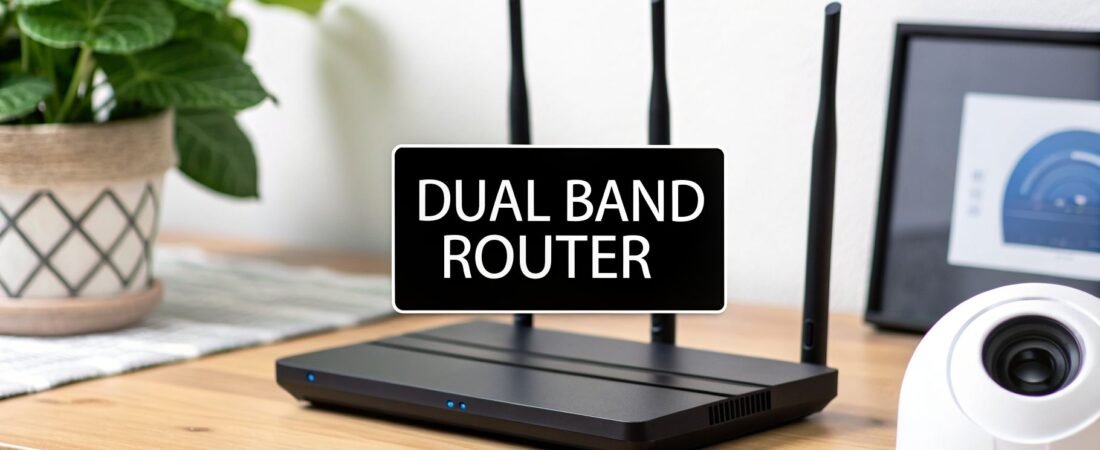
Ever find yourself staring at a buffering screen mid-movie on your smart TV, or getting a "connection failed" error from a security camera? That digital traffic jam is a classic sign your router can't keep up. The modern fix for this headache is a dual-band WiFi router.
Think of it like adding a new, express lane to your home's internet highway. Instead of one congested road, you get two separate networks (2.4GHz and 5GHz) to sort your devices, preventing them from slowing each other down.
Why Your Old Router Is Overwhelmed
In a typical smart home, you've got dozens of devices all fighting for a piece of the internet pie. Your smart TV, gaming console, security cameras, and smart speakers are all constantly demanding bandwidth. An older, single-band router crams all that traffic into a single lane, which is why you end up with frustrating lag and dropouts.
A dual-band WiFi router tackles this problem by creating two distinct networks. This isn't just a minor tweak; it’s a complete rethinking of how a home network should function. The market has certainly taken notice, with these routers grabbing a 51.3% share of the U.S. wireless router market in 2025. That's a huge deal, especially when you consider that 47.2% of all U.S. households depend on a wireless router as their primary connection hub. For more on this trend, you can discover more insights on the state of the wireless router market.
A dual-band router is like a traffic cop for your digital life. It intelligently directs your devices onto the right path, so everything runs smoothly without getting in each other's way.
The Benefits of Two WiFi Lanes
By splitting your devices across two bands, a dual-band router delivers real, immediate improvements to your smart home. It's the secret to unlocking a faster, more dependable connection for every gadget you own.
- Less Interference: It shifts high-demand devices, like a 4K streaming stick, to a less crowded frequency. This helps you avoid interference from common household items like microwaves and old cordless phones that also use the 2.4GHz band.
- Smarter Performance: You can put your devices on the network that suits them best. Long-range, low-priority gadgets can go on one band, while your high-speed, critical devices get their own express lane on the other.
- Rock-Solid Stability: When your internet traffic is managed properly, connections become far more stable. This is crucial for things like security cameras and smart locks that absolutely need to be online 24/7.
Getting a handle on how to use both bands is the first step. And if you're also worried about getting a strong signal to every corner of a larger house, our guide on how to extend your WiFi range has you covered.
Understanding Your Two WiFi Highways
At its heart, a dual-band WiFi router is all about giving your devices options. Instead of cramming everything onto a single, congested network, it broadcasts two separate signals. Think of them as two different highways for your internet traffic: the 2.4GHz band and the 5GHz band. Getting a handle on how these two highways work is the secret to a fast, stable smart home.
The 2.4GHz Band: The Country Road
Imagine the 2.4GHz band as a scenic country road. It's built for distance. Its signal travels farther and does a much better job of getting through walls, floors, and other obstacles in your home. This makes it perfect for devices that are scattered around the house and don't need a ton of speed—things like your smart plugs, thermostat, or that smart bulb in the basement.
The catch? This country road has a lower speed limit and gets easily congested. It’s a popular frequency, and not just for WiFi. A lot of common household gadgets—like older cordless phones, baby monitors, and even your microwave oven—operate on the 2.4GHz frequency, which can cause a lot of signal interference and frustrating slowdowns.
The 5GHz Band: The Expressway
On the flip side, the 5GHz band is your multi-lane, high-speed expressway. It offers dramatically faster speeds, with the potential to fly past 1 Gigabit per second (Gbps), while the 2.4GHz band typically maxes out around 100 Mbps. This lane is also way less crowded, which means your connection is much less likely to get knocked around by interference from other electronics.
This makes the 5GHz band the go-to for anything that chews up a lot of bandwidth. We're talking about streaming a 4K movie without buffering, playing an online game where every millisecond counts, or hopping on an important video call for work. The trade-off is range. Its higher-frequency signal doesn't travel as far and has a tough time punching through solid objects like concrete or brick walls.
This flowchart shows how a dual-band router steps in to solve the all-too-common problem of smart home buffering by directing network traffic.

As you can see, by splitting devices between the two bands, the router prevents a digital traffic jam, giving every connected device a much smoother ride.
The Bottom Line: A dual-band router doesn't magically make your internet faster. Instead, it creates more efficient pathways for the internet speed you already pay for, letting your devices run at their best without tripping over each other.
To help you visualize these differences, here’s a quick side-by-side comparison.
2.4GHz vs 5GHz WiFi Bands at a Glance
| Feature | 2.4GHz Band (The Country Road) | 5GHz Band (The Expressway) |
|---|---|---|
| Top Speed | Slower (up to ~100 Mbps) | Much Faster (up to 1 Gbps+) |
| Range | Longer range, better at penetrating walls | Shorter range, weaker through obstacles |
| Interference | High (from microwaves, cordless phones, etc.) | Low (less crowded frequency) |
| Best For | Smart plugs, thermostats, smart bulbs, web browsing | 4K streaming, online gaming, video calls, large file downloads |
| Device Compatibility | Nearly all WiFi devices | Newer devices (most made in the last 5-7 years) |
This table makes it clear: it's not about which band is "better," but which is the right tool for the job.
Why Dual-Band Became the New Normal
The move to dual-band routers directly follows our ever-growing collection of connected gadgets. The global home WiFi router market jumped from $1.9 billion in 2021 and is on track to hit $3.1 billion by 2026, a surge fueled by our need to manage this explosion of devices. You can read the full research on the wireless router market to see the trends. While plenty of older routers are still out there, modern dual-band models became the answer to the bandwidth crunch caused by streaming, gaming, and the whole universe of smart home (IoT) devices.
By placing your high-demand devices on the 5GHz expressway and your low-priority ones on the 2.4GHz country road, you’re essentially becoming a traffic controller for your own network. This simple act of organization prevents bottlenecks and ensures everything from your doorbell camera to your gaming PC gets the steady, reliable connection it needs to work properly.
How a Dual-Band Router Upgrades Your Smart Home
Putting aside the technical jargon, the real beauty of a dual-band router is how it completely changes the feel of your smart home. This isn't just about faster downloads; it's about building a stable, efficient, and frustration-free network where every single one of your gadgets just works. By intelligently splitting your network traffic, you finally get to experience your smart home ecosystem the way it was meant to be.

Think of it like being a good manager—you assign tasks based on skill. High-demand jobs get the best resources, ensuring they run perfectly. Meanwhile, the smaller, less critical tasks are handled quietly in the background without getting in the way.
Flawless Streaming and Buffer-Free Calls
The most immediate and satisfying upgrade comes when you dedicate the 5GHz band to your high-bandwidth activities. This is the VIP lane on your digital highway.
By moving your 4K smart TV, gaming console, and work laptop over to this faster, less crowded "expressway," you can finally wave goodbye to that dreaded buffering wheel during movie night. Your video calls become crisp and clear, and online gaming is free from the lag that can cost you the match. This simple bit of organization gives your most demanding devices the clean, powerful signal they crave.
A dual-band router allows you to reserve the 5GHz band for your most critical devices, guaranteeing they have the speed and stability needed for high-performance tasks like 4K streaming and video conferencing, without interference from other gadgets.
It’s a simple fix that prevents a digital traffic jam where your Netflix stream is suddenly fighting for bandwidth with a smart thermostat.
Enhancing Smart Home Reliability
For a smart home to feel truly "smart," it has to be reliable. Devices you count on—like security cameras, smart locks, and video doorbells—need a rock-solid, always-on connection. A dual-band router is a game-changer here, isolating these essential gadgets from the network congestion caused by everything else.
You can be strategic about which network your devices join.
- Critical Security Devices: Your security camera at the far end of the hallway? Put it on the 2.4GHz band. Its longer range will punch through walls to give it a stable connection, which is far more important than raw speed for this kind of device.
- Older IoT Gadgets: Smart plugs, bulbs, and most sensors barely sip bandwidth. Shifting them to the 2.4GHz band keeps them connected without cluttering up your high-speed 5GHz network.
This kind of smart device management keeps the 5GHz expressway clear for your entertainment and work, while the 2.4GHz "country road" handles the slow-and-steady traffic from all your little IoT helpers. The result is a more secure and seamless smart home where every device performs its job without a hitch. If you're digging into the basics, you might find our guide on whether you still need a WiFi router helpful.
Dual-Band vs. Tri-Band: Which Do You Actually Need?
Once you start shopping for a new router, you’ll quickly run into tri-band models. The marketing sounds impressive, but is more always better? For most people, the answer is a firm no. Understanding the key difference will help you avoid paying for features you simply don't need.
Think of a dual-band router as a two-lane highway. A tri-band router, on the other hand, adds a third, exclusive express lane. It doesn't create a brand-new frequency; it just broadcasts the standard 2.4GHz band and two completely separate 5GHz bands. This design exists for one reason: to tackle extreme network congestion.
Who Truly Needs a Tri-Band Router?
A tri-band router is really a specialized piece of gear. It’s built for homes where an enormous number of high-demand devices are all fighting for bandwidth at the exact same time. We're not just talking about a lot of gadgets; we're talking about a lot of power-hungry gadgets running simultaneously.
You should only really consider a tri-band router if your home looks something like this:
- Multiple Competitive Gamers: Two or more people are deep into online gaming where low latency is non-negotiable.
- Simultaneous 4K/8K Streaming: You’ve got several TVs streaming in ultra-high-definition at the same time, on top of everything else.
- Massive Device Density: Your home has over 50 active devices, including heavy hitters like VR headsets, game consoles, and home media servers.
For these specific power-user scenarios, that extra 5GHz band acts like a dedicated VIP lane. It keeps a gamer’s connection zippy and responsive, even while someone else in the house is firing up a 4K movie.
For the vast majority of smart homes—even those with dozens of connected devices—a quality dual-band WiFi router hits the sweet spot. It delivers all the speed and coverage you need without the premium price tag of a third band.
The Smart Choice for Most Homeowners
Ultimately, it all comes down to value. Tri-band routers command a much higher price, and for most households, that extra investment delivers zero noticeable improvement in day-to-day performance. The two lanes provided by a solid what is dual band WiFi router are more than enough to handle what a modern, connected family throws at it.
You can get fantastic performance just by being smart about how you connect your devices. Put your high-demand gadgets on the 5GHz band and let your less critical smart home devices stick to the 2.4GHz band. That simple bit of organization is usually all it takes to build a fast, stable, and reliable network for your home—no extra horsepower required.
Unlocking Your Router's Smartest Features
A modern dual-band router is more than just a box with two different WiFi signals. The real magic is what happens under the hood. These devices are loaded with smart features that work tirelessly in the background to keep your network running smoothly, often without you ever noticing.
Two of the most important of these features are Band Steering and Quality of Service (QoS). Getting a handle on what they do is the key to turning your WiFi from a simple utility into a powerful, optimized system that works for you.
Band Steering: The Automatic Traffic Controller
Imagine Band Steering as an invisible, highly efficient traffic cop for your home network. Instead of you having to manually pick which band to connect your phone or laptop to, the router intelligently does it for you. It's constantly analyzing your devices and the radio environment to make the best call.
Let's say your brand-new smartphone connects to the slower 2.4GHz band just because it's the first one it saw. Band Steering recognizes that your phone is capable of much faster speeds and nudges it over to the wide-open 5GHz highway. This happens seamlessly, without dropping your connection.
Why is this so great? It keeps your high-speed devices from getting stuck in the slow lane, and it frees up the 2.4GHz band for the older gadgets that actually need it. The result is a better, faster experience for everything connected to your network.
With Band Steering, your router isn't just passive—it actively manages where your devices connect. It automatically pushes capable gadgets to the faster 5GHz band, ensuring everything from your 4K TV to your smart thermostat gets the best connection possible.
QoS: Your Network's VIP Pass
If Band Steering directs traffic, then Quality of Service (QoS) is the system that hands out the VIP passes. It lets you tell your router which devices or activities are the most important, guaranteeing they get the bandwidth they need, even when things get busy.
Think about this scenario: you're on a critical video call for work while your kids fire up an intense online gaming session and someone else starts streaming a 4K movie. Without QoS, it's a free-for-all, and your call might start to stutter and lag.
But with QoS, you can set rules to avoid this chaos.
- Prioritize by Device: You can tell your router to always give your work laptop or the living room smart TV first crack at the internet connection.
- Prioritize by Application: You can also prioritize specific types of traffic, like video calls, streaming, or online gaming, ensuring they always run without a hitch.
Essentially, QoS carves out a dedicated slice of bandwidth for your most important tasks. It’s the ultimate tool for tailoring your network to how you actually use it, making sure your priorities are always met.
How to Choose and Set Up Your New Router
Upgrading to a dual-band router is one of the smartest moves you can make to improve your smart home's reliability. But let's be honest, staring at a wall of routers with their alphabet soup of specs can be overwhelming. So, let’s cut through the noise and focus on what really matters.
This guide will walk you through picking the right router and then get it up and running without any headaches.

What to Look for When Buying
Your first big decision is the WiFi standard. You’ll mainly see two options on the shelves today: WiFi 5 (802.11ac) and the newer, more advanced WiFi 6 (802.11ax).
Think of it this way: WiFi 5 is a proven workhorse that’s perfectly fine for many households. But if you have a lot of smart devices, stream 4K video, or just want to future-proof your network, WiFi 6 is the way to go. It’s built to handle dozens of devices at once without breaking a sweat.
Here’s a quick breakdown to help you decide.
Choosing Your WiFi Standard WiFi 5 vs WiFi 6
| Feature | WiFi 5 (802.11ac) | WiFi 6 (802.11ax) |
|---|---|---|
| Speed | Fast, great for HD streaming and typical use. | Significantly faster, ideal for 4K/8K and heavy use. |
| Device Capacity | Handles a good number of devices but can slow down. | Excellent at managing dozens of devices simultaneously. |
| Efficiency | Good, but older technology. | Much more efficient, leading to less congestion. |
| Best For | Average homes with fewer than 15-20 connected devices. | Smart homes with lots of devices, gamers, and 4K streamers. |
While WiFi 6 costs a bit more, the performance jump is often worth it, especially in a busy smart home.
Next up, don't overlook security. The latest standard is WPA3, and it’s a big step up from the older WPA2. It provides much stronger defenses against hackers trying to guess your password, which is a must-have for protecting your smart home. Routers like the D-Link Wireless AC Smart Router Dual Band AC1750 are a good example of models that package these essential features together.
A Pain-Free Setup Process
Okay, you’ve got the box. Now what? Good news: setting up a modern router is surprisingly easy. Most use a simple smartphone app that walks you through everything, but the basic steps are always the same.
- Unplug Your Old Gear: First things first, unplug your old router and your modem from the wall. Give them about 30 seconds to completely power down.
- Connect the New Router: Grab an Ethernet cable and plug it from your modem into the new router's WAN or "Internet" port (it's usually a different color). Now, plug the power cords back in for both the modem and your new router.
- Follow the App's Lead: Open the manufacturer's app on your smartphone and just follow the on-screen prompts. You'll be asked to create a new WiFi network name (also called an SSID) and a strong password.
Pro Tip: Whatever you do, don't stick with the default network name and password printed on the router. These are often easy to find online, making your network a wide-open invitation for trouble.
Where You Put Your Router Matters. A Lot.
Your router’s location can make or break your WiFi experience. Tucking it away in a basement corner or shoving it into a media cabinet is a recipe for a weak, spotty signal.
For the best performance, follow these simple rules:
- Go Central: Place the router in a central spot in your home, ideally on the main floor.
- Get It High: Put it on a bookshelf or table instead of on the floor. Elevation helps the signal travel farther.
- Avoid Blockers: Keep it away from thick concrete walls, large metal objects (like a refrigerator), and other electronics like microwaves, which can interfere with the signal.
Following these tips ensures your new dual-band router can deliver the speed and coverage you paid for. For an even more detailed breakdown, be sure to check out our complete guide on how to choose the right WiFi router for your home.
Common Questions About Dual-Band Routers
Jumping into dual-band WiFi usually sparks a few questions. Let's tackle some of the most common ones you'll run into so you can get the most out of your home network.
Can My Old Gadgets Connect to a Dual-Band Router?
Yes, absolutely. One of the best things about a dual-band router is its built-in backward compatibility.
Your older devices, the ones that only know about the 2.4GHz frequency, will have no problem connecting to that band. At the same time, your newer phones, laptops, and streaming boxes can hop on the faster 5GHz superhighway. Everyone gets to play.
Should I Use the Same Name and Password for Both Bands?
This is a great question, and it really boils down to how much control you want over your network.
One Name (SSID): This is the simple, "set it and forget it" approach. With a single network name, features like Band Steering can work their magic, automatically shifting your devices to the best band without you lifting a finger. For most people, this is the way to go.
Two Different Names: If you like to be in the driver's seat, you can give each band a unique name (like "MyWiFi_2.4" and "MyWiFi_5"). This lets you manually decide which device connects to which network. It's perfect for tech enthusiasts who want to fine-tune their setup.
How Do I Know Which Band I'm Connected To?
It's pretty easy to check.
On a Windows PC, just head to your WiFi settings, click "Properties" for the network you're on, and you'll see a line item for "Network band."
If you're on a Mac, it's even quicker: hold down the Option key and click the WiFi symbol in your top menu bar. The details will pop right up. For your phone, this info is usually tucked away in the WiFi connection details within your settings app.


Leave a Reply