
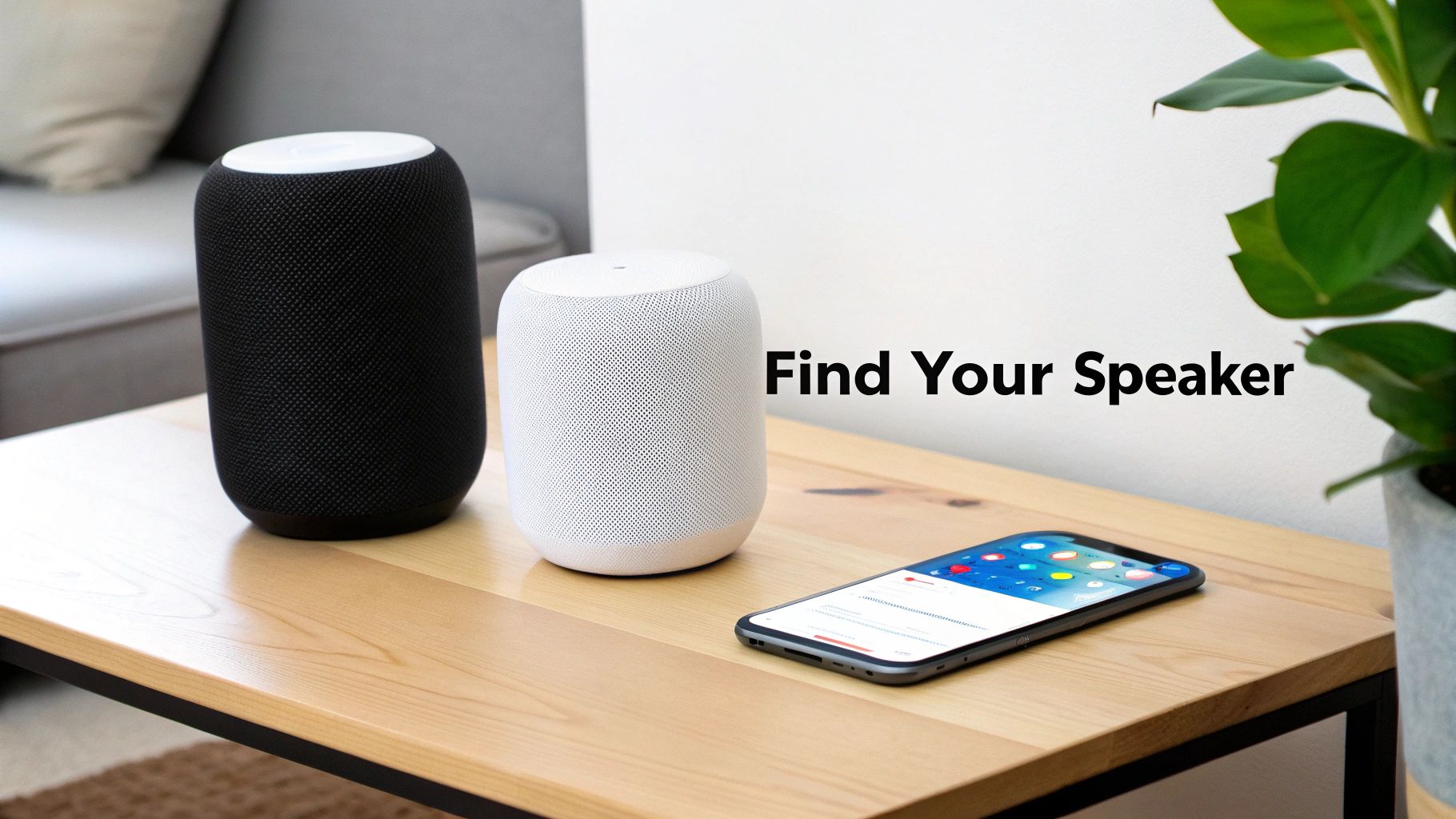
Choosing the right smart speaker for your home really comes down to what you value most. If you're an audiophile, the Apple HomePod's superior sound quality will likely win you over. For those building an extensive smart home, the Amazon Echo family's unmatched compatibility is the clear choice. And if you want the best conversational AI, Google Nest is hard to beat. There's no single "best" speaker for everyone; it's all about finding the perfect fit for your lifestyle.
Comparing the Core Smart Speaker Features
Picking a smart speaker isn't just about sound. When you choose a device, you're buying into a whole digital ecosystem, complete with its own voice assistant and compatibility quirks. Think of it as the brain of your smart home. This guide will cut through the marketing noise and give you a practical framework for making the right call.
We're going to break down the top contenders across five critical areas that actually matter in day-to-day use. Getting a handle on these differences is the key to finding a speaker that truly becomes the central hub of your connected life, not just another gadget gathering dust.
Key Decision-Making Criteria
Before you even look at specific models, take a moment to think about what's most important to you. Your perfect smart speaker will be strong in the areas you care about most.
- Audio Performance: How does it sound? We're not just talking about bass. A good speaker should handle complex music, podcasts, and audiobooks with clarity. For music lovers, understanding various audio file formats can also help you appreciate which speakers make the most of high-quality tracks.
- Voice Assistant Intelligence: How well does it actually understand you? This is the core battleground, and it's worth checking out a detailed breakdown of Alexa vs. Siri vs. Google: https://automatedhomeguide.com/alexa-v-siri-v-google/. A smart assistant that "gets it" the first time makes all the difference.
- Ecosystem Compatibility: Will it work with the other smart gadgets you own or plan to buy? A speaker with broad support for lights, thermostats, and security cameras gives you much more freedom down the line.
- Privacy Controls: How much control do you have over your data? Easy-to-find microphone mute buttons and straightforward options for managing your voice recordings are non-negotiable for peace of mind.
- Overall Value: Is the price fair for what you get? This isn't just about the upfront cost, but the long-term utility of the speaker within its ecosystem.
To give you a head start, here's a quick cheat sheet on how the big three platforms generally compare.
| Feature Area | Amazon Alexa | Google Assistant | Apple Siri |
|---|---|---|---|
| Best For | Smart Home Control & Skills | Conversational AI & Search | Audio Quality & Apple Integration |
| Smart Home Support | Excellent (Largest) | Very Good | Good (Growing) |
| Conversational Ability | Good | Excellent | Fair |
| Audio Fidelity Focus | Varies by model | Good | Excellent |
The Evolution of Smart Home Audio
To really get a feel for what makes a great smart speaker today, it helps to look back at how quickly they went from being quirky gadgets to the centerpiece of many homes. It wasn't that long ago—maybe a decade—that talking to a speaker felt like something out of a sci-fi movie. The first ones were pretty limited, often fumbling basic commands and doing little more than playing music. They were a neat party trick, but hardly essential.
The biggest hurdle in those early days was just getting the voice recognition right. The tech had to learn how to ignore a running TV, understand different accents, and pick out a specific wake word from everyday chatter. The real breakthrough happened when these devices started to understand context, not just commands, thanks to huge leaps in natural language processing (NLP).
From Voice Commands to Smart Conversations
That first major leap was the jump from stiff, keyword-based instructions to more natural, conversational requests. You no longer had to say, "Play the song 'Bohemian Rhapsody' by Queen." Instead, you could just say, "Play Queen," and the assistant knew what you meant. This small change made the technology feel so much more intuitive for everyone in the house.
Behind the scenes, this was all powered by connecting the speakers to massive, cloud-based AI platforms. Every time you asked a question, it didn't just get you an answer; it also sent data back to improve the AI models. This constant feedback loop is what makes a true smart assistant different from a basic voice remote.
This shift from simple voice recognition to conversational AI is the single most important development in smart speaker technology. It transformed the devices from mere audio players into interactive assistants capable of managing tasks, answering complex questions, and controlling an entire home ecosystem.
The Explosion of Connectivity and Market Growth
At the same time, the Internet of Things (IoT) was taking off. As more of our everyday devices—lights, thermostats, cameras—got "smart," the speaker naturally became the perfect central hub to control them all. This integration was the final piece of the puzzle, turning the smart speaker into the brain of the modern connected home.
The market caught on fast. What started as a niche product became a household staple, signaling a real change in how we live with technology. The numbers back this up: the global smart speaker market was valued at around USD 13.91 billion in 2024 and is expected to more than double to USD 30.1 billion by 2032. That’s a compound annual growth rate of roughly 9.8%, which shows just how much people continue to buy into this tech. You can explore more detailed market trends to see the full picture.
This fierce competition between the big players—Amazon, Google, and Apple—has fueled a ton of innovation. Every new generation of speaker comes with better sound, smarter assistants, and tighter smart home integration. Knowing this backstory gives you the context for the small but crucial differences we're about to dive into, helping you pick the right device for your own home.
Comparing the Top Smart Speaker Ecosystems
Picking a smart speaker is about more than just buying a piece of hardware; you're really choosing which digital world you want to live in. This single decision shapes how you’ll control your smart lights, what music services you can easily access, and even who answers your kid's late-night homework questions. Let's cut through the marketing fluff and get into a real-world analysis of the big players.
We'll break this down by what actually matters in day-to-day use: how they sound, how smart the assistant is, how well they play with other gadgets, and what they do with your data. Getting these things right is the key to finding a speaker that actually fits into your life, rather than just complicating it.
Audio Quality and Sound Performance
First things first: how does it sound? For a lot of people, this is the make-or-break feature. But "good sound" isn't a one-size-fits-all thing. A speaker that’s brilliant for lush, detailed music might not be the best choice if you mostly listen to podcasts.
Apple’s HomePod, for example, is clearly built by and for music lovers. It's engineered for high-fidelity audio, delivering deep bass and incredibly crisp highs that really bring out the subtle details in your favorite tracks. It’s designed to fill a room with a rich, immersive sound that audiophiles will appreciate.
On the other hand, speakers like the Amazon Echo and Google Nest Audio are fantastic all-rounders. They produce a balanced sound that works just as well for music as it does for news briefings and podcasts, with a real focus on vocal clarity. While they might not quite hit the HomePod's pure musical highs, they deliver a consistently great listening experience across the board.
Key Takeaway: If you plan on doing some serious, critical music listening, the Apple HomePod’s hardware and software tuning give it a noticeable edge. But if you need a versatile speaker for a mix of music, podcasts, and assistant chatter, you can't go wrong with either an Amazon Echo or a Google Nest.
Voice Assistant Intelligence and Intuition
A smart speaker is only as smart as the assistant inside it. This is where the real battle between Amazon's Alexa, Google Assistant, and Apple's Siri goes down. The real test isn't just answering a simple question—it's understanding context, handling multi-part requests, and just feeling natural to talk to.
Google Assistant is the undisputed champion of conversation. Powered by Google's massive search engine, it's incredible at answering a huge range of questions and understanding follow-ups. You can ask, "Who directed Inception?" and then immediately ask, "What other movies has he directed?" without having to say Christopher Nolan's name again. It just gets it.
Amazon's Alexa has been around the longest, and its main strength lies in its massive library of third-party "Skills." This makes it unbelievably versatile for getting specific things done, like ordering a pizza or starting a specific workout. The trade-off is that its conversational abilities can feel a bit more rigid; you sometimes have to phrase things just right.
Siri, living inside the HomePod, is at its best when you're deep in the Apple ecosystem. It’s fantastic for controlling your Apple Music, managing your calendar, and interacting with HomeKit devices. While its general knowledge has gotten much better over the years, it still occasionally stumbles on complex questions that Google Assistant handles with ease.
The AI driving these assistants is constantly evolving. In fact, the US smart home speaker market is expected to grow by about USD 6.41 billion between 2024 and 2029, a surge driven by these AI improvements. If you're curious about the industry trends, you can learn more about the smart speaker industry's growth on Technavio.com.
Smart Home Ecosystem and Compatibility
For many of us, a smart speaker is the command center for a connected home. Its ability to talk to and automate all your other gadgets—from lights and thermostats to locks and cameras—is absolutely critical. This is where the size of the ecosystem truly matters.
Amazon Alexa is the king of compatibility. With support for tens of thousands of devices from just about every brand imaginable, it's rare to find a smart product that doesn't work with Alexa. This makes the Amazon Echo lineup the go-to choice if you want maximum flexibility to mix and match your smart home gear.
Google Assistant’s ecosystem is also massive and continues to grow, supporting nearly every major smart home brand. The experience is especially seamless if you're using Nest products, as the integration is incredibly tight.
Apple's HomeKit has historically been smaller, but its calling card is a heavy focus on security and privacy. With the arrival of the Matter smart home standard, the playing field is leveling out, and HomeKit can now control a much wider range of devices. To see how these platforms stack up as the brains of an operation, take a look at our comprehensive smart home hub comparison.
Privacy Controls and Data Management
Putting a device with an always-on microphone in your living room is a big deal, and it's natural to have privacy concerns. How each company handles your data and how transparent they are about it should be a major factor in your decision.
Thankfully, all the major players have taken this seriously. Every leading smart speaker has a physical microphone mute button. This is a hardware switch that cuts power to the mics, giving you a foolproof way to ensure it isn't listening.
Beyond that, each ecosystem gives you control over your voice data:
- Amazon Alexa: In the Alexa app, you can review your entire voice history and delete recordings one by one or all at once. You can even set them to auto-delete after a certain period.
- Google Assistant: Your Google Account dashboard lets you see and delete your activity. Google also offers auto-delete options and is increasingly processing commands directly on the device to keep more data out of the cloud.
- Apple Siri: Apple makes privacy a core part of its pitch. A lot of the audio processing happens on the device itself. When requests do go to the cloud, they are anonymized and not linked to your Apple ID.
Value Price and Total Cost of Ownership
Finally, let's talk about money. Value isn't just the sticker price of the speaker. It’s the total cost of getting set up in an ecosystem, including any subscriptions or future devices you might buy.
Amazon and Google have you covered at every price point, from the small and affordable Echo Pop and Nest Mini to higher-end models like the Echo Studio and Nest Hub Max. This makes it really easy to get started without a huge upfront investment.
Apple positions the HomePod and HomePod mini as premium products, and their prices reflect that. If you're already all-in on Apple devices, the seamless integration offers incredible value. If you're not, the higher cost of entry might be a tough pill to swallow.
To help you see it all at a glance, I've put together a quick comparison of the top models and what they bring to the table.
Smart Speaker Feature Comparison
This table offers a side-by-side look at how the flagship speakers from Amazon, Google, and Apple stack up across the most important features. It’s a great way to quickly see where each one shines.
| Feature | Amazon Echo | Google Nest Audio | Apple HomePod |
|---|---|---|---|
| Best For | Maximum smart home compatibility | Conversational AI and search | Superior audio and Apple users |
| Assistant | Alexa | Google Assistant | Siri |
| Ecosystem Size | Largest | Very Large | Growing (HomeKit) |
| Privacy | Good, with robust user controls | Good, with on-device processing | Excellent, with a strong focus on privacy |
| Price Point | Wide Range | Wide Range | Premium |
Ultimately, the "best" speaker really depends on what you value most. Hopefully, this breakdown helps you pinpoint the right ecosystem for your home.
Finding the Right Speaker for Your Lifestyle
Picking the best smart speaker for your home isn't a one-size-fits-all deal. It’s really about matching the right piece of tech to how you actually live. The perfect speaker for an audiophile chasing lossless sound will be a terrible fit for someone on a budget who just wants to ask about the weather and set a kitchen timer.
The first step is figuring out what you’ll really use it for. Are you trying to build a fully automated smart home, do you crave concert-quality sound, or are you just looking for the smartest digital assistant to answer random questions? That single decision points you toward the right ecosystem and hardware, making sure your new gadget is a useful part of your day, not just another piece of clutter.
This little decision tree can help you see which path makes the most sense for you.
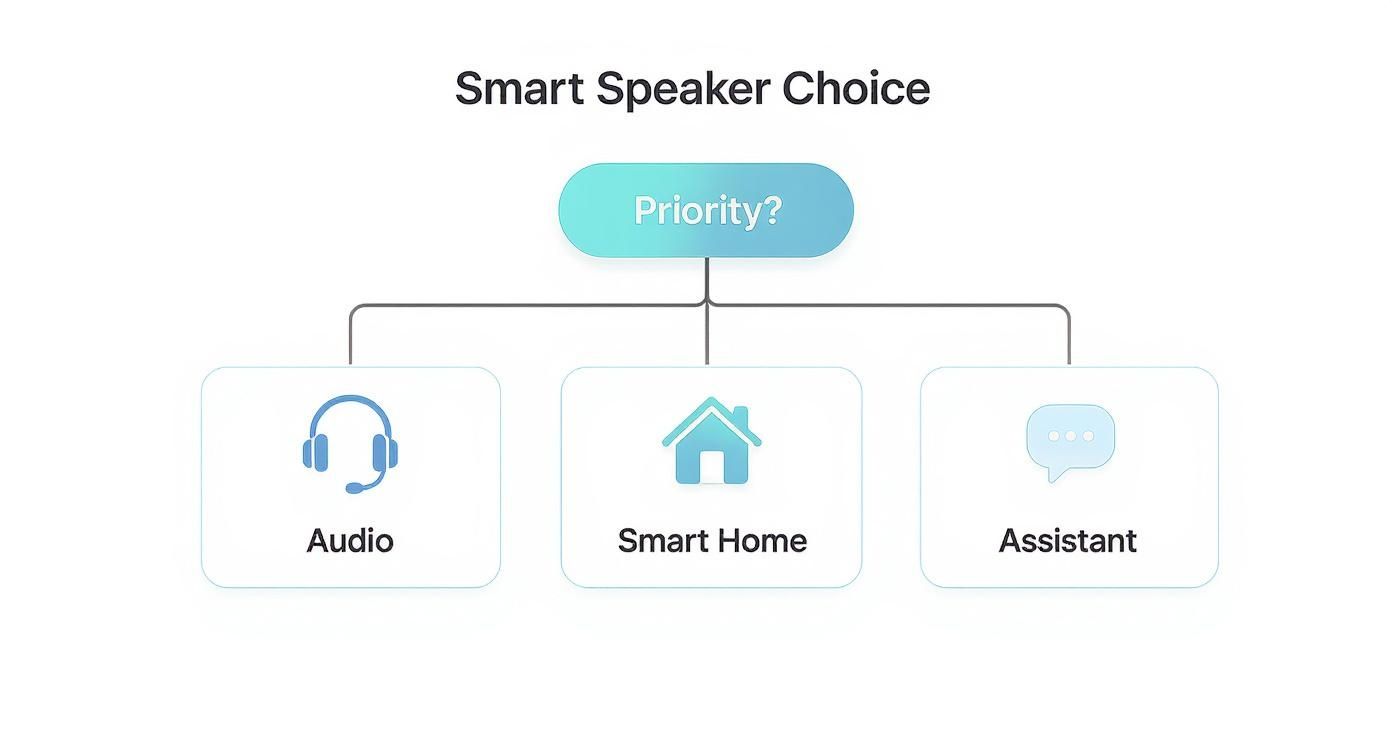
As you can see, your starting point—audio, smart home, or assistant—is the biggest factor in determining which brand will give you the best experience.
For the Audiophile Seeking Sonic Perfection
If sound quality is everything, your choice gets a lot simpler. You’re looking for a speaker that was engineered for one thing: incredible audio. It needs to reproduce music with the depth and clarity the artist intended, which means you should be looking at premium hardware, advanced audio processing, and support for lossless formats.
For this kind of listener, the Apple HomePod is usually the top contender. Its entire design philosophy is built around audio excellence, packing a high-excursion woofer and multiple tweeters to create a truly immersive soundstage. It also shines with spatial audio and lossless streaming via Apple Music, making it an easy choice for anyone who takes their sound seriously.
Another fantastic option is the Amazon Echo Studio. This speaker is a versatile beast, delivering deep, powerful bass and crisp highs. It also supports high-resolution lossless audio and Dolby Atmos, which is a huge plus for anyone who wants premium sound but prefers to stay within the Alexa ecosystem.
For the Smart Home Enthusiast Building a Connected Castle
If your main goal is to create a seamless, automated home where your lights, locks, and thermostat all talk to each other, then your focus shifts to compatibility. The best speaker for you is really a central hub that can communicate with the widest possible range of smart devices.
Here, the Amazon Echo (4th Gen) is the undisputed king. Amazon's Alexa platform is simply massive, supporting tens of thousands of devices and "Skills." More importantly, speakers like the Echo often come with built-in Zigbee and Matter hubs, letting them control a huge number of smart home gadgets directly without needing extra hardware.
For the smart home builder, a built-in hub is a game-changer. It simplifies setup, reduces clutter, and ensures your central command center can communicate directly with devices like Philips Hue bulbs or Samsung SmartThings sensors, creating a more robust and responsive network.
While Google Nest devices have solid smart home support, especially as Matter gains traction, the sheer breadth of the Alexa ecosystem gives it the edge for now. It just offers more flexibility right out of the box.
For the Budget-Conscious Buyer
You absolutely do not need to spend a fortune to get the core benefits of a smart speaker. If you’re just dipping your toes in and want a simple voice assistant for timers, music, news updates, and controlling a smart plug or two, the entry-level models are an incredible value.
The Amazon Echo Pop and Google Nest Mini are the two heavyweights in this arena. Both are small, affordable, and give you access to the full power of Alexa and Google Assistant, respectively. Their compact size means they won't be rattling any windows with bass, but they are absolutely perfect for a kitchen, bedroom, or home office.
The choice between them often boils down to which assistant you prefer. If you want the best conversational AI for answering questions, the Nest Mini is brilliant. If your priority is a wider range of smart home integrations and Skills, the Echo Pop is the way to go.
For the Privacy-Focused Household
Putting a live microphone in your home requires a certain level of trust. For anyone concerned about data privacy—and you should be—the best smart speaker is one that offers transparent controls, strong security, and a commitment to on-device processing to keep as much of your data as possible from ever reaching the cloud.
While all the big players have improved their privacy settings, Apple makes it a core part of its brand. The Apple HomePod mini is designed to process most Siri requests right on the device itself, meaning your audio never leaves your home. On the rare occasion that data is sent to Apple's servers, it's anonymized and not linked back to your Apple ID.
For the ultimate privacy advocate, there’s another path: open-source hardware from communities like Home Assistant. These platforms are built from the ground up for local control, guaranteeing your voice commands and personal data stay inside your own home network. They demand a bit more technical know-how to set up, but they offer a level of privacy and customization that mainstream products simply can't match.
Getting the Most from Your New Smart Speaker
So, you've got your new smart speaker out of the box. What now? The real magic happens when you move beyond just asking for the weather and start making it the true command center of your home. It’s all about smart placement, connecting your digital life, and learning how to automate the little things.
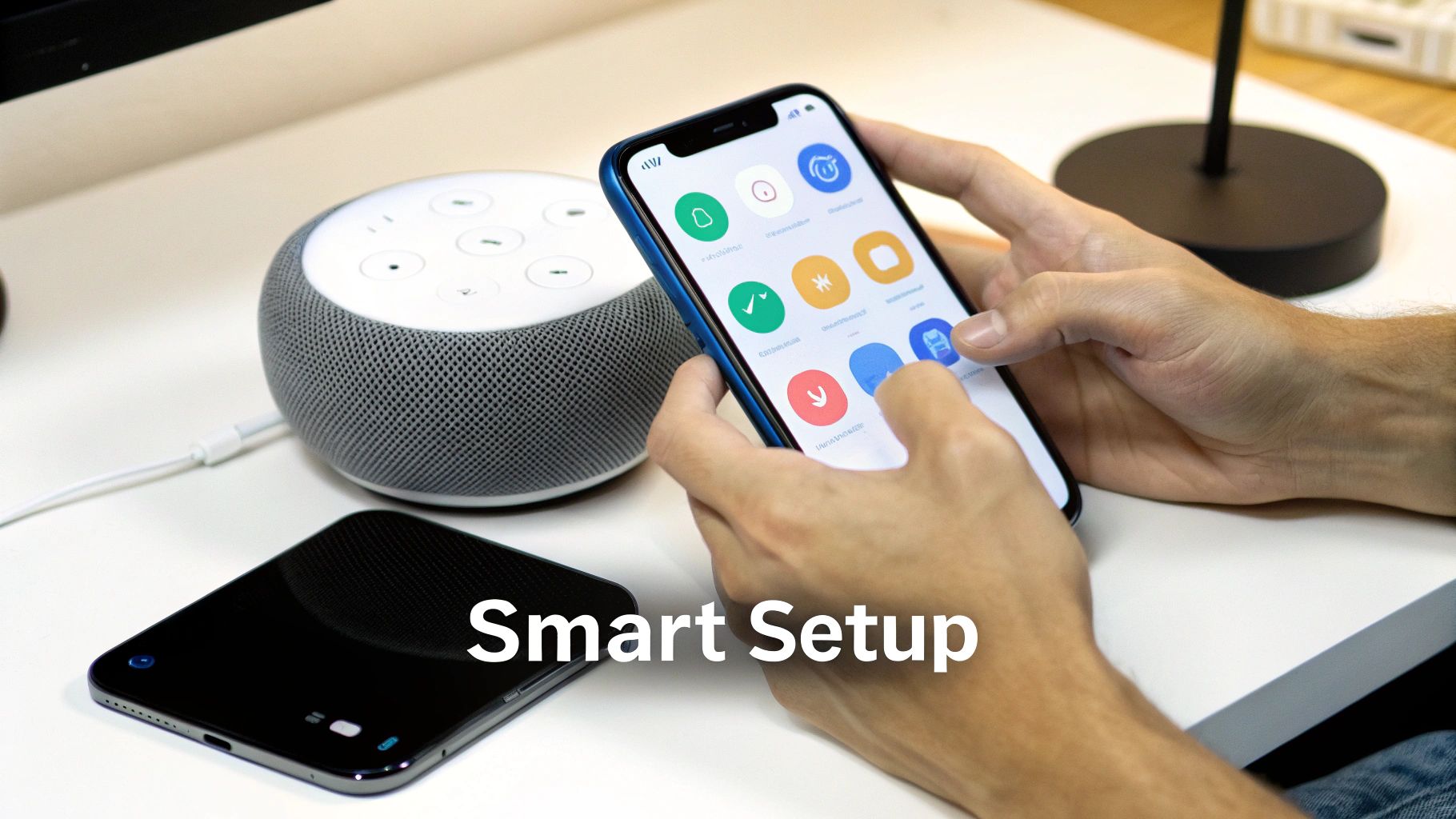
Before you even think about apps, think about location. Where you physically place your speaker has a huge impact on both how well it hears you and how good it sounds. Shoving it into a bookshelf might look tidy, but it's a recipe for boomy, distorted bass.
Likewise, setting it next to a noisy dishwasher or an air conditioner is just asking for trouble. The microphones will struggle to pick up your voice over the background racket. The sweet spot is usually somewhere central in the room, around ear level, and a little bit away from walls or corners. This gives the sound space to breathe and the mics a clear shot at hearing you.
Integrating Your Digital Services
Out of the box, a smart speaker doesn't know you at all. It's up to you to connect the dots by linking your most-used services. This is how it goes from a generic gadget to a genuinely helpful personal assistant.
Jump into the companion app (Amazon Alexa, Google Home, or Apple Home) and start linking these accounts right away:
- Music Streaming: Hook up your Spotify, Apple Music, or whatever service you use. This is non-negotiable for seamless voice-controlled music.
- Calendars: Sync your Google, Apple, or Outlook calendar. Being able to ask "What's on my schedule?" or add an appointment with your voice is a game-changer.
- Smart Home Devices: Here’s where it gets really fun. Start adding your smart lights, thermostat, plugs, and locks. This is how you build a cohesive, voice-controlled home.
For anyone using Amazon's ecosystem, our guide on how to connect devices to Alexa breaks down the process step-by-step.
Think of it this way: by linking your services, you're building a network of information your assistant can pull from. This is the bedrock of a truly "smart" home, one where technology actually anticipates what you need.
To really get a handle on how all these gadgets talk to each other, it helps to understand the core technology behind it all. For a great primer on this, check out this guide explaining What Is the Internet of Things Explained.
Creating Powerful Custom Routines
Routines are your secret weapon for true automation. They let you chain multiple actions together that are all triggered by a single, custom voice command. Why say three separate commands when one will do?
Instead of "Turn off the lamp," "Lock the front door," and "Set the thermostat to 68," just create a "Goodnight" routine that does it all at once.
Here are a few ideas to get you started:
- "Good Morning" Routine: Kick off your day with a news briefing, have the lights fade on slowly, and get a rundown of your first calendar event.
- "I'm Leaving" Routine: One phrase can turn off all the lights, switch the thermostat to an away mode, and make sure the doors are locked.
- "Dinner Time" Routine: Dim the dining room lights to 50% and start playing your favorite chill dinner playlist.
These small automations are what really make a smart speaker feel indispensable, smoothing out the rough edges of your daily schedule.
Managing Your Privacy Settings
Last but certainly not least, take a few minutes to get your privacy settings in order. It's smart to do this from day one. While the privacy controls have gotten much better over the years, you should still customize them to a level you're comfortable with.
Open your speaker’s app and find the privacy section. You'll want to review your voice recording history. Most services let you listen to them, delete them one by one, or even set them to auto-delete after a certain period (like 3 months). Also, get familiar with the physical microphone mute button on the device itself. Knowing it's there for when you want absolute privacy provides real peace of mind.
Got Questions About Smart Speakers? We've Got Answers.
Jumping into the world of smart speakers can bring up a lot of questions. Will it listen to everything I say? Can I mix and match different brands? It's easy to get tangled up in the details.
We've rounded up the most common questions people ask before buying a smart speaker. Here are some straightforward answers to help you feel confident in your choice.
Do Smart Speakers Work Without the Internet?
For the most part, no. A smart speaker's "smarts"—voice commands, music streaming, smart home controls—all rely on a Wi-Fi connection to talk to the cloud. Without it, your voice assistant is offline.
However, almost every smart speaker can double as a standard Bluetooth speaker. If your internet goes down, you can still pair your phone or tablet and play audio directly from your device. Alarms and timers you've already set might still go off, but you won't be able to ask for anything new.
Can I Set Up Multi-Room Audio?
Absolutely, and it's one of the coolest features. The catch is you have to stick with one ecosystem. To get that seamless, whole-home audio experience, you'll need all Amazon Echo devices or all Google Nest devices.
Once you have a few, you can hop into the manufacturer’s app and create "speaker groups." This lets you play the same song in perfect sync across the entire house. For a serious sound upgrade in one room, you can also pair two identical speakers to create a true stereo setup.
What Are the Biggest Privacy Risks?
The main worry is that the speaker might accidentally record a private conversation. To combat this, manufacturers have put several safeguards in place. The device only sends audio to the cloud after it hears a specific wake word, like "Alexa" or "Hey Google."
Every major smart speaker comes with a physical microphone mute button. Pressing it electronically disconnects the mics, giving you a foolproof way to guarantee it isn't listening when you need total privacy.
For extra peace of mind, you should regularly review and delete your voice recording history in the companion app. It's also a great idea to secure your account with a strong, unique password and turn on two-factor authentication to keep anyone else out.
Can Different Smart Speaker Brands Work Together?
Historically, not really. You couldn't ask Alexa to play music on your Google Nest speaker. But for controlling smart home gadgets, the new Matter smart home standard is a huge step forward. Think of Matter as a universal translator for your devices.
If you buy a Matter-certified smart plug and a Matter-certified smart speaker, they'll work together regardless of the brand. This means you could use an Apple HomePod to turn on a light that was originally set up with Amazon Alexa. It gives you far more flexibility and helps you avoid being locked into a single ecosystem.
Will My Current Speaker Get Smarter Over Time?
Yes, they're constantly improving through software updates. Assistants are getting a major boost from AI advancements, with Google Assistant set to become much more capable with the integration of its Gemini model.
For example, the Gemini for Home voice assistant is slated to roll out to all Google-made speakers and displays released since 2016. This means even an older device like the original Google Home will learn new, more conversational tricks without you needing to buy new hardware. Just make sure to keep an eye on your device's app for the latest updates.
At Automated Home Guide, we're here to help you build a smarter, safer, and more convenient home. Check out our expert reviews and practical tips to find the perfect technology for your lifestyle at https://automatedhomeguide.com.

Leave a Reply