Welcome to the new era of home cleaning. The best robot vacuum cleaners have officially moved beyond being novelty gadgets and are now indispensable tools in a modern smart home. With smart navigation, serious suction power, and docks that handle the dirty work for you, these automated helpers make keeping your floors clean an afterthought.
This guide will help you navigate the options and find the perfect model for your home and lifestyle.
Why Robot Vacuums Are a Smart Home Necessity
The market for these little helpers is booming. It's expected to jump from $11.17 billion in 2025 to $12.7 billion in 2026, which is a massive 13.7% growth rate in just one year. Why the surge? People are tired of daily chores and are embracing smart tech that gives them their time back. It's a key part of a larger trend, and you can learn more about the benefits of home automation.
Today's robot vacuums aren't the simple bump-and-go sweepers from a few years ago. They're complex cleaning systems that can tackle tricky layouts and stubborn messes. For anyone with a furry friend, these devices are a game-changer and often top the list of the best pet hair removal tools.
The real value of a great robot vacuum isn't just a clean floor—it's the freedom it gives you. It takes a repetitive task off your plate, so you can focus on what matters while still coming home to a spotless space.
Key Features of Top Models
So, what really separates a top-tier model from a basic one? It comes down to a few core technologies. Getting a handle on these features is the first step toward choosing the right machine.
| Feature | Basic Models | Advanced Models |
|---|---|---|
| Navigation | Bounces randomly | LiDAR or vSLAM mapping |
| Suction | Lower power (1500-2000 Pa) | High power (4000-8000+ Pa) |
| Smart Tech | Basic app control | AI obstacle avoidance |
| Docking | Simple charging base | Self-emptying and self-washing |
In this guide, we'll dive deep into what these specs mean for you day-to-day. We’ll help you figure out what you actually need, whether you have a shedding pet, a complicated floor plan, or a mix of carpets and hardwood. We're here to evaluate these vacuums based on real-world performance, not just what it says on the box.
Decoding Robot Vacuum Technology
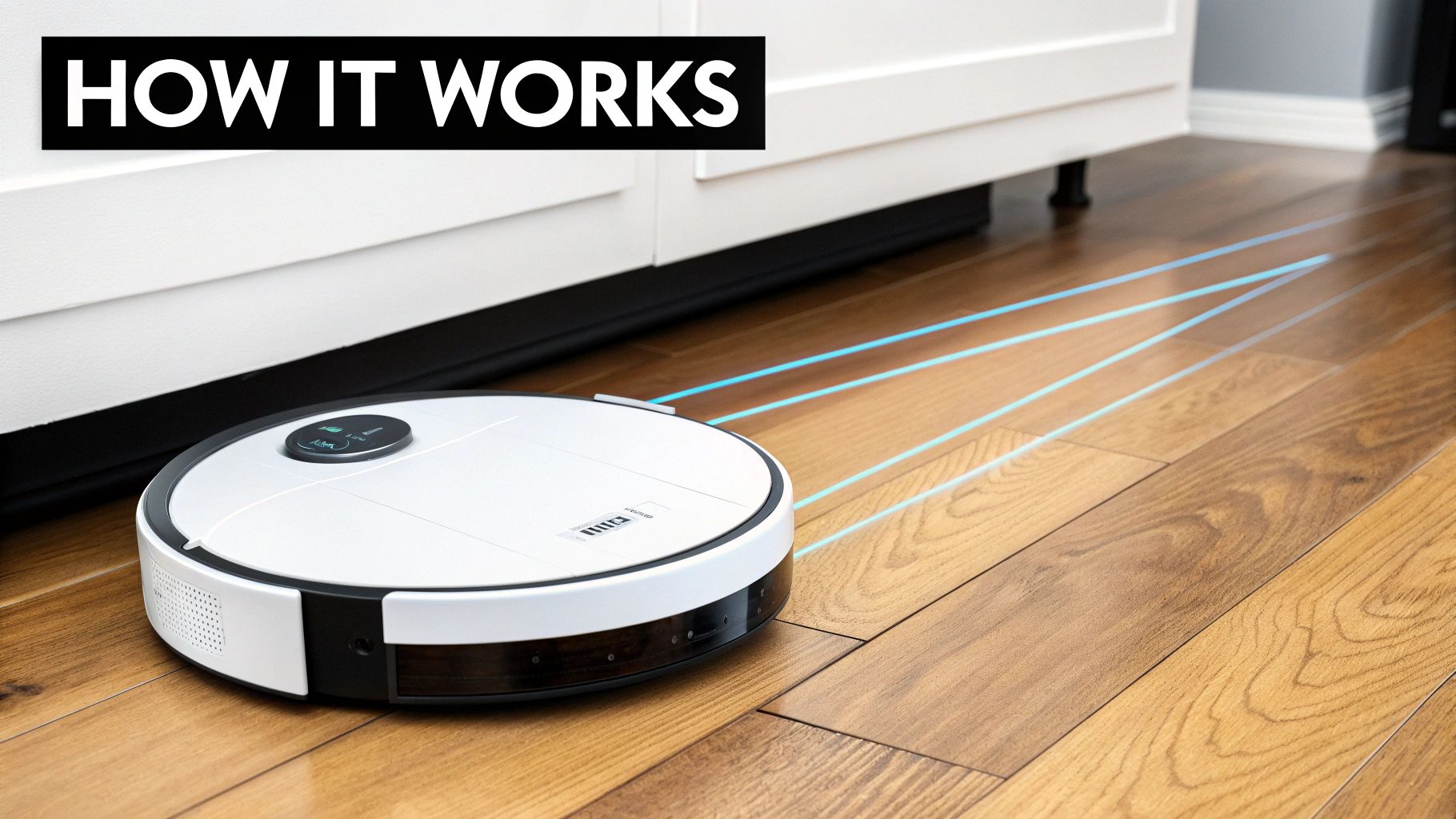
Before we get into specific models, let's pull back the curtain on the technology that powers these machines. The real difference between a so-so robot and a great one comes down to a few key things: how it "sees" your home, how much power it has to pull up dirt, and the nitty-gritty of its brushes and filters. Understanding this tech is the best way to make a choice you'll be happy with for years.
The single most important piece of the puzzle is the navigation system. This is the robot's brain, and it dictates whether the vacuum methodically covers every inch in straight lines or just bounces around like a pinball. The two big players here are LiDAR and vSLAM.
Navigating Your Home: LiDAR vs. vSLAM
LiDAR (Light Detection and Ranging) is the technology you'll find in most top-tier robots. It uses a spinning laser turret on top of the unit to build an incredibly precise, 360-degree map of your space. Because it's actively measuring distances, it knows exactly where it is, doesn't get lost, and cleans with remarkable efficiency. Best of all, it works perfectly in the dark.
On the other hand, we have vSLAM (Visual Simultaneous Localization and Mapping). Instead of a laser, these robots use a camera to spot landmarks—the leg of your sofa, a doorway, a piece of art—to figure out where they are. It’s a clever system that works well in brightly lit rooms, but it can struggle when the lights go down. The main upside? Robots with vSLAM are often shorter since they don't have that laser turret on top, letting them sneak under lower furniture.
Key Takeaway: If you have a complicated floor plan or want the freedom to run cleanings overnight, a LiDAR robot is the way to go. Its accuracy is just unbeatable. For simpler, well-lit homes, vSLAM is a solid, often more affordable, alternative.
Suction Power: What Pascals Really Mean
You'll see suction power measured in Pascals (Pa). While it's tempting to think bigger is always better, the right number really depends on your floors.
- Hardwood, Tile, and Laminate: On hard surfaces, you don't need a hurricane. A suction rating of 2000-3000 Pa is plenty to grab dust, pet hair, and crumbs without just scattering them around.
- Low-Pile Carpets and Rugs: To get the gunk that's settled into shorter carpet fibers, you'll need a bit more oomph. I'd look for something with at least 4000 Pa to properly lift that embedded dirt.
- Deep-Pile and Shag Carpets: This is where raw power is a must. For thick, plush carpets, you'll want a robot packing 5000 Pa or more. Anything less will just be skimming the surface.
A feature I always look for is automatic suction boosting. The robot's sensors detect when it moves from a hard floor onto a carpet and instantly crank up the power. It's a smart way to get a deep clean where you need it most while saving battery life everywhere else.
Brushes and Filters: The Unsung Heroes
Finally, let's talk about the parts that do the dirty work. The design of the main brush has come a long way from the old bristle brushes that were magnets for tangled hair.
The best modern robots now use dual rubber rollers. These are a game-changer, especially for pet owners. They flex to stay in close contact with the floor, and their finned design actively resists hair wrap. One roller loosens dirt, and the other sweeps it in—a simple but highly effective system.
Your last line of defense is the filter. While any filter will catch big dust bunnies, a HEPA (High-Efficiency Particulate Air) filter is non-negotiable for anyone with allergies or pets. These can trap 99.97% of tiny particles like pollen, dander, and dust mites, which makes a noticeable difference in your home's air quality.
Head-to-Head: Putting the Top Robot Vacuums to the Test
Spec sheets are one thing, but how these top-tier robot vacuums handle the chaos of a real home is another story entirely. This is where we pit the leading models against each other, looking past the marketing jargon to see what really matters: how well they navigate, how smartly they avoid trouble, and how automated their self-emptying docks truly are.
We're going to get into the details that make or break your experience. Can one run quietly enough not to interrupt your Zoom call? Which app makes it dead simple to create a keep-out zone around the dog's water bowl? These are the little things that separate a good robot from a great one.
Mapping and Navigation: Who Knows Your Home Best?
A robot vacuum’s single most important job is figuring out how to get around your house efficiently. Bad navigation means it gets lost, misses entire sections, or just bangs into furniture, while smart navigation gives you a perfect, methodical clean every time.
The Roborock S8 Pro Ultra is a master of precision. Its LiDAR system maps your home in 3D with incredible speed and accuracy. In our testing, it consistently chose the most logical cleaning routes, deftly maneuvering around tricky table legs and cluttered living rooms without missing a beat. Its room recognition is spot-on, which makes telling it to "just clean the kitchen" a simple and reliable command.
The iRobot Roomba j9+, on the other hand, relies on its vSLAM camera system. It takes a few cleaning runs to fully learn the layout, but the payoff is a highly detailed "Imprint Smart Map." I was impressed by its ability to identify specific furniture, letting you give it commands like, "clean in front of the couch." Its only real hiccup is in low-light conditions, where LiDAR models simply see better.
The Real-World Obstacle Course
A robot vacuum isn't much help if you have to tidy up before it can do its job. We put each model through its paces with a gauntlet of everyday household clutter—charging cables, stray socks, and even a fake pile of pet waste.
Here, the Ecovacs DEEBOT T20 OMNI really shines with its AIVI 3.0 technology. Using a front-facing camera and some serious AI smarts, it identifies and dodges dozens of common obstacles. It successfully navigated around a pair of shoes and a tangled USB cable more than 90% of the time during our tests. For a busy home where the floor isn't always pristine, this is a huge win.
Roborock’s S8 Pro Ultra also held its own with its Reactive 3D Obstacle Avoidance, proving especially good at seeing larger items and low-profile objects. For pet owners, the Roomba j9+ comes with its P.O.O.P. (Pet Owner Official Promise), a specific guarantee that it will steer clear of pet waste—a promise that offers incredible peace of mind. While the technology has improved across the board, very flat items like a piece of paper can still trip up even the best models.
Our Takeaway: Obstacle avoidance has made huge leaps, but it's not foolproof yet. The best robots are the ones that consistently avoid the most common, and most problematic, household items. They dramatically cut down on the amount of "pre-cleaning" you have to do before the robot can get to work.
The Docking Station: More Than Just a Charging Port
The self-emptying dock is what delivers that truly hands-off cleaning experience. But they aren't all built the same. We looked at how well they empty the robot, how much they can hold, and what extra tricks they have up their sleeves.
The dock for the iRobot Roomba j9+ is all about powerful simplicity. It uses a strong vacuum to yank every bit of debris from the robot's bin into a sealed AllergenLock bag. These bags are big enough to hold up to 60 days of dirt, making it a fantastic set-and-forget system, especially for anyone with allergies who wants to avoid a face full of dust.
The Roborock S8 Pro Ultra and Ecovacs DEEBOT T20 OMNI take things to a whole new level with their all-in-one stations. These behemoths don't just empty the dustbin—they also wash the mopping pads, dry them with hot air to stop mildew from growing, and refill the robot’s water tank. The Ecovacs dock even uses hot water to clean the mop for better sanitation. It's an incredible level of automation, but be warned: the docks are much larger and you’ll have to refill the clean water tank and empty the dirty one.
For an even deeper dive into these and other models, check out our comprehensive robotic vacuum cleaner comparison chart, which covers more brands and features.
Comparing Top Robot Vacuum Models
To help you see the key differences at a glance, we've put together this quick comparison table. It highlights what makes each of our top picks stand out, so you can easily match a robot to your home's unique needs.
| Model | Navigation Technology | Suction Power (Pa) | Best For | Self-Emptying | Smart Home Integration |
|---|---|---|---|---|---|
| Roborock S8 Pro Ultra | LiDAR & 3D Structured Light | 6,000 | All-in-one cleaning power | Yes – washes & dries mop, refills water | Alexa, Google, Siri |
| iRobot Roomba j9+ | vSLAM (Camera-Based) | Proprietary | Pet owners & simplicity | Yes – empties into a 60-day sealed bag | Alexa, Google, Siri |
| Ecovacs DEEBOT T20 OMNI | LiDAR & AI Camera | 6,000 | Advanced mopping with hot water | Yes – washes & dries mop, hot water cleaning | Alexa, Google, Yext |
| DreameBot L20 Ultra | LiDAR & AI Camera | 7,000 | Edge cleaning & hands-free use | Yes – washes & dries mop, auto-adds cleaning fluid | Alexa, Google, Siri |
Each of these robots is a top performer, representing the best technology available today. The right one for you really comes down to what you value most—is it avoiding pet messes at all costs, getting the best possible mop, or just having a vacuum that works reliably with minimal fuss?
Matching a Robot Vacuum to Your Lifestyle
Picking the right robot vacuum isn't about chasing the longest feature list. It's about finding the one that actually solves your cleaning problems without creating new headaches. The perfect bot for a small, tidy apartment is going to get lost in a sprawling multi-story house, and a deep-pile carpet champion is probably overkill if you've only got hardwood floors.
This is where we get personal. By matching a robot's core strengths to your real-life situation, you'll end up with a machine that feels less like a gadget and more like a genuine part of your home.
The Pet Owner's Playbook
If you share your home with furry friends, you're not just fighting dust—you're in a constant war against fur, dander, and whatever they track in from outside. Your robot needs a specific skill set to win this battle.
First up, a tangle-resistant brush design is non-negotiable. Look for models with dual rubber rollers instead of traditional bristles. They are lightyears better at pulling hair from both carpets and hard floors without turning into a tangled mess. This one feature will save you hours of annoying maintenance.
Next, you absolutely need high suction power (at least 5,000 Pa) and a HEPA filter. Powerful suction is the only way to pull stubborn fur out of carpet fibers, and a HEPA filter is crucial for trapping the microscopic dander and allergens that can wreak havoc on your air quality.
For pet owners, the ultimate peace of mind comes from advanced obstacle avoidance. Look for models with AI-powered cameras that can specifically identify and steer clear of pet waste. This feature alone can prevent a cleaning disaster and is a must-have for any home with animals.
Conquering Large and Multi-Floor Homes
Big homes come with their own logistical challenges. A robot vacuum needs serious endurance and smarts to cover huge areas without getting lost or dying halfway through the job.
The most critical feature here is long battery life—you should be looking for a runtime of at least 150 minutes on a single charge. Just as important is the "recharge and resume" function. This lets the robot head back to its dock for a top-up, then intelligently pick up cleaning right where it left off.
For homes with more than one level, multi-floor mapping is a total game-changer. This feature allows the robot to create and save a unique map for each floor. When you move it upstairs, it instantly knows where it is and uses the correct map with all its no-go zones, no re-scanning required.
This decision tree gives you a great visual for how to approach this.
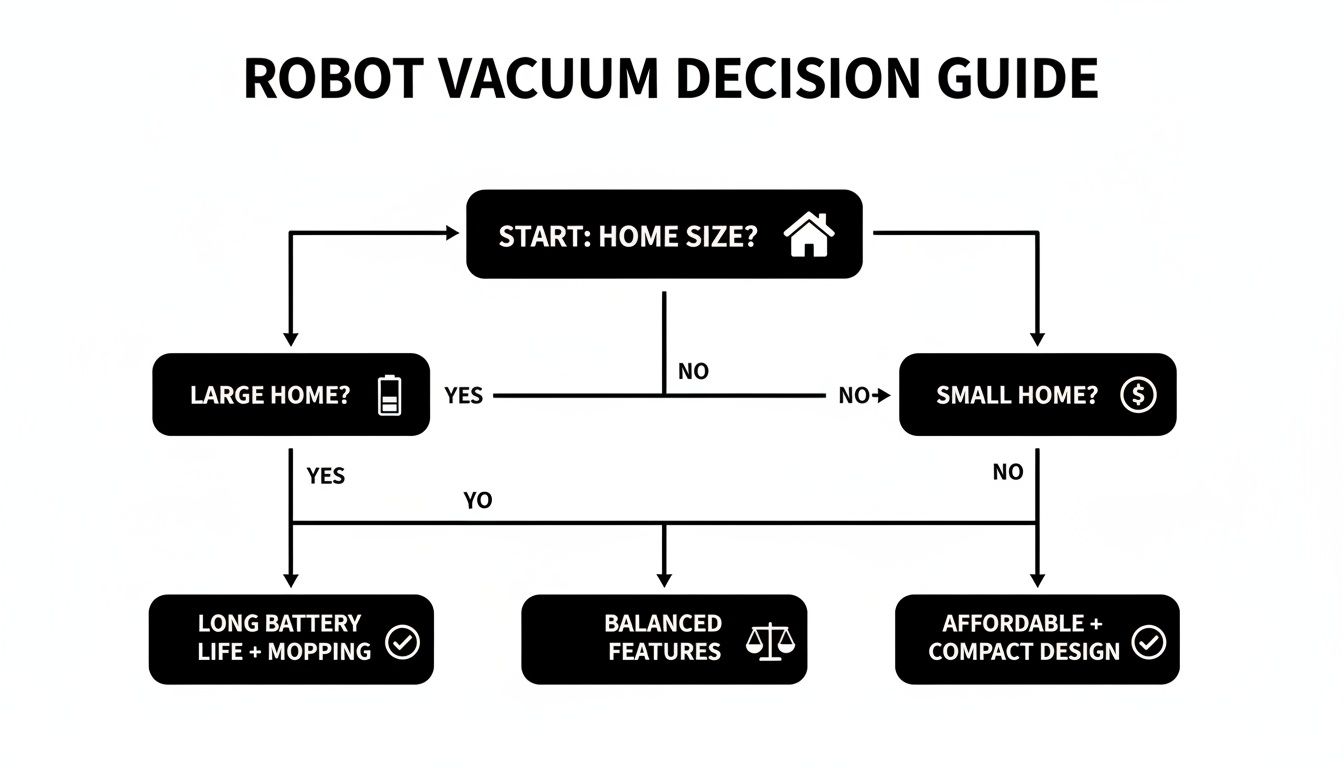
As you can see, your home's size immediately points you toward prioritizing either battery and mapping or more budget-friendly efficiency.
Best Choices for Hardwood and Tile Floors
If your home is mostly hard surfaces like wood, tile, or laminate, raw suction power takes a backseat to mopping capability. Any decent robot can pick up dust, but a great vacuum-mop hybrid is what will leave your floors with that satisfying sparkle.
When you’re looking at hybrids, keep an eye out for these more advanced mopping features:
- Sonic Mopping or Vibrating Pads: These systems actively scrub the floor, often thousands of times a minute. It’s the difference between wiping up a spill and actually scrubbing it away.
- Automatic Mop Lifting: This is a brilliant feature that lets the robot move seamlessly from mopping your kitchen tile to vacuuming the living room rug. It senses the carpet and lifts the wet pad to keep your rugs dry.
- Self-Washing and Drying Docks: The top-tier models come with bases that not only empty the dustbin but also wash the mopping pads with clean water and dry them with hot air. This completely prevents that funky, mildewy smell.
Finding Value on a Budget
You really don't have to spend a fortune to get a solid robot vacuum. The best budget models nail the essentials without tacking on the premium cost of all-in-one docks or fancy object avoidance.
On a budget, your top priority should be LiDAR navigation. This tech used to be exclusive to high-end models, but it's now available on affordable options and gives you those neat, methodical cleaning patterns that are vastly better than the old "bump-and-go" bots. Combine that with strong suction (around 3,000 Pa) and good app control for scheduling, and you've got a winner. You might have to empty the dustbin yourself, but you still get the core benefit of automated daily cleaning.
Beyond Cleaning: Smart Home Integration
Today's best robot vacuums are far more than just little cleaning gadgets. They're becoming fully-fledged members of the connected home, working in concert with your other smart devices. This ability to communicate and coordinate elevates them from a simple tool to an intelligent assistant that actually responds to your life.
The most basic, and maybe most useful, feature is voice assistant compatibility. All the top-tier models work seamlessly with Amazon Alexa, Google Assistant, and even Apple's Siri Shortcuts. This shifts control from an app on your phone to your voice, which just feels more natural.
Instead of hunting for your phone and opening an app, you can just say, "Hey Google, tell the robot to clean the kitchen," or "Alexa, start vacuuming." It's a small thing, but that hands-free convenience is a huge deal when you're busy or in another room.
Creating Intelligent Cleaning Routines
The real magic starts when you go beyond simple voice commands and build automated routines. A modern robot vacuum can become a key player in your smart home, either triggering other devices or being triggered by them. This is where your cleaning schedule starts to adapt to your actual life.
For instance, you could have the robot automatically start cleaning the living room every time you leave the house—a status confirmed by your smart lock or security system. Or, you could create a "Movie Night" scene that dims the lights, turns on the TV, and sends the vacuum back to its dock so it doesn't interrupt.
This level of integration is why smart-connected models are taking over. In fact, these advanced robots are projected to hold a massive 67.6% market share in 2025, a trend driven by Wi-Fi, voice assistants, and cloud technology. It’s only going to accelerate, with self-charging models expected to hit a 91.5% share by 2035 as people demand total autonomy. If you're interested in the market data, you can delve into the research on robotic vacuum cleaner trends.
Advanced App Features and Customization
The companion app is your robot's command center, and the best ones offer deep customization that puts you in total control. The days of a simple "start" button are long gone. A good app provides a rich, interactive experience.
Here are a few of the most important features to look for:
- Virtual No-Go Zones: The ability to draw a box on the map to keep the robot out of a certain area is non-negotiable. Think a kid's play area cluttered with LEGOs or the spot where you keep your pet's water bowls.
- Room-Specific Cleaning: Once the map is built, you can name each room and send the robot to clean only the kitchen or just the master bedroom.
- Custom Cleaning Sequences: You can program the robot to tackle high-traffic areas first, like the entryway, before moving on to quieter rooms.
- Adjustable Power Settings: Manually set suction and water flow (for mopping models) on a per-room basis. For example, max suction for the carpeted bedroom and a lower, quieter setting for the hardwood office.
A powerful app turns a good robot into a great one. The ability to fine-tune its behavior to match your home's unique layout is what delivers a truly personalized and effective cleaning experience.
The best robot vacuums use these features to become more than just efficient—they become considerate. To get the most out of these integrations, you’ll need a central brain for your smart home; check out our guide on choosing the right smart home hub to see how it all fits together.
AI Object Recognition: The Final Frontier
The single biggest feature separating premium models from the pack is AI-powered object recognition. Using front-facing cameras and machine learning, these robots can identify and avoid common household clutter in real time. This is a complete game-changer.
Instead of just bumping into something and changing direction, the robot can actually see a shoe, a charging cable, or a pet toy and intelligently navigate around it. For pet owners, this technology is a lifesaver, as the best models can now accurately identify and steer clear of pet waste, preventing a truly horrifying mess.
This level of intelligence means you don't have to "pre-clean" your floors before the robot runs, making the entire process feel truly automated.
Your Robot Vacuum Questions, Answered
Even after poring over spec sheets and watching video reviews, you probably still have a few questions. That's completely normal. Buying a good robot vacuum is a real investment, and you want to know how it's actually going to fit into your daily life.
Let's cut through the marketing jargon and tackle the most common questions I hear from people. We'll cover everything from pet hair battles to whether you can finally ditch your old upright vacuum for good.
How Well Do These Things Actually Handle Pet Hair?
Honestly, the best robot vacuums are absolute lifesavers for pet owners, but you have to choose the right one. The secret isn't just about suction power, though you should look for at least 2,500 Pa. The real magic is in the brush design. Models with brushless rubber rollers are far superior, as they agitate carpets to lift hair and resist getting tangled in a way bristle brushes just can't match.
Top-tier models also pack HEPA filters to trap dander and other allergens, which makes a noticeable difference in your home's air quality. And if you've ever worried about "puppy landmine" incidents, some robots now use AI-powered cameras to spot and steer clear of pet waste. For pet parents, that feature alone is worth its weight in gold.
A self-emptying dock is a non-negotiable for homes with heavy shedders. Pet hair fills those tiny onboard dustbins in a flash. A dock that automatically sucks it all out means your robot can clean every single day without you having to lift a finger.
Can a Robot Vacuum Really Replace My Regular Vacuum?
For the day-to-day grind? Absolutely. A good robot vacuum will keep your floors consistently free of dust, crumbs, and that endless layer of pet fur. Think of it as your tireless partner for daily maintenance, drastically cutting down on how often you need to do a full, manual clean.
But you'll probably want to hang on to your traditional vacuum. A robot can’t do stairs, clean your couch, or get into the car. It also won't reach deep into tight corners or handle a massive, sudden spill like a whole bag of flour. The best way to think about it is this: the robot handles the daily upkeep, so your home always looks presentable, while your upright or stick vac is there for deep cleaning and spot duty.
Are Self-Emptying Docks Worth the Extra Money?
For most people, yes, one hundred percent. The convenience factor is enormous. Without a dock, you're emptying a tiny, dusty bin every day or two. With one, that task becomes a once-a-month affair. It truly transforms the robot from a helpful gadget into a fully autonomous cleaning system.
This hands-free operation is especially huge for a few key groups:
- Allergy Sufferers: You avoid that little puff of dust every time you empty the bin.
- Pet Owners: The robot can run daily to keep up with shedding without the bin overflowing.
- Anyone with a Large Home: The robot can empty itself mid-clean and then get back to work to finish the entire floor.
While the upfront cost is higher, the "set it and forget it" freedom is what the modern robot vacuum experience is all about.
How Do They Navigate Without Just Bumping Around?
The days of robots aimlessly pinballing off your furniture are long gone. Today's models use incredibly smart navigation systems. LiDAR (Light Detection and Ranging) is the gold standard, using a spinning laser to build a precise map of your home. This allows it to clean in neat, methodical rows, and it works perfectly even in the dark.
Another common method is vSLAM (Visual Simultaneous Localization and Mapping), which uses a camera to identify landmarks—like your couch or a doorway—to figure out where it is. The most advanced robots layer these systems with front-facing AI cameras that can identify and avoid small, everyday obstacles like phone chargers, shoes, and toys in real time.
When your robot eventually reaches the end of its useful life, remember to look into responsible disposal options, like professional vacuum cleaner recycling.
At Automated Home Guide, we're committed to helping you understand every aspect of smart home technology. Explore our guides to find the perfect automated solutions for your lifestyle. Learn more at https://automatedhomeguide.com.




Leave a Reply