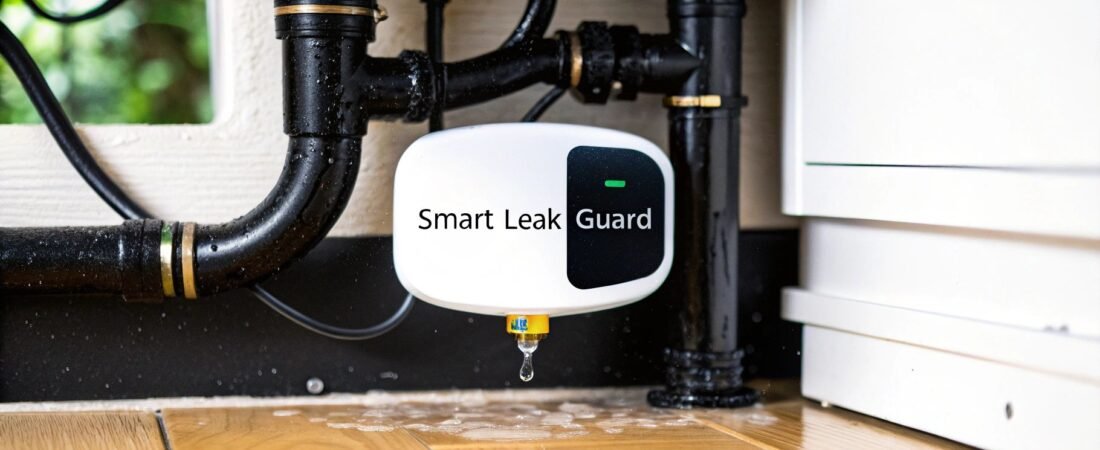
If you're serious about protecting your home, the best smart water leak detectors are no longer a luxury—they're a necessity. Brands like Moen, Phyn, and YoLink are leading the charge, offering everything from simple moisture sensors to systems that can shut off your water main automatically. It's all about getting an instant alert on your phone and having reliable connectivity when it counts.
Why Smart Water Leak Detectors Are a Game-Changer
We've all heard the horror stories. A slow, unnoticed drip under a bathroom sink or a sudden pipe burst behind the drywall can escalate into a disaster in no time. Water damage isn't just a mess; it's a massive financial drain, with the average insurance claim soaring past $11,000. This is precisely why smart water leak detectors have become a core part of any modern home protection plan.
Think of these little devices as a 24/7 sentry for your home's most vulnerable spots. Just tuck one behind the washing machine, under the dishwasher, or near the water heater. The second it senses moisture, it sends an alert straight to your phone. That immediate notification can be the difference between wiping up a small puddle and dealing with a full-blown flood that costs thousands to fix.
But it's not just about the money. Installing a reliable leak detector brings a level of peace of mind that’s hard to put a price on. This is especially true for:
- Frequent Travelers: Keep an eye on your home, even from halfway across the world.
- Landlords: Protect your investment and prevent major headaches for your tenants.
- Owners of Older Homes: Let's face it, older plumbing is just more likely to spring a leak.
Home Water Safety Has Come a Long Way
The market for these gadgets has exploded, which is great news for homeowners. They're more affordable, easier to set up, and integrate smoothly into your existing smart home. To see how they fit into the bigger picture, you can explore our guide on smart home security systems.
The industry's growth tells the story. The global smart water leak detector market was valued at around USD 1,367 million and is expected to hit USD 2,272 million by 2033, climbing at a CAGR of 5.8%. You can dig into the numbers over at imarcgroup.com.
A smart water leak detector is one of the few smart home devices that can pay for itself many times over by preventing a single major incident. It transforms home protection from a reactive cleanup effort to a proactive, preventative strategy.
This screenshot from Wikipedia's page on smart homes really shows how these devices are part of a larger, interconnected network. They don't just work in isolation; they communicate with other sensors and controllers in your home.
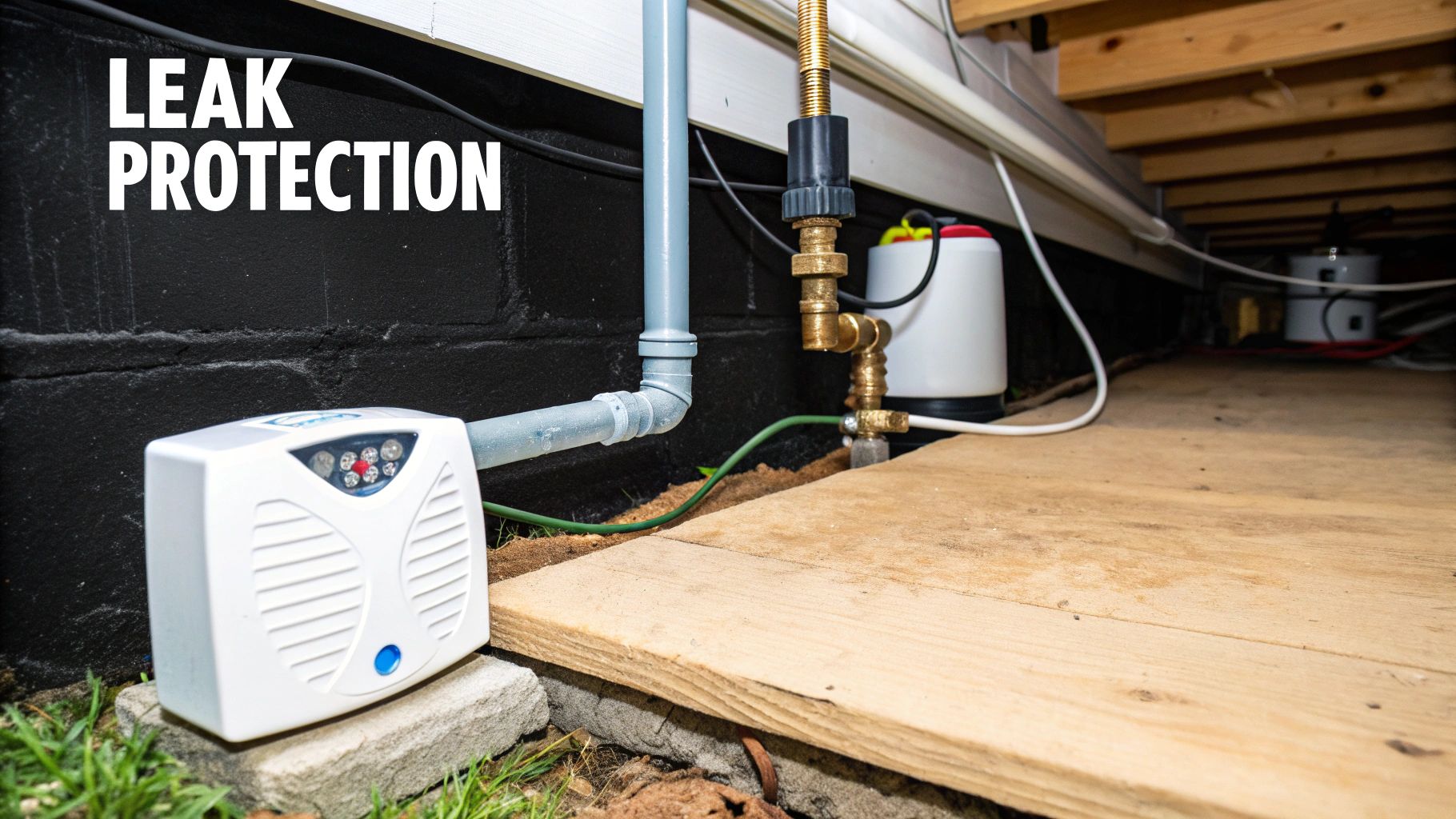
This integration is key. A leak detector that can automatically trigger your main water valve to shut off is the ultimate safety net. This guide will walk you through the tech, break down the real differences between the top models, and help you find the right system to guard your most important asset.
How We Tested These Leak Detectors
When it comes to something as critical as protecting your home from water damage, a simple feature list just doesn't cut it. That's why we put these devices through their paces using a hands-on, real-world testing process. We wanted to see how they’d perform not just on a spec sheet, but in a real home. This is the same framework we'd use to choose a device for our own houses, and we believe it’s the best way to help you find the right one for yours.
At the heart of our evaluation is core performance. A leak detector has one primary job: sense water and tell you about it, fast. We timed how quickly an alert went from the sensor detecting water to a notification buzzing on a phone—we're talking milliseconds. We also tested the accuracy of the water sensors and their ability to detect ambient temperature changes, since a freeze warning can be just as crucial as a leak alert. Battery life was another big one; we analyzed performance under different conditions to make sure a dead battery wouldn't leave you vulnerable.
This infographic breaks down the three performance areas we focused on most during our testing.
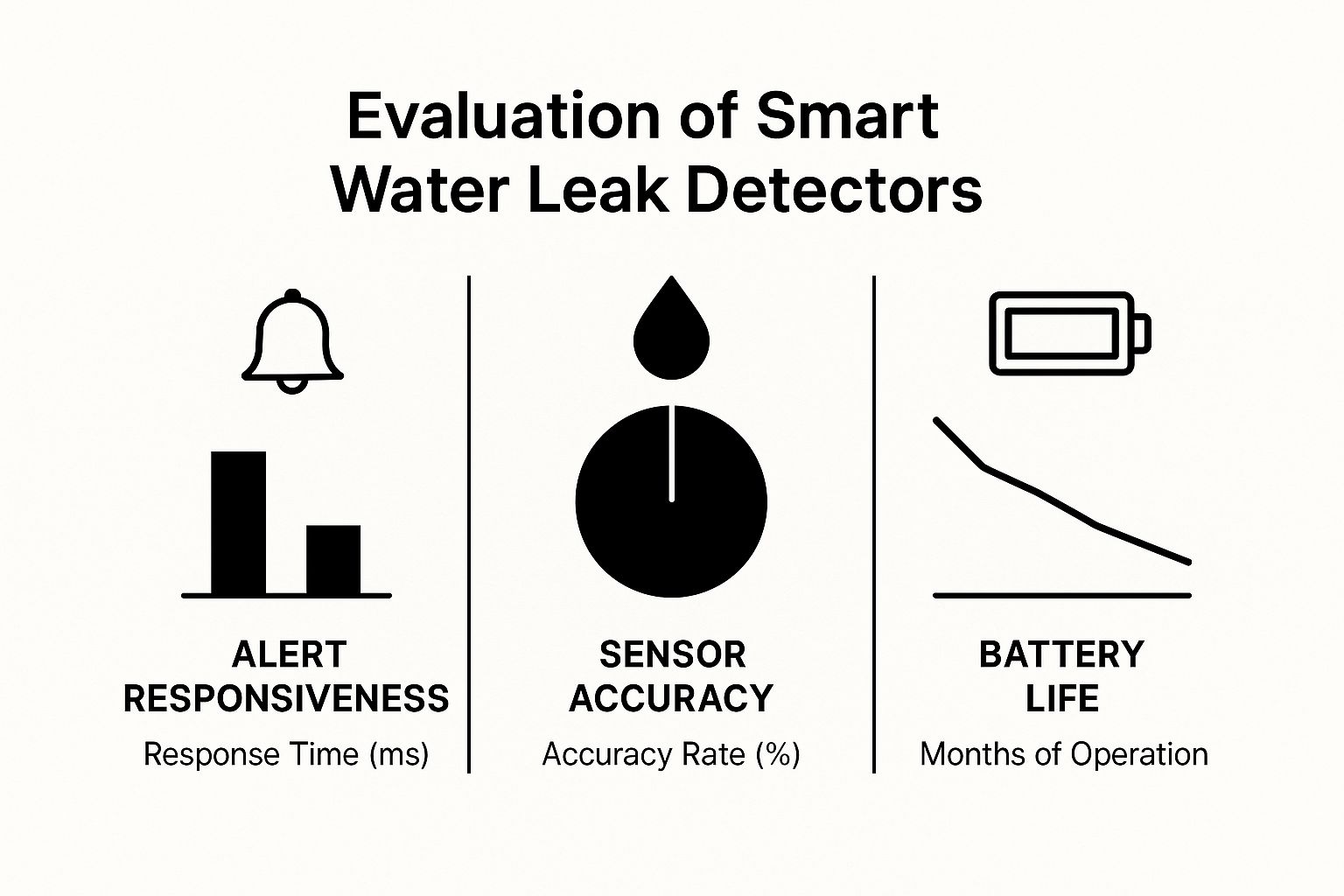
As you can see, there's often a trade-off. Some models send alerts in a flash but might need new batteries more often. This highlights why it’s so important to match the device's strengths to your specific situation.
Connectivity and The App Experience
A sensor's hardware is only half the story; its reliability hangs on its connectivity protocol. We looked closely at how each connection type really works in a home environment:
- Wi-Fi: This is the easiest to set up. It connects right to your home's router, no extra hub needed. The downside? It's a bit of a power hog, which usually means you'll be swapping batteries more frequently.
- Zigbee & Z-Wave: These protocols are the marathon runners of the smart home world. They operate on low-power mesh networks that require a smart hub, but their battery life is incredible—often lasting several years. They also create their own network, so they won't clog up your Wi-Fi.
Getting a handle on these different systems is fundamental to building a smart home that doesn't give you headaches. If you want to dive deeper, our complete guide to choosing a smart home protocol is a great place to start.
A seamless app experience transforms a functional device into a truly user-friendly tool. If the setup is clunky or notifications are difficult to customize, you're less likely to rely on the system when it matters most.
Finally, we spent a lot of time with each device's app. We went through the entire process, from unboxing and pairing to tweaking alert settings for temperature and moisture. We also looked for practical features like historical data logs, which are fantastic for spotting those slow, sneaky leaks that might otherwise go unnoticed. A good app is what makes a smart detector feel truly integrated into your life, not just another gadget you have to manage.
Comparing the Top Smart Water Leak Detectors
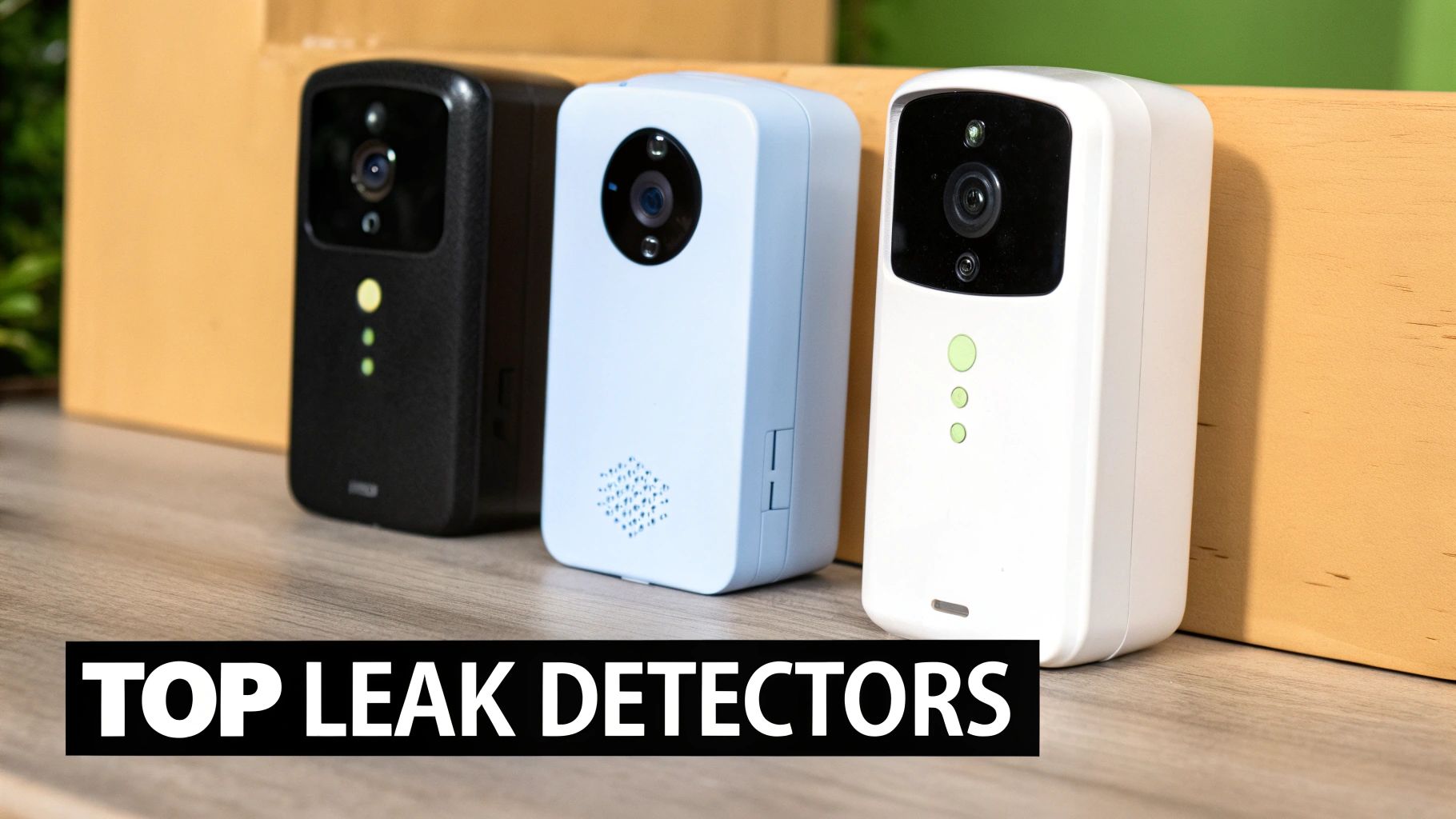
Picking the right water leak detector isn't about finding the one with the longest feature list. It's about understanding how those features work in the real world and matching a device's strengths—be it a screaming-loud siren or a five-year battery life—to your home's layout and your own needs.
Let's cut through the noise and break down the top contenders. We'll go beyond the marketing hype to look at what really makes a difference: how they connect, how they alert you, and what else they can do to protect your home.
Connectivity: The Foundation of Reliability
How a sensor talks to the outside world is the first big decision you'll make. This choice has a direct impact on how easy it is to set up, how long the batteries last, and how quickly you get an alert. The main players here are Wi-Fi, Z-Wave, and Zigbee.
Wi-Fi detectors are the go-to for simplicity. They connect straight to your home's router, so there's no need to buy a separate smart home hub. This makes them a fantastic starting point if you're just dipping your toes into smart home tech.
But that convenience has a trade-off. Wi-Fi is power-hungry, meaning you'll be swapping batteries every one to two years. It also adds another device competing for bandwidth on your network, which can sometimes cause congestion if you have a lot of gadgets.
On the other side of the coin, Z-Wave and Zigbee detectors are built for efficiency. They run on low-power mesh networks, letting their batteries last for an impressive three to five years, sometimes even longer. Instead of connecting to your router, they talk to a central hub (like one from SmartThings or a newer Amazon Echo), which handles the internet connection.
This hub-based setup creates a more stable, dedicated network for your smart devices, so it won't interfere with your Netflix stream. The catch, of course, is that you need that compatible hub to get started.
Key Differentiator: The choice between Wi-Fi and a hub-based system like Z-Wave or Zigbee really boils down to simplicity versus efficiency. For a couple of sensors, Wi-Fi is easy and hub-free. For a whole-home system, a hub provides much better battery life and rock-solid reliability.
Feature Showdown of Top Smart Water Leak Detectors
To see how these differences play out in real products, a side-by-side look at the specs is invaluable. This table breaks down the core capabilities of the most popular models, making it easier to spot the perfect fit for your smart home.
| Model | Connectivity | Power Source | Alert Types | Automatic Shut-Off | Smart Home Integration |
|---|---|---|---|---|---|
| Govee Wi-Fi Water Sensor | Wi-Fi | 2x AAA Batteries | Push Notification, Email, 100dB Siren | No | Amazon Alexa, Google Assistant |
| Flo by Moen Smart Water Detector | Wi-Fi | CR123A Battery | Push, Email, SMS, Audible Beep | Yes (with Moen Shut-Off) | Amazon Alexa, Google Assistant, IFTTT |
| Ring Alarm Flood & Freeze Sensor | Z-Wave | CR123A Battery | Push Notification | No | Amazon Alexa (requires Ring Alarm Base Station) |
| Aqara Water Leak Sensor | Zigbee | CR2032 Battery | Push Notification, Hub Siren | Yes (with Aqara products) | Apple HomeKit, Amazon Alexa, Google Home |
| YoLink Water Leak Sensor 2 | LoRaWAN | 2x AAA Batteries | Push, Email, SMS (with credits) | Yes (with YoLink Valve Controller) | Amazon Alexa, IFTTT |
This is just a snapshot, of course. The best device for a basement prone to freezing might be different than the one you stick under a bathroom sink, but seeing the specs laid out like this really helps clarify the options.
The Nuances of Alert Systems
What happens when the sensor actually finds water? How it gets your attention is arguably its most important job. After all, an alert you miss is completely useless.
Nearly every modern sensor will send push notifications to your phone through its app. This is fast and effective, as long as your phone has service and your notifications are on. A good app will also let you notify multiple family members, which is a nice touch.
But what if your phone is on silent, dead, or you're in a spot with bad reception? That’s when a good old-fashioned audible siren proves its worth.
Many of the best models have a built-in siren, typically between 85 and 100 decibels—that's loud enough to get your attention from a few rooms away. This local alarm doesn't rely on your phone or the internet. A piercing siren from under the sink at 2 a.m. will wake you up far more effectively than a quiet notification you won't see until morning.
Some systems go even further with their alerts:
- Email Notifications: A solid backup that provides a written log of the event.
- SMS Text Messages: Can be more dependable than app notifications if your data connection is spotty.
- Automated Phone Calls: A premium feature, but it's a powerful failsafe for ensuring a critical alert is never missed.
Think about your own habits. If you travel a lot, a system with multiple alert types (push, email, and SMS) is a clear winner. If you have a large home, a loud siren is a must-have.
Advanced Capabilities: Freeze and Humidity Monitoring
The smartest detectors are more than just one-trick ponies; they're multi-purpose environmental sensors. Two of the most practical bonus features are freeze and humidity detection, which can help you prevent disasters before they even start.
Freeze detection is a lifesaver if you live in a cold climate. An onboard temperature sensor keeps an eye on the air. If it dips below a set point (usually around 40°F or 4°C), you get a "freeze alert." This early warning gives you time to prevent a pipe from bursting, making it essential for basements, crawl spaces, and vacation homes sitting empty in the winter.
Humidity monitoring is just as crucial for stopping slow-moving damage. High humidity in places like basements or attics is a breeding ground for mold and rot. A sensor with a hygrometer can alert you when humidity climbs above a healthy range (typically over 60-70%), so you can fire up a dehumidifier long before you see—or smell—a problem.
This trend toward multi-functionality is a big part of why the smart sensor market is growing so fast. The global market for water leak sensors is expected to nearly double, jumping from USD 2.16 billion in 2025 to USD 4.07 billion by 2035, thanks to the integration of technologies like Wi-Fi and Zigbee. For a deep dive into these trends, you can check out the full market analysis on Future Market Insights.
Smart Home Integration and Ecosystem Compatibility
A smart device's true power is unlocked when it works with the other gadgets in your home. Solid integration with platforms like Amazon Alexa, Google Assistant, and Apple HomeKit elevates a simple sensor into a key player in an automated home safety system.
At a basic level, this means you can ask, "Hey Google, is the laundry room sensor okay?" But the real magic happens when you create automated routines.
Think about these real-world scenarios:
- Visual Alerts: Set up a routine so that a detected leak makes your Philips Hue lights flash red.
- Whole-Home Announcements: Have your smart speakers broadcast, "Warning: Water leak detected in the basement," so everyone hears it.
- Active Flood Prevention: This is the ultimate setup. A leak sensor can talk to a smart water shut-off valve and automatically turn off your home's main water line the second it detects moisture, stopping a flood before it can even start.
As you compare models, look beyond the simple "works with" logos. Some devices only allow for basic voice checks, while others offer the deep integration needed for these kinds of powerful automations. The right choice depends entirely on the smart home system you already have and how automated you want your protection to be.
Taking Protection to the Next Level: Whole-Home Automatic Shut-Off Valves
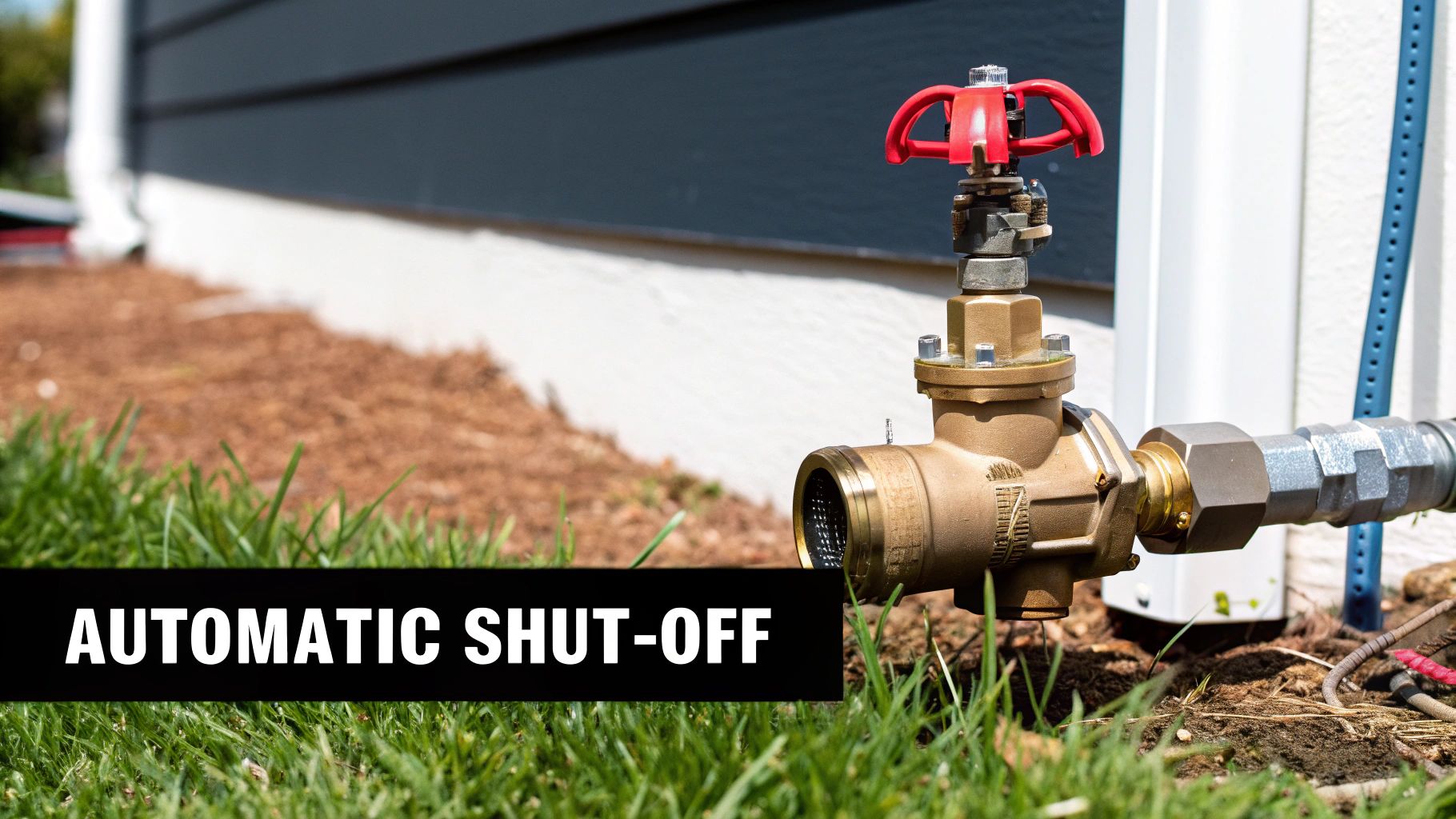
While placing individual sensors around the house is a great first step, a truly robust strategy goes from just alerting you to a problem to actively preventing a disaster. This is where systems with automatic shut-off valves completely change the game. Think of them as the ultimate safety net, capable of stopping a flood in its tracks without you lifting a finger.
These systems are installed directly onto your home's main water line. The moment a connected sensor detects moisture, it signals the valve to slam shut, cutting off the water supply to the entire house within seconds. This seamless response turns your leak detection system from a simple alarm into a powerful, preventative tool.
Is a Shut-Off System Right for You?
Honestly, not every home needs this level of protection. But for certain situations, it's an investment that pays for itself in peace of mind alone. An automatic shut-off is one of the best smart water leak detectors for anyone who wants to eliminate the "what-if" scenarios.
It's a particularly smart move in these cases:
- Vacation Homes & Rentals: If a property sits empty for long stretches, a small leak can turn into a catastrophe before anyone notices. An auto shut-off stops the water instantly, whether you're there or not.
- Finished Basements: These spaces are often packed with valuable electronics, furniture, and sentimental items. A flood here isn't just a mess; it's a major financial and emotional loss.
- Homes with Older Plumbing: Let's face it, older pipes are a ticking time bomb. A shut-off valve is your best defense against the inevitable weaknesses of an aging plumbing system.
- Second-Floor Laundry Rooms: A washing machine hose letting go on an upper floor can ruin ceilings, walls, and floors on multiple levels. The repair bills can be staggering.
An automatic shut-off valve is the difference between getting an alert that your basement is flooding and getting an alert that a leak was detected and immediately stopped. It shifts the outcome from damage control to damage avoidance.
Weighing the Cost Against the Long-Term Payoff
There’s no getting around it—the upfront cost is the biggest hurdle for most people. Systems with automatic shut-off valves are quite a bit more expensive than standalone sensors. You’ll also likely need a professional plumber to install it, adding to the initial bill.
But you have to weigh that cost against the potential savings. Water damage is one of the most common and expensive homeowner headaches, with the average claim topping $11,000. A single flood prevented by the system pays for it many times over. This is why so many insurance companies offer significant discounts on your premium if you have one installed.
The market for these active systems is growing, especially in high-stakes commercial buildings like data centers and hospitals. In fact, this segment is projected to grow at a CAGR of 6.2% from 2025 to 2035. You can dig into the data and market trends yourself over at Fact.MR. This trend shows a clear shift toward active prevention because, simply put, it works better. Ultimately, choosing a system with an automatic shut-off isn't just another gadget; it's a serious investment in your property's security.
How to Choose the Right Leak Detector for Your Home
Picking the right smart water leak detector isn't about finding the one with the most features—it's about finding the right one for your home. Your ideal choice really boils down to your living situation, your home's unique quirks, and how deep you already are into the smart home world.
A renter in a high-rise apartment has completely different needs than a homeowner with a finished basement and an old water heater. Let's break down how to find a solution that gives you maximum protection with minimum fuss.
Are You a Renter or a Homeowner?
The first and most important question is whether you own or rent, because this dictates everything from installation to scalability.
If you're a renter, your best friends are battery-powered, standalone Wi-Fi sensors. They're a breeze to set up. You just place them where you need them—under the kitchen sink, next to the washing machine—and connect them to your Wi-Fi. No wiring, no plumbing, no angry landlords. When your lease is up, you just pack them up and take them to your next place.
For homeowners, it’s better to think bigger with a scalable, whole-home system. You have more ground to cover and more at stake, like a second-floor laundry room, a basement sump pump, or that water heater in the back of the closet. A system that uses a central hub is usually the way to go. It’s a bit more of an investment upfront, but hub-based networks (often using Z-Wave or Zigbee) are incredibly reliable and have much better battery life. This setup lets you add more sensors over time as you identify new trouble spots.
Your living situation is the biggest factor here. Renters need simple, portable Wi-Fi sensors. Homeowners will get more long-term value from a scalable, hub-based system that can grow with them.
Figure Out Your Home's Weak Spots
Every home has its own personality, and that includes its own set of potential plumbing problems. Before you buy anything, grab a notepad and walk through your house to map out the most vulnerable areas.
Here's a quick checklist to get you started:
- Kitchen: Check under the sink, behind the dishwasher, and especially near the fridge's ice maker line.
- Bathrooms: Place one behind every toilet, under each sink, and near the tub.
- Utility & Laundry Rooms: Get a sensor next to the washing machine, around the base of the water heater, and near any sump pumps.
- Basements & Attics: Don't forget areas with exposed pipes or HVAC condensation pans.
Once you have your list, think about the consequences of a leak in each spot. A small drip in a concrete basement is an annoyance. A leak from your second-floor laundry room could bring down the ceiling below. For these high-risk areas, a sensor with a loud, built-in audible alarm is a must-have. You can't rely solely on a smartphone notification when you need an immediate, can't-miss alert.
Match Your Tech to Your Smart Home (and Your Budget)
Finally, your new leak detector should slide right into your existing smart home setup, not feel like another random gadget with its own app.
If you're just dipping your toes into smart home tech, a couple of standalone Wi-Fi sensors might be all you need. It’s a simple, budget-friendly approach that gets you the essential alerts on your phone without needing a central hub.
But if you’re already running a smart home hub like SmartThings or use Alexa Routines for everything, then a Z-Wave or Zigbee sensor is the smarter investment. These little devices can trigger powerful automations. Imagine a leak being detected and your smart lights instantly flashing red or your Echo speakers announcing a warning. If you need help deciding on an ecosystem, our smart home hub comparison breaks down the pros and cons of the major players.
It all comes down to balancing your home's risks, your budget, and how connected you want everything to be. Taking a few minutes to think through these points will ensure you end up with a system that actually works for you and brings some real peace of mind.
Still Have Questions? Let's Clear Things Up.
Even after comparing the top models, you probably have a few practical questions floating around. I get it. Let's tackle some of the most common ones I hear from people setting up these systems for the first time.
Where’s the Best Place to Put These Sensors?
Proper placement is everything. You're trying to catch the first sign of trouble, so think like a drop of water. Where are the most likely weak points in your home's plumbing?
Your goal is to put a sensor right where a leak would start, long before it becomes a disaster.
Here are the non-negotiable spots I recommend for maximum peace of mind:
- Under Sinks: Kitchen and bathroom sinks are notorious for slow drips from supply lines and drains. A sensor here is your first line of defense.
- Next to Major Appliances: Put one right beside your washing machine, dishwasher, and refrigerator (if it has an ice maker). A ruptured hose on one of these can flood a room in minutes.
- Around the Water Heater: When these tanks fail, they fail big. Having a sensor at the base is absolutely critical.
- Tucked Behind Toilets: A leaky wax seal or a cracked supply line is a classic "silent but deadly" problem. A sensor can spot it immediately.
- In the Basement: Place sensors near your sump pump and in any low corners where water naturally pools.
Do I Need to Buy a Smart Hub for These to Work?
It really depends on the specific detector you choose. This is one of the key technical differences that affects not just the setup, but also battery life and how reliable the connection is.
Many of the most popular models today connect straight to your home's Wi-Fi. This is the most straightforward route—no extra gear needed. You just link the sensor to your router using the product's app. Simple.
On the other hand, some detectors run on low-power protocols like Z-Wave or Zigbee. These are fantastic for battery life but do require a compatible smart home hub to act as the "brain," like one from SmartThings or a newer Amazon Echo that has a Zigbee hub built-in.
It’s a trade-off: Wi-Fi is great for simplicity and if you only need a few sensors. But for a whole-house system, hub-based networks like Z-Wave or Zigbee are more stable and their batteries last much, much longer.
Can a Leak Detector Actually Lower My Home Insurance Bill?
Yes, and you should definitely look into it. Water damage is a massive headache for insurance companies, leading to some of their most frequent and costly claims—the average can easily top $11,000.
Because of this, many providers are happy to offer a discount if you take proactive steps to prevent it. A basic sensor might get you a small percentage off, but the real savings come from systems that feature an automatic water shut-off. Insurers love those.
The best way to find out is to give your agent a call. Be specific and ask about discounts for "water leak detection systems" or "automatic water shut-off valves." They’ll tell you exactly what you need to qualify and what kind of proof they need.
How Often Will I Be Changing Batteries?
Battery life can vary quite a bit from one model to another, and it almost always comes down to the connection type.
Wi-Fi sensors are power-hungry. They need to stay connected to your network, which drains the battery faster. You can generally expect to get about one to two years out of them.
Z-Wave or Zigbee sensors, however, are the marathon runners of the group. They use way less energy, so their batteries can easily last for three to five years—sometimes even more. It's a huge difference.
The good news is you won't be left guessing. Just about every quality smart detector on the market will send a low-battery notification to your phone, giving you plenty of warning before it's time for a swap.
At Automated Home Guide, our goal is to help you make smart, practical decisions for a safer home. For more hands-on reviews and expert smart home advice, come visit us at https://automatedhomeguide.com.



Leave a Reply