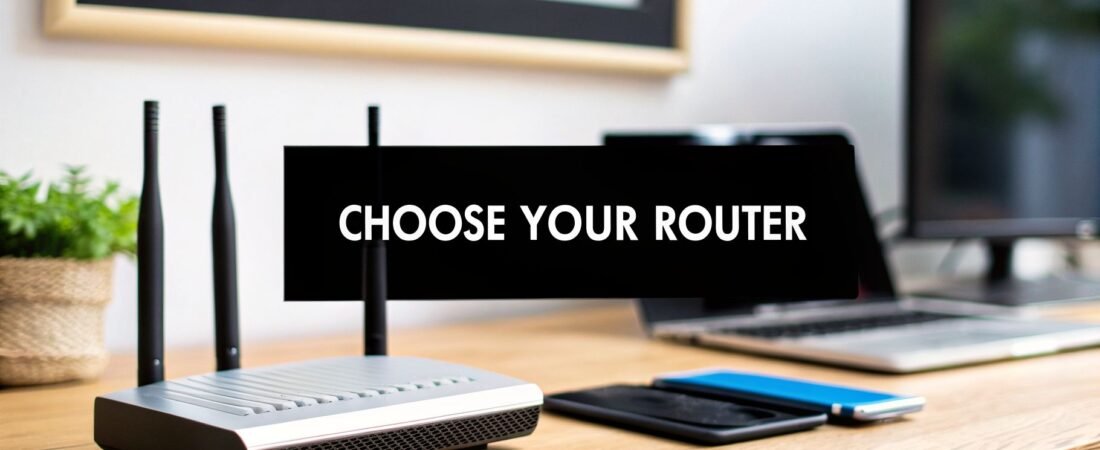
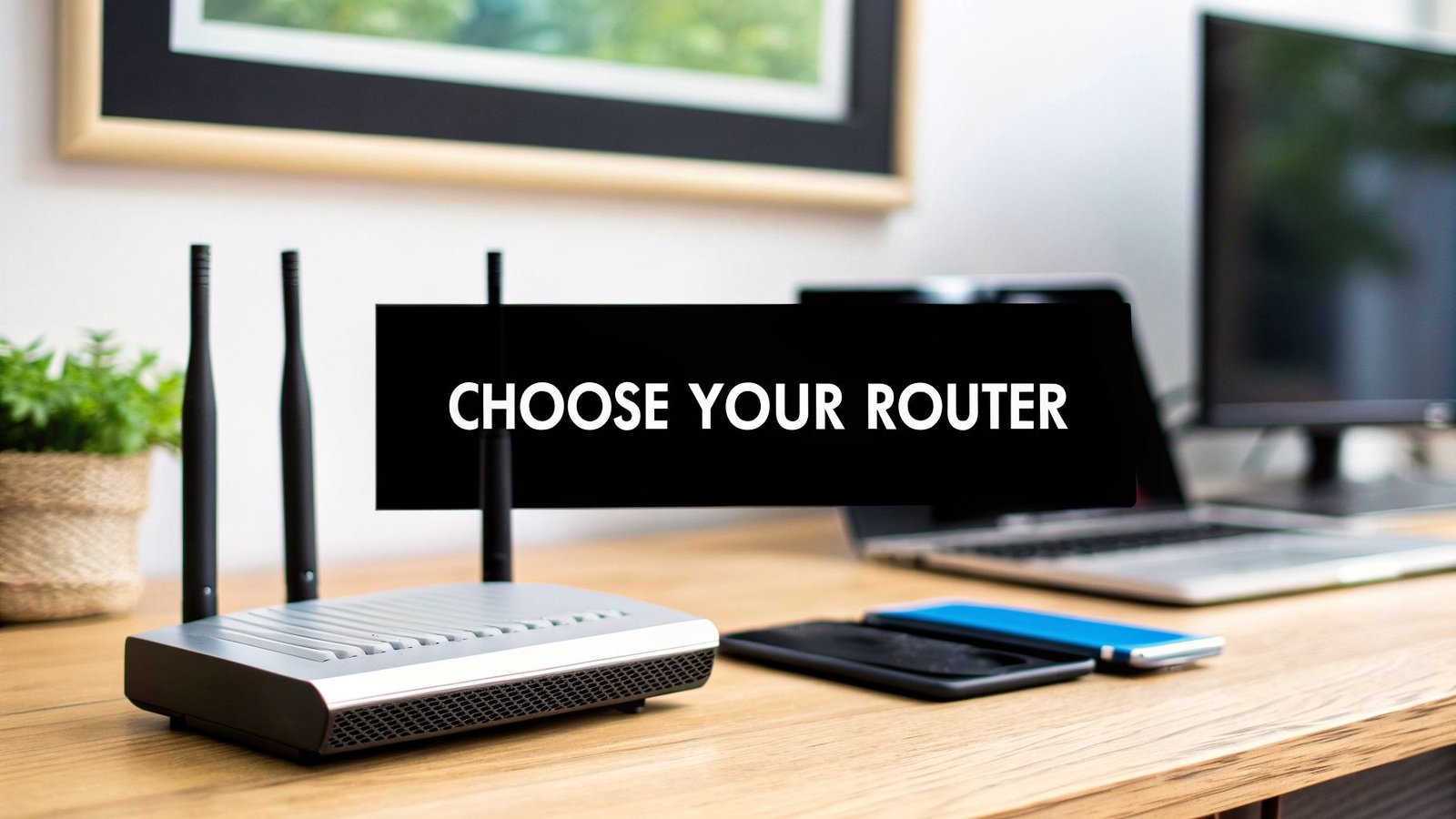
Picking the right router really just comes down to a simple equation: matching its power to your reality. You have to consider your internet speed, the size of your home, and just how many devices are fighting for bandwidth. A basic router might be fine for checking email on a laptop, but a modern smart home needs something with more muscle, like Wi-Fi 6 technology, to juggle dozens of gadgets without breaking a sweat.
Your Smart Home Starts with the Right Router

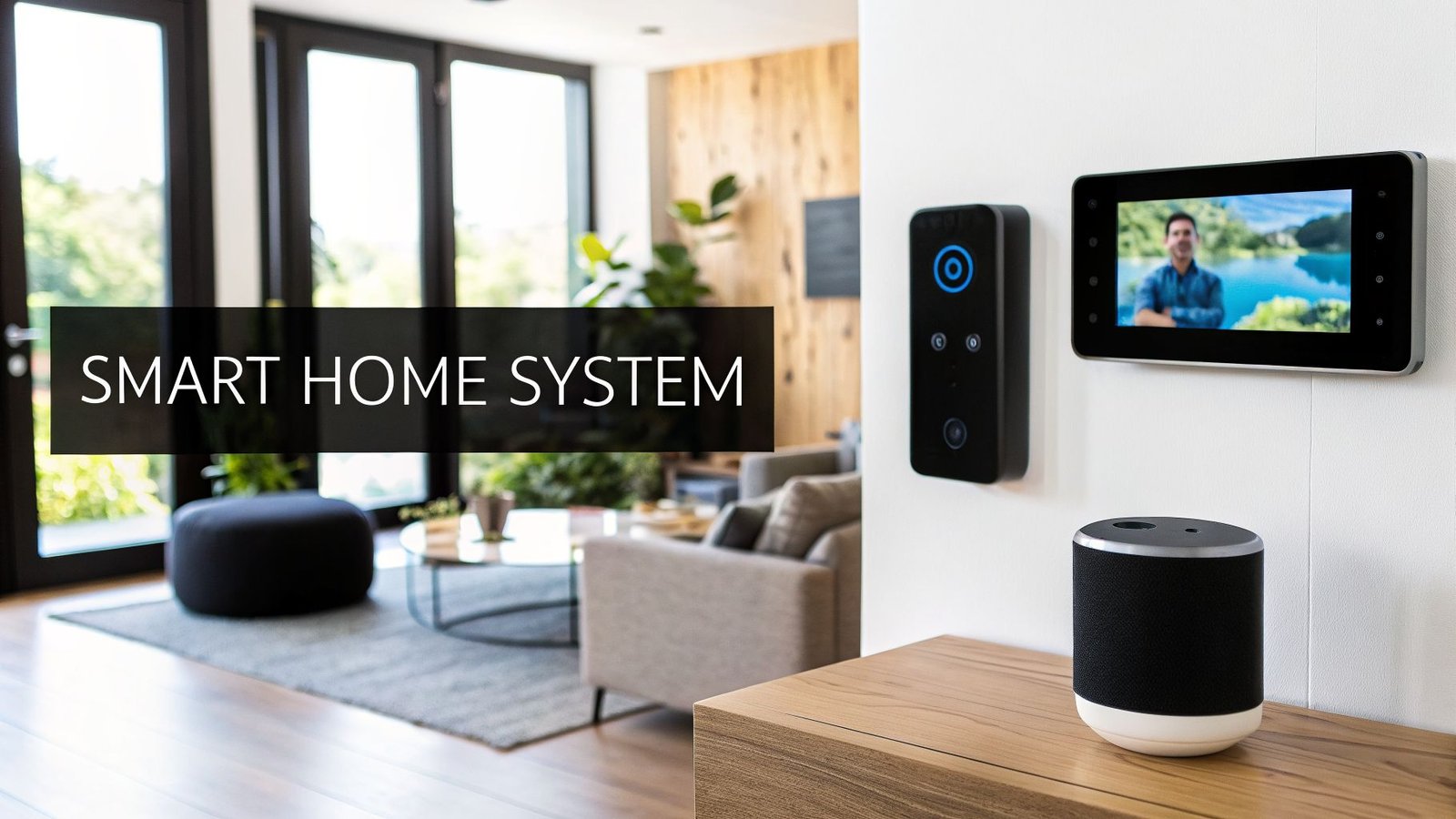
It’s easy to forget about your router, but it’s truly the central nervous system of your entire smart home. It's the unsung hero directing traffic for everything—from your security cameras and smart speakers to your thermostat and video doorbell. When it’s doing its job right, you don’t even know it’s there. But the moment it starts to struggle, your whole connected world can grind to a halt.
Why Your Old Router Is Struggling
Let's be honest, the router you got from your internet provider five years ago was never built for this. It wasn't designed to handle the constant data chatter from a dozen smart bulbs, multiple 4K streams, and a few online gaming sessions all happening at the same time. This creates a digital traffic jam, leading to some all-too-common smart home headaches.
You've probably experienced them:
- Laggy Video Feeds: That security camera feed stutters and freezes right when you need it most.
- Dropped Connections: Your smart speaker suddenly cuts out in the middle of a song or just stops responding.
- Slow Performance: The whole network feels sluggish, even though you’re paying for blazing-fast internet.
Making a smart choice now saves you from a world of frustration later. The global wireless router market hit a value of USD 2.99 billion in 2024, and it's no surprise that Wi-Fi 6 and 6E models are driving that growth. They're built specifically to handle crowded networks. This is a direct response to the explosion in smart homes, which are projected to have over 50 billion connected gadgets worldwide by 2030. You can find out more about wireless router market trends to see just how fast this space is growing.
Choosing the right router is less about chasing the absolute highest speeds and more about ensuring stable, consistent connectivity for every single device in your home. Think of it as an investment in reliability.
This guide is designed to cut through the confusing specs and technical jargon. We'll give you a clear, practical roadmap for picking a router that fits your home's unique demands, ensuring your smart ecosystem runs flawlessly today and is ready for whatever new gadgets you bring home tomorrow.
Assess Your Home's Unique Wi-Fi Needs

Before you even start looking at router specs or comparing prices, you need to take a step back and figure out what your network is actually up against day-to-day. It’s the most critical part of the whole process.
Skipping this step is like buying a car without knowing if you're commuting in the city or hauling gear up a mountain. This quick home audit is the foundation for picking a router that won't just work, but will work for you.
Cataloging Your Connected Devices
First things first: do a quick inventory of every single device that connects to your Wi-Fi. And I mean everything—not just the obvious stuff like your phone and laptop.
Take a walk around your home and make a real list. You’ll probably be surprised. In a typical smart home, it's not uncommon to have 30 or 40 gadgets all fighting for a slice of the Wi-Fi pie.
Be sure to count things like:
- Entertainment: Smart TVs, streaming sticks (Roku, Apple TV), gaming consoles, and smart speakers.
- Smart Home Hubs: Video doorbells, security cameras, thermostats, smart plugs, and light bulbs.
- Personal Gadgets: Laptops, tablets, smartphones, and smartwatches for everyone in the house.
- Miscellaneous: Connected appliances like refrigerators, robot vacuums, or even that smart garage door opener.
This number gives you a clear idea of the capacity your router needs. A router that's overloaded with connections will start dropping devices at random, which is a one-way ticket to frustration.
A router's performance isn't just about speed; it's about its ability to manage dozens of simultaneous conversations without getting overwhelmed. Think of it as an air traffic controller for your home's data.
Evaluating Your Physical Environment
Next up, take a hard look at your home’s layout and what it’s made of. Wi-Fi signals are just radio waves, and they get seriously weakened by certain materials. The same router that works perfectly in a small, open-plan apartment could be a total dud in a two-story house with thick walls.
Keep an eye out for these common signal killers:
- Thick Walls: Plaster, brick, and especially concrete are notorious for blocking Wi-Fi.
- Multiple Floors: Signals have a tough time traveling vertically, which is why basements and top floors often turn into dead zones.
- Metal and Water: Large metal appliances (your refrigerator is a big one) or even something like a large aquarium can block or reflect signals in weird ways.
Mapping out these physical roadblocks now will help you decide later whether one powerful router will do the trick or if you need to step up to a mesh system for better coverage.
Assessing Your Family’s Usage Habits
Finally, be honest about how your household actually uses the internet. What you're doing online is just as important as how many devices are connected.
A family with someone streaming a 4K movie, a teenager in a competitive online game, and another person on a video call is putting a massive strain on the network. That's a completely different scenario from a home where everyone is just casually browsing social media.
This assessment helps you zero in on the right features, so your smart home runs without constant buffering or lag. Getting this part right is what separates a good purchase from a great one.
Decoding Modern Wi-Fi Standards and Bands
Trying to figure out Wi-Fi standards can feel like you're reading a different language. You’ll see terms like Wi-Fi 6, 6E, dual-band, and tri-band thrown around, but what do they actually mean for your smart home?
Let’s get straight to it. Each new Wi-Fi standard is basically a generational leap in technology, bringing improvements in speed and, more importantly, efficiency. For just about any smart home I've set up recently, Wi-Fi 6 (also known as 802.11ax) is the gold standard. It was built from the ground up to handle dozens of devices clamoring for attention at once—which is the exact definition of a modern smart home.
The real magic of Wi-Fi 6 isn't just about faster download speeds for your laptop. Its secret weapon is how it handles all that traffic. It uses a clever piece of tech called OFDMA (Orthogonal Frequency Division Multiple Access), which lets the router talk to many devices simultaneously instead of serving them one by one.
Think of it this way: older Wi-Fi was like a single-lane road, where devices had to wait their turn. Wi-Fi 6 is like an eight-lane superhighway, allowing your security camera, smart lights, and thermostat to all get the data they need at the same time without causing a digital traffic jam.
For any smart home pushing past 30 connected gadgets, I consider Wi-Fi 6 a non-negotiable feature. It's the foundation for a network that actually feels responsive and stable.
What’s the Deal with Wi-Fi Bands?
Beyond the standard, you'll see routers advertised as "dual-band" or "tri-band." This simply refers to the radio frequencies the router uses to send out its signal. It’s one of the most important choices you’ll make.
Dual-Band: This is the most common setup. It gives you two networks: a 2.4 GHz band and a 5 GHz band. The 2.4 GHz frequency travels farther but is slower and gets crowded easily by everything from old cordless phones to your microwave. The 5 GHz band is much faster but doesn't have the same wall-penetrating range.
Tri-Band: This is where things get interesting. A tri-band router adds a second 5 GHz band, or in the case of newer Wi-Fi 6E models, a brand new 6 GHz band. This extra band is like having an exclusive express lane on the highway for your most critical devices.
For a serious smart home, a tri-band router is a game-changer. I often recommend clients dedicate one of the 5 GHz bands solely to their smart home devices. This isolates them completely from the traffic generated by your 4K TV streaming and Zoom calls, which prevents your video doorbell feed from stuttering the moment someone starts watching Netflix.
If you really want to get into the weeds, our guide on the different types of Wi-Fi for your home covers this in much greater detail.
So, what's the bottom line? For any modern smart home, a Wi-Fi 6 dual-band router is your minimum starting point. But if you want a truly robust and future-proof network that can handle a growing army of gadgets, stepping up to a tri-band model is an investment you won't regret.
Single Router or a Full-Fledged Mesh System?
This is probably the biggest fork in the road you'll face when picking a router. The classic, high-powered single router can absolutely be the right choice. If you live in an apartment or a smaller home—say, under 1,500 square feet—with a pretty open layout, a single, powerful router is often the simplest and most budget-friendly way to go.
But the minute you're dealing with multiple floors, a sprawling floor plan, or walls made of signal-killing materials like brick or old-school plaster, that single router's signal is going to struggle. That’s where a mesh Wi-Fi system steps in and saves the day.
Instead of one central hub, a mesh system uses a main router and several satellite "nodes" you place around your house. They all work together to create one big, seamless Wi-Fi network. The goal is to blanket your entire property with a strong, consistent signal, finally killing off those dead zones in the back bedroom or the basement workshop.
So, When Does Mesh Really Shine?
The magic of a mesh system is something called seamless roaming. It’s a feature you don’t think about until you experience it. Picture this: you're on a video call on your phone, and you walk from the living room out to the patio. Your phone intelligently and automatically switches to the strongest mesh node without ever dropping the connection.
With a traditional router and a separate Wi-Fi extender, that same walk would cause a frustrating stutter or a complete drop as your phone disconnects from the router and reconnects to the extender. For a smart home with devices like outdoor security cameras or a smart lock on a detached garage that need a constant connection, that seamless handoff is non-negotiable.
If you're curious about the setup process, our guide on a wireless mesh network setup walks you through the practical steps.
This quick decision tree can help you visualize whether Wi-Fi 6 or 6E is a better fit based on the number and age of your devices.

As you can see, Wi-Fi 6 is the go-to for most smart homes packed with devices. Wi-Fi 6E, on the other hand, is for those who are all-in on the latest tech and have the brand-new gadgets that can actually use that exclusive 6 GHz band.
Why Everyone's Talking About Mesh
The move toward mesh systems isn't just hype. It's a practical response to how we live now—in bigger, more complex homes filled with dozens of connected devices. The market data backs this up, with mesh systems expected to grow at a healthy 11.74% compound annual growth rate through 2031.
While standalone routers still make up a significant 43.62% of the market, the demand for mesh is climbing fast. It's especially true for larger homes where getting reliable Wi-Fi across 5,000+ square feet is crucial for keeping a modern smart home running smoothly. For those with larger properties, looking into a proven solution like the Linksys Velop mesh system can provide a good benchmark for what to expect.
To make the choice a little easier, here's a side-by-side comparison.
Single Router vs. Mesh System at a Glance
This table breaks down the key differences to help you decide which setup is the right fit for your home's size and your smart-home ambitions.
| Feature | Traditional Single Router | Mesh Wi-Fi System |
|---|---|---|
| Best For | Smaller homes (< 1,500 sq ft), apartments, open layouts | Larger homes (> 1,500 sq ft), multiple floors, complex layouts |
| Coverage | Centralized signal that weakens with distance and obstacles | Multiple nodes create a wide, consistent coverage blanket |
| Dead Zones | Prone to dead zones in corners, basements, and far rooms | Designed specifically to eliminate dead zones |
| Roaming Experience | Devices cling to one signal; extenders cause connection drops | Seamless roaming; devices automatically switch to the strongest node |
| Setup & Management | Typically a single device to configure | Generally easy setup via a mobile app, manages all nodes at once |
| Cost | Often more budget-friendly upfront | Higher initial investment, but expandable by adding more nodes |
| Expandability | Limited; requires separate range extenders (clunky) | Easily expandable by adding more compatible nodes to the system |
| Smart Home Performance | Can struggle with many devices spread throughout a home | Excellent for homes with many smart devices needing stable signals |
Ultimately, your home’s size, layout, and building materials are the biggest factors here. A sprawling ranch-style home with thick walls has very different needs than a two-story modern build with an open floor plan. Choose the solution that solves your specific coverage problems.
Don't Overlook Security and Smart Features
Every smart device you add to your home—from a smart speaker to a video doorbell—is another potential doorway into your network. This is why a router's built-in security isn't just a nice-to-have feature; it's your first and most important line of defense. Getting this right is a fundamental part of choosing a router that will actually keep your home safe.
The threat is real and growing. In 2023 alone, there were over 1.5 billion recorded cyberattacks on IoT devices. This explosion in threats is why the global router market is expected to reach $75 billion by 2032, largely driven by the 60.98% of home users who desperately need better protection against breaches.
When you're building out a smart home, following essential IoT security best practices is critical, and a secure router is the foundation that makes it all possible.
Core Security Protections to Look For
First things first, check the encryption standard. The absolute minimum you should accept is WPA3. It’s the latest, most secure protocol, and it makes it exponentially harder for anyone to brute-force your password and snoop on your activity compared to the older WPA2 standard.
Another non-negotiable is automatic firmware updates. Manufacturers are constantly finding and patching security holes. A router that updates itself automatically means you’re protected from the latest threats without having to remember to log in and do it yourself. It’s a set-it-and-forget-it feature that’s crucial for peace of mind.
Think of automatic updates like a self-maintaining security guard for your network. It's always on duty, getting the latest intel on threats and patching up weaknesses before they can be exploited.
Smart Features That Actually Make a Difference
Beyond the security essentials, some "smart" features are genuinely useful for managing a busy smart home network. The most important one is Quality of Service (QoS).
QoS is a powerful tool that lets you prioritize traffic for specific devices or applications. For example, you can tell your router that your 4K smart TV streaming and your work-from-home video calls are more important than your kid's gaming console downloads.
This means your critical devices get the bandwidth they need, when they need it. Your video call won't drop just because someone else starts a huge download. It’s a simple feature that makes your entire network feel more responsive and reliable. For a more detailed look at securing your network, take a look at our complete guide to home network security best practices.
Making the Final Checks Before You Buy
You’ve done the heavy lifting. You've audited your smart home, decoded the tech specs, and picked a side in the great router-versus-mesh debate. But before you pull the trigger, let’s run through a few final, practical checks. This is the last step to make sure you're getting a perfect fit, not a box of buyer's remorse.
Is It Compatible with Your Internet Provider?
First things first, let's talk about your Internet Service Provider (ISP). It seems obvious, but you’d be surprised how many people get this wrong. While most routers play nice with major providers like Comcast Xfinity or Verizon Fios, some ISPs have quirky requirements or proprietary equipment.
A quick visit to your ISP’s website or a five-minute call to their support line can confirm compatibility and save you a massive headache down the line.
This is especially critical if you’re paying for blazing-fast gigabit internet. Your new router absolutely must be able to handle those speeds. If it can't, you're literally throwing money away on performance you'll never get to use.
Don't Forget About Wired Connections
In our wireless-obsessed world, it's easy to overlook the humble Ethernet port. Don't make that mistake. The stability of your entire smart home can depend on those physical connections. Take a hard look at the back of any router you're considering and count the Ethernet ports.
Many of the newer, sleeker routers—especially mesh nodes—are going minimalist, sometimes offering only one or two ports. That might work for some, but if you have critical devices that can't afford to drop their connection, you're going to need more.
Think about the devices that thrive on a wired connection:
- Gaming consoles (PS5, Xbox): A wired connection is non-negotiable for low latency and a smooth online experience.
- Smart home hubs: Your Philips Hue or Samsung SmartThings hub is the brain of your operation. It needs a rock-solid link to the network.
- Work-from-home PCs or NAS drives: For anyone transferring large files or relying on an uninterrupted connection for video calls, wired is king.
Running out of ports after you’ve set everything up is a uniquely frustrating experience. Plan for your wired devices now, and you’ll thank yourself later.
Your budget is a balancing act. You need to get the features you require today while leaving a little room to grow for tomorrow. Overspending is wasteful, but skimping on a router that can't keep up is a recipe for daily frustration.
Finally, let's talk money. You can easily spend a fortune on a top-of-the-line router, but you probably don't need to. A really solid Wi-Fi 6 router can often be found for around $150. If you're going the mesh route, a good three-piece system typically starts in the $200-$300 range. The goal is to find that sweet spot: a router that delivers the performance your smart home needs without you paying a premium for features you'll never touch.
Common Questions When Picking a New Router
Even with all the research done, there are always a few lingering questions that come up right before you pull the trigger on a new router. Let’s clear up some of the most common ones I hear, so you can buy with confidence.
Is It Really Worth Replacing the Router My ISP Gave Me?
I get this question a lot. It’s tempting to just stick with the freebie from your internet provider, but for a smart home, that’s almost always a mistake. Think of it as the bottleneck for your entire network.
ISP gear is usually built to a price point, not for performance. They often skimp on processing power and lack modern features like Wi-Fi 6 or robust security protocols. As soon as you start adding smart plugs, cameras, and speakers, that basic router will start to struggle.
Upgrading is probably the single best investment you can make for your network's health. You'll see a real-world difference in speed, get much stronger security (like WPA3 encryption), and gain a ton more control. For a smart home that actually works reliably, it’s not just a recommendation—it’s a necessity.
What's the Real Difference Between Wi-Fi 6 and Wi-Fi 6E?
The big differentiator here is access to a whole new frequency band. Wi-Fi 6 is a massive leap forward, operating on the same 2.4 GHz and 5 GHz bands we've used for years but doing it way more efficiently. It’s built to juggle a house full of devices without slowing down.
Wi-Fi 6E takes it to another level by opening up an exclusive 6 GHz band.
The best way to picture the 6 GHz band is as a brand new, multi-lane superhighway. It’s completely empty and reserved only for your newest, 6E-capable devices, free from all the traffic and interference of the old bands.
So, while Wi-Fi 6 is an excellent choice for any modern smart home, Wi-Fi 6E is all about future-proofing and getting the absolute best performance for your latest and greatest tech.
How Many Devices Can a Good Router Actually Handle?
This is where you really see the gap between old and new technology. An older router from a few years ago might start to choke, lag, and drop connections once you hit 15 or 20 devices. Sound familiar?
A solid Wi-Fi 6 router, on the other hand, is built from the ground up to handle 50+ devices simultaneously without breaking a sweat. It uses smart tech like OFDMA to talk to lots of gadgets at once, instead of making them take turns.
For those of us with fully loaded smart homes—multiple cameras, dozens of sensors, smart speakers in every room—a high-end mesh system can comfortably manage well over 100 connected devices. It ensures your entire ecosystem runs exactly as it should, with no frustrating hiccups.
At Automated Home Guide, we're committed to helping you build a smarter, safer, and more efficient home. For more expert tips and in-depth reviews, explore our resources at https://automatedhomeguide.com.



Leave a Reply