The concept of a 'smart home' has evolved far beyond a voice-activated lightbulb or a thermostat controlled from your phone. Today, a truly smart home is an integrated ecosystem designed to enhance your life in meaningful ways. It can improve security, conserve energy, add profound convenience, and even promote personal wellness. This guide moves past the basics to explore 10 powerful smart home idea blueprints that you can implement right away.
Each idea presented is a complete, actionable concept, organized by its primary benefit. We provide practical implementation tips, estimated costs, and product examples to help you build a more intelligent, responsive, and efficient living space. As more devices connect and share data, a robust network foundation becomes critical. As we delve into the future of connected homes, it's essential to understand why fiber internet for smart home upgrades in 2026 is quickly becoming the new standard.
Whether you are just starting your automation journey or looking to upgrade an existing setup, these curated ideas offer both the inspiration and the specific knowledge you need. Let’s explore how to transform your house into a home that truly works for you.
1. Smart Home Security System with AI-Powered Monitoring
A foundational smart home idea for peace of mind is an integrated security system that leverages artificial intelligence. This goes beyond simple motion alerts by using machine learning to differentiate between a passing car, a stray animal, and a genuine intruder. This intelligent monitoring drastically reduces false alarms and ensures you only receive notifications that matter. The core components include smart cameras, door and window sensors, and a central hub that coordinates everything.
When a potential threat is detected, the system sends a real-time alert to your smartphone, often with a video clip for immediate verification. This modern security solution is highly customizable; for instance, you can link it with other smart devices. A detected intruder at night could automatically trigger all interior lights, sound an alarm, and even secure all exits.
Implementation Tips
- Strategic Placement: Install cameras to cover all primary entry points and ground-floor windows.
- Create Routines: Set up an "Away" mode that automatically arms sensors and activates motion alerts when you leave.
- Integrate Access: Combine your system with one of the best smart door locks to remotely grant access to trusted visitors or lock down your home during an alert.
- Network Strength: Ensure robust Wi-Fi coverage at all sensor and camera locations to prevent connectivity dropouts. Test your system monthly.
2. Whole-Home Energy Management System
A truly intelligent smart home idea involves a comprehensive energy management system that monitors and optimizes electricity consumption house-wide. This technology goes far beyond a simple smart thermostat by tracking real-time usage patterns, identifying energy-hungry appliances, and making automatic adjustments to heating, cooling, and even EV charging based on utility rates and your daily habits. Advanced systems like the Sense energy monitor or Enphase IQ can integrate with solar panels and battery storage to maximize self-sufficiency.
These platforms provide a detailed dashboard on your smartphone, showing exactly where every watt is going. For example, you can see if the old freezer in the garage is costing you a fortune or if your HVAC system is running inefficiently. For those looking to integrate their electric vehicle into a comprehensive home energy strategy, understanding concepts like Bidirectional Charging for EVs is essential, as these systems can manage that flow of energy.
Implementation Tips
- Establish a Baseline: Start with a whole-home energy monitor connected to your electrical panel to understand your baseline usage before making changes.
- Prioritize High-Energy Devices: Focus your initial automation efforts on high-draw appliances like your water heater, HVAC system, and pool pump.
- Leverage Time-of-Use Rates: If your utility offers them, schedule high-consumption tasks like laundry or EV charging to run during off-peak, cheaper hours.
- Combine with a Smart Thermostat: Integrating a smart thermostat like the Google Nest provides granular control and maximizes HVAC savings. Explore other ways to build an energy-efficient smart home.
3. Smart Lighting System with Automated Scheduling and Ambiance Control
A fantastic smart home idea for both convenience and atmosphere is a smart lighting system. This technology allows you to control the brightness, color, and timing of your lights using a smartphone app, voice commands, or automated schedules. Modern systems can even mimic natural daylight patterns to support your circadian rhythm, helping you feel more energized in the morning and relaxed at night. The core components are smart bulbs or switches connected to a central hub or directly to your Wi-Fi.
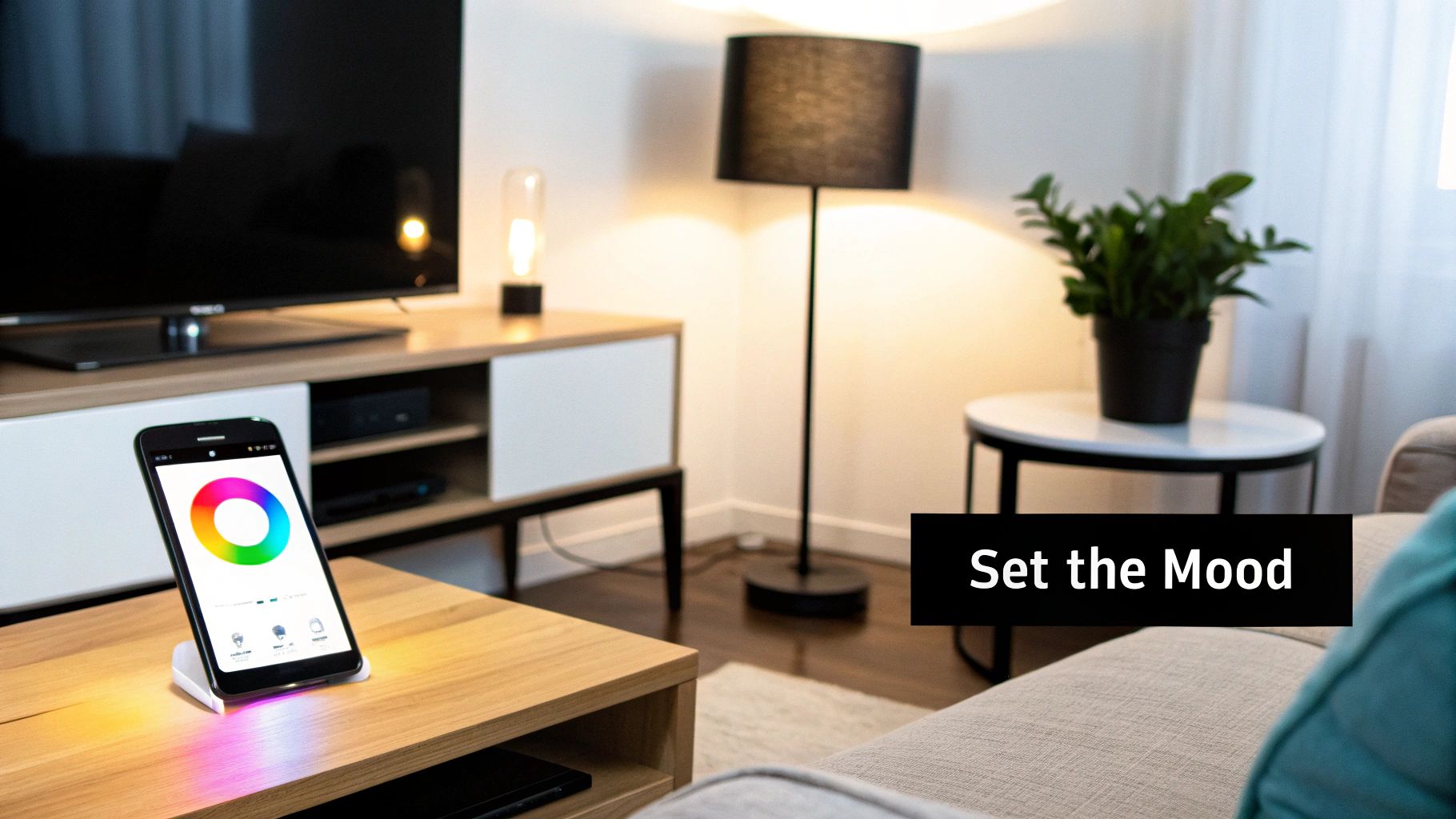
This level of control transforms your home's ambiance instantly. You can create custom "scenes" for different activities like "Movie Night" which dims the lights and changes them to a soft blue, or "Focus Mode" which sets them to a bright, cool white. When you’re away, you can schedule lights to turn on and off randomly, simulating occupancy for enhanced security. This smart home idea offers a perfect blend of practicality, energy efficiency, and aesthetic customization.
Implementation Tips
- Start Small: Begin by upgrading a few key rooms like the living room and bedroom before expanding to the entire house.
- Create Scenes: Program lighting scenes for different activities such as reading, cooking, or relaxing to change the mood with a single command.
- Use Geofencing: Set your lights to automatically turn on as you arrive home or turn off when you leave, ensuring you never waste energy.
- Automate Your Day: To learn how to make your lights work for you, check out our guide on how to automate your house lights for enhanced convenience and security.
- Warm Tones for Evening: Use warm, amber-toned light (around 2700K) in the evenings to promote relaxation and support better sleep.
4. Smart Climate Control with Learning Thermostats
A transformative smart home idea for both comfort and energy savings is an intelligent climate control system centered around a learning thermostat. These devices go far beyond programmable schedules by using sensors, algorithms, and even geofencing to learn your household's patterns. They automatically adjust heating and cooling based on your presence, local weather forecasts, and historical preferences, optimizing temperature without manual intervention.
Over time, thermostats like the Google Nest or Ecobee build a profile of your comfort needs, knowing to warm the house before you wake up or enter an eco-mode when everyone leaves. This automated efficiency can lead to significant reductions in energy bills. When paired with remote sensors, the system can even target specific rooms, ensuring the nursery is warm or the home office is cool, eliminating hot and cold spots throughout your home.
Implementation Tips
- Optimal Placement: Install the main thermostat in a central area, away from direct sunlight, drafts, or heat sources like lamps for accurate readings.
- Enable Geofencing: Activate the home/away feature using your smartphone's location to let the system automatically enter an energy-saving mode when the house is empty.
- Use Room Sensors: For homes with uneven temperatures, add smart sensors to prioritize comfort in the most-used rooms, such as the living room during the day and bedrooms at night.
- Review Energy Reports: Most smart thermostats provide detailed energy usage reports. Check them monthly to find opportunities for further savings and to see how your habits impact consumption.
5. Smart Kitchen Automation with Connected Appliances
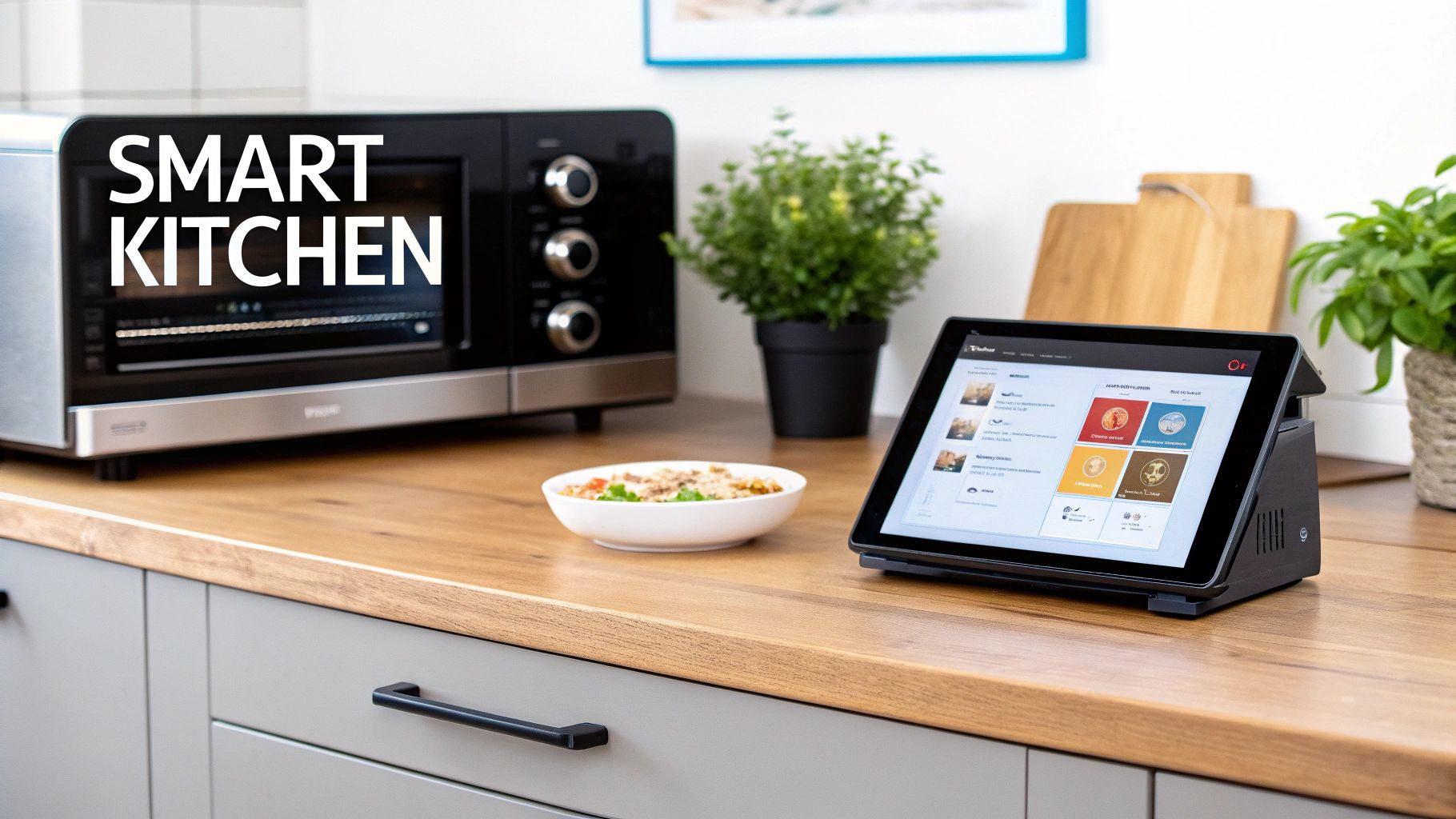
Transforming your kitchen into a connected hub is a fantastic smart home idea that boosts both convenience and efficiency. This involves integrating Wi-Fi-enabled appliances like refrigerators, ovens, and coffee makers that communicate with each other and can be controlled remotely via a smartphone app. These devices go beyond basic functions by sending maintenance alerts, synchronizing recipes directly to your oven, and even helping you manage your grocery list with internal cameras that let you see inside your fridge from anywhere.
A connected kitchen streamlines daily routines and optimizes energy use. Imagine preheating your oven on your way home from work, getting a notification when the dishwasher cycle is complete, or having your coffee maker automatically brew a fresh cup when your morning alarm goes off. Ecosystems like Samsung SmartThings and LG ThinQ allow you to manage all your appliances from a single interface, creating a seamless and intelligent cooking environment.
Implementation Tips
- Choose a Unified Ecosystem: Stick with a single brand like Bosch Home Connect or GE SmartHQ to ensure all your appliances work together seamlessly.
- Phase Your Upgrades: You don't need to buy everything at once. Replace old appliances with smart versions as they wear out, starting with the ones you use most.
- Leverage Off-Peak Energy: Use the "delay start" feature on dishwashers and ovens to run them during off-peak hours, which can help lower your electricity bill.
- Enable Smart Alerts: Activate notifications for critical reminders, such as when your refrigerator door is left open or when your oven has finished preheating.
6. Smart Bedroom Setup with Sleep Optimization Technology
Transform your bedroom into a sanctuary for rest with a smart setup designed to optimize your sleep quality. This powerful smart home idea uses technology to control your environment, promoting deeper and more restorative sleep. It combines elements like smart lighting that shifts to warm, sleep-inducing colors, temperature-controlled mattress pads like the Eight Sleep Pod, and smart speakers that can generate white noise. The goal is to create a perfect pre-sleep and sleep environment that aligns with your body's natural circadian rhythm.
These systems do more than just set the mood; many track your sleep patterns using under-mattress analyzers or wearables like the ŌURA Ring. They gather data on your sleep stages, heart rate, and movements, then provide personalized insights to improve your sleep health. For example, your system could learn that you sleep best when the room is 67°F and automatically adjust the thermostat before you go to bed, creating an automated, data-driven path to better rest.
Implementation Tips
- Create a "Wind Down" Routine: Program your smart lights to begin dimming and shifting to a warm, amber hue 30 to 60 minutes before your scheduled bedtime.
- Maintain Optimal Temperature: Use a smart thermostat or a temperature-regulating mattress pad to keep your bedroom between 65-68°F (18-20°C) for ideal sleep conditions.
- Automate Your Wake-Up: Instead of a jarring alarm, use smart blinds to open gradually with the sunrise or program your lights to simulate a natural dawn, waking you up gently.
- Track and Adjust: Use a sleep tracker for a few weeks to establish a baseline. Use this data to make small, informed adjustments to your environment and routines.
7. Whole-Home Voice Control and Smart Hub System
A powerful smart home idea is to establish a central command system using a voice assistant and a network of smart speakers or displays. This creates a cohesive environment where you can manage all your connected devices, trigger complex routines, and access information hands-free from anywhere in your home. Assistants like Amazon Alexa, Google Assistant, or Apple's Siri act as the brain, allowing you to orchestrate everything with a simple vocal command.
This unified control is a game-changer for convenience. For instance, a single command like "Goodnight" can simultaneously lock the doors, turn off the lights, adjust the thermostat, and arm the security system. Smart displays, such as the Amazon Echo Show or Google Nest Hub, add a visual layer, letting you view security camera feeds, check the weather forecast, or follow a recipe with both audio and video guidance.
Implementation Tips
- Strategic Placement: Install smart speakers in high-traffic areas like the kitchen, living room, and master bedroom for maximum accessibility.
- Build Routines: Create custom routines for common sequences of actions, such as "Morning" to get news briefings and turn on lights, or "Leaving Home" to power down non-essential devices.
- Use Voice Profiles: Set up unique voice profiles for each family member to receive personalized calendars, music playlists, and responses.
- Privacy First: Regularly review your voice assistant's privacy settings and history to manage what data is stored and how it is used.
8. Smart Bathroom Setup with Wellness and Water Conservation
Transforming your bathroom into a smart wellness retreat is a fantastic smart home idea that blends comfort, hygiene, and sustainability. This setup goes beyond simple automation by integrating devices focused on water conservation and personal health. Key components include smart shower systems that allow precise temperature control, water-saving showerheads, smart mirrors displaying health metrics, and automated ventilation to manage humidity.
This connected ecosystem works to create a personalized and efficient experience. For example, a smart shower like the Kohler DTV or Moen Opté can be programmed to your exact temperature preference, warming up before you step in while also monitoring water usage. Smart toilets like the Toto Washlet add a layer of hygiene and luxury, while humidity sensors automatically trigger exhaust fans to prevent mold growth, creating a healthier environment.
Implementation Tips
- Start Simple: Begin with a smart showerhead like those from Nebia to see immediate water savings without a major installation.
- Automate Ventilation: Install a smart humidity sensor and link it to your existing exhaust fan via a smart switch to automatically control moisture levels.
- Monitor for Leaks: Use smart water monitors to track consumption patterns, helping you identify costly leaks early and set realistic reduction goals.
- Set the Mood: Integrate smart lighting to create routines, such as a gentle, warm light for morning routines or a dim, relaxing light for evening baths.
9. Smart Home Entertainment and Media Room Setup
A truly immersive smart home idea is a fully integrated media and entertainment system. This setup connects your smart TV, audio systems, lighting, and even climate control to create the perfect viewing or listening experience. It allows for effortless whole-home audio streaming, synchronized multi-room entertainment, and voice-controlled content selection, moving far beyond a simple universal remote. The goal is to create automated scenes that transform your room with a single command.
Imagine saying, "Alexa, start movie night." The system instantly dims the lights to a cinematic level, lowers the smart blinds, adjusts the thermostat, turns on your AV receiver, and queues up your favorite streaming service. This level of automation, powered by ecosystems like Sonos for audio or Control4 for whole-home integration, centralizes control and eliminates the hassle of managing multiple devices. It ensures your environment is always optimized for entertainment.
Implementation Tips
- Start Small: Begin with a quality smart speaker and a streaming device like an Amazon Fire TV or Apple TV. Build your system gradually from this core.
- Create Lighting Scenes: Use smart bulbs or switches to program dedicated lighting scenes, such as "Movie," "Gaming," or "Music," for instant ambiance.
- Prioritize Network Strength: Ensure a strong and stable Wi-Fi signal in your entertainment areas to handle 4K streaming and high-resolution audio without buffering.
- Integrate Voice Control: Link your devices to a voice assistant for completely hands-free operation, from changing the volume to finding a specific show.
- Calibrate Your Audio: Take time to properly calibrate your audio settings for optimal sound quality, whether it's a simple soundbar or a full surround sound system.
10. Smart Home Automation Routines and Scene Creation
A truly intelligent home runs on autopilot, and that’s where automation routines and scenes come in. This powerful smart home idea involves creating sequences of actions that are triggered automatically by a specific condition like time of day, your location, or a sensor event. Instead of manually controlling individual devices, routines bundle multiple commands into a single, seamless experience, like a "Good Morning" scene that gradually brightens your lights, starts the coffee maker, and plays your favorite morning news podcast.
This core automation layer is what transforms a collection of smart gadgets into a cohesive, responsive environment. For example, a "Movie Time" routine could dim the smart lights, lower the motorized shades, lock the front door, and turn on the TV and soundbar with one voice command or tap. Platforms like Amazon Alexa, Google Home, and Apple HomeKit make building these sequences accessible, enabling you to orchestrate complex actions across different brands and device types, saving time and adding a new level of convenience to daily life.
Implementation Tips
- Start Simple: Begin with basic two or three-step routines, such as turning off all lights when you say "Goodnight," before building more complex sequences.
- Use Geofencing: Create "Arriving Home" and "Leaving Home" automations based on your phone's location to adjust thermostats, arm security, and manage lights.
- Leverage Time-Based Triggers: Automate consistent daily tasks, like turning on porch lights at sunset or starting a morning wake-up sequence at 7 AM on weekdays.
- Test and Refine: Always test a new routine multiple times to ensure all devices respond correctly. Review and optimize your automations quarterly to adapt to changing needs.
Top 10 Smart Home Ideas: Features & Comparison
| Item | Implementation Complexity 🔄 | Resource Requirements 💡 | Expected Outcomes 📊 | Ideal Use Cases ⭐ | Key Advantages ⚡ |
|---|---|---|---|---|---|
| Smart Home Security System with AI-Powered Monitoring | 🔄 Intermediate — network setup, camera placement, AI tuning | 💡 Cameras, sensors, cloud/local storage, reliable internet; $500–$2,500+; possible monthly fees | 📊 High — reduced break-ins, 24/7 alerts and evidence collection | ⭐ Families, frequent travelers, homes with valuables | ⚡ Fast real-time alerts; remote control; integrated automation |
| Whole-Home Energy Management System | 🔄 Intermediate–Advanced — professional installation for full integration | 💡 Energy monitors, sensors, possible solar/battery/EV integration; $3,000–$10,000+ | 📊 Significant — typical 10–30% bill reduction; better renewable use | ⭐ Homes with solar, EVs, or high energy consumption | ⚡ Optimizes costs & usage; predictive analytics for savings |
| Smart Lighting System with Automated Scheduling and Ambiance Control | 🔄 Easy — plug-and-play bulbs or hub setup; minimal wiring | 💡 Smart bulbs/switches, optional hub, strong Wi‑Fi; $20–$100+/room | 📊 High — large energy savings vs incandescent; improved ambiance | ⭐ Entry-level smart homes, mood/scene lighting, security simulation | ⚡ Quick install and instant control; highly customizable scenes |
| Smart Climate Control with Learning Thermostats | 🔄 Intermediate — HVAC compatibility and setup, possible zoning | 💡 Smart thermostat(s), room sensors, Wi‑Fi; $250–$600+ per unit | 📊 Moderate — ~10–15% HVAC energy savings; improved comfort | ⭐ Homes seeking HVAC efficiency and remote temperature control | ⚡ Automated learning adjusts comfort and saves energy over time |
| Smart Kitchen Automation with Connected Appliances | 🔄 Easy–Moderate — per-appliance Wi‑Fi setup; ecosystem planning | 💡 Wi‑Fi appliances (fridge, oven, dishwasher), tablets/apps; $800–$3,000+ per appliance | 📊 Moderate — convenience, maintenance alerts, some energy savings | ⭐ Frequent cooks, smart-kitchen enthusiasts, remodeling projects | ⚡ Remote monitoring/control; improved food safety and convenience |
| Smart Bedroom Setup with Sleep Optimization Technology | 🔄 Intermediate — multi-device calibration and data syncing | 💡 Smart lighting, temperature pads/mattress, sensors; $1,000–$5,000+ | 📊 Moderate–High — improved sleep quality and personalized insights | ⭐ Users prioritizing sleep health and personalized wellness | ⚡ Tailored sleep environment; data-driven recommendations |
| Whole-Home Voice Control and Smart Hub System | 🔄 Easy — device setup simple; whole-home coverage needs multiple units | 💡 Smart speakers/displays, hub/platform; $50–$200/device; ecosystem choice | 📊 High — hands-free control, accessibility, faster interactions | ⭐ Multi-device homes, accessibility needs, voice-first users | ⚡ Fast hands-free control and routine orchestration across devices |
| Smart Bathroom Setup with Wellness and Water Conservation | 🔄 Intermediate–Advanced — may require plumbing and fixture upgrades | 💡 Smart showerheads, toilets, mirrors, humidity sensors; $500–$5,000+ | 📊 High — typical 30–50% water savings; improved comfort/wellness | ⭐ Eco-conscious homes, luxury bathroom upgrades, health-focused users | ⚡ Major water/energy conservation; automated humidity and comfort control |
| Smart Home Entertainment and Media Room Setup | 🔄 Advanced — complex AV integration, calibration, possible pro install | 💡 AV receivers, speakers, smart TV/streamers, lighting control; $1,000–$10,000+ | 📊 High — immersive experience, synchronized multi-room media | ⭐ Dedicated media rooms, home theaters, audiophiles | ⚡ Seamless multi-room playback and cinematic automation |
| Smart Home Automation Routines and Scene Creation | 🔄 Beginner–Intermediate — simple to start, complex logic can be advanced | 💡 Uses existing devices and platform; low cost or platform fees ($0–$15/mo) | 📊 High — automates daily tasks, saves time and energy; centralizes control | ⭐ Any multi-device household wanting convenience and efficiency | ⚡ Powerful coordination across devices; scalable and low-cost to implement |
Bringing Your Smart Home Vision to Life
We've explored a wide spectrum of possibilities, moving far beyond simple voice commands to turn on a light. From comprehensive AI-powered security systems that proactively protect your home to sophisticated energy management platforms that slash utility bills, the potential to enhance your daily life is immense. Each smart home idea presented, whether it's optimizing your sleep with a connected bedroom or creating immersive experiences in a smart media room, serves a distinct purpose.
The journey from a traditional house to an intelligent, responsive home is not about acquiring every gadget on the market. Instead, it’s about strategic integration. The most impactful smart homes are built thoughtfully, with a focus on solving specific problems or enhancing particular routines. Think of your home as a personalized ecosystem where each device communicates to create a seamless experience.
Key Takeaways for Your Smart Home Journey
To truly succeed, shift your perspective from individual devices to integrated solutions. The real power isn't just in a smart thermostat; it's in a thermostat that works with your smart blinds, lighting, and security system to create an "Away" scene that maximizes energy savings and security with a single command.
Here are the core principles to remember:
- Start with Your Why: Before buying any device, identify the problem you want to solve or the routine you wish to improve. Is it enhancing security for peace of mind? Is it saving time during your hectic morning routine? Your core motivation should guide every purchase.
- Build on a Solid Foundation: A reliable Wi-Fi network and a powerful smart hub are the central nervous system of your smart home. Investing in this core infrastructure first will prevent frustrating connectivity issues and compatibility headaches down the road.
- Master Routines and Scenes: The true magic happens when devices work in concert. Experiment with creating automation routines, such as a "Good Morning" scene that gradually brightens your lights, raises the blinds, starts the coffee maker, and plays your favorite news briefing. This is where a collection of gadgets becomes a truly smart home.
- Prioritize Interoperability: Look for devices that support universal standards like Matter, or that integrate well with major ecosystems like Amazon Alexa, Google Home, or Apple HomeKit. This ensures that your smart home idea can grow and evolve without being locked into a single brand.
Your Next Steps to a Smarter Home
Building your ideal smart home is an exciting and ongoing project. Begin by selecting one or two ideas from this list that resonate most strongly with your lifestyle needs. Perhaps it's the immediate security benefits of an AI camera system or the simple comfort of automated climate control.
Commit to mastering that one area first. Install the devices, learn the software, and perfect the automation routines associated with it. Once you've experienced the tangible benefits and built your confidence, you can progressively expand your system, layering on new functionalities that tie into your existing setup. This iterative approach ensures that your smart home grows with you, becoming an intuitive and indispensable part of your life, making it safer, more efficient, and perfectly tailored to you.
Ready to dive deeper and turn these ideas into reality? The world of home automation is constantly evolving. For expert reviews, in-depth tutorials, and the latest news on smart home technology, visit the Automated Home Guide. Our comprehensive resources are designed to help you make informed decisions and build the smart home of your dreams. Automated Home Guide

Leave a Reply